Operator Algebras, Bi-Unitary Connections and Tensor Networks - Lecture 4
Explore tensor categories as quantum symmetries, using Jones subfactor theory and bi-unitary connections to study 2D topological order and tensor networks.
Operator Algebras, Bi-Unitary Connections and Tensor Networks - Lecture 2
Explore tensor categories as quantum symmetries, using Jones subfactor theory and bi-unitary connections to study 2D topological order and tensor networks.
Operator Algebras, Bi-Unitary Connections and Tensor Networks - Lecture 1
Explore tensor categories as quantum symmetries, using Jones subfactor theory and bi-unitary connections to study 2D topological order and tensor networks.
S-duality and Lie Super-algebras
Explore geometric realization of quantum simple Lie super-algebras, S-duality, and connections to geometric Langlands correspondence and relative Langlands duality.
Langlands Duality for the Affine Hecke Category
Explore Langlands duality for affine Hecke category, its applications in representation theory, and potential generalizations to symplectic singularities. Gain insights into geometric local Langlands duality.
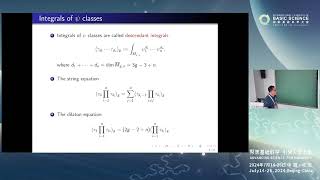
Intersection Theory on Moduli Space of Super Riemann Surfaces
Explore intersection theory on super Riemann surface moduli spaces, including recursion formulas, polynomiality, and applications to JT gravity.
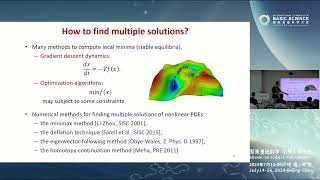
Construction of Solution Landscape for Complex Systems
Explore the novel "Solution Landscape" concept and its applications in complex systems, including nematic liquid crystals, crystalline phases, and Bose-Einstein condensates.
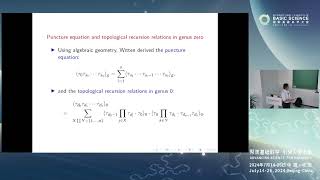
Gromov-Witten Type Theory and Statistical Physics
Explore connections between Gromov-Witten theory and statistical physics, applying concepts from both fields to gain new insights and tackle complex problems in topological string theory.
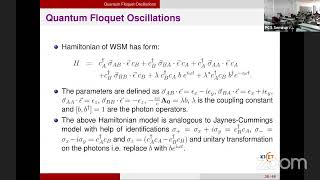
Floquet Engineering - Exploring Control and Phenomena of High-Frequency Electromagnetic Fields in Condensed-Matter Structures
Explore Floquet engineering in condensed-matter structures, examining oscillations under various field conditions and their detection through pump-probe spectra. Uncover intriguing phenomena like the Bloch-Siegert shift.
Graphic Talk About the Universe - Clifford V. Johnson Public Lecture
Explore the art of transforming complex scientific concepts into engaging visual narratives. Learn techniques for making science accessible and compelling to diverse audiences through graphic storytelling.
Quanticle: A Saga of Non-realism - 2024 Digital Edge Award Winner
Explore an award-winning animation blending art and science to demystify Quantum Optics concepts, showcasing creative potential and innovative storytelling techniques.
6D Superconformal Field Theories and Little String Theories
Explore quantum field theories in 6 dimensions, string theory concepts, and their implications for understanding fundamental physics, black holes, and geometric mathematics.
Decoding the Physics of the Early Universe Through Primordial Black Holes, Dark Matter and GWs
Explore the complex physics of primordial black holes, their role in universe reheating, dark matter production, and gravitational waves through advanced theoretical concepts and recent observational data.
Electromechanics for Thermodynamics at the Nanoscale - Information as Fuel
Explore how quantum information and thermodynamics intersect at nanoscale levels, examining fundamental laws through experimental frameworks that combine classical thermodynamic elements with quantum systems.

Is There a Theory of Everything? - Great Mysteries of Physics
Explore the quest for physics' holy grail - a unified theory connecting quantum and cosmic scales - through expert discussions on its necessity, feasibility, and implications for science.
Does Objective Reality Exist? - Great Mysteries of Physics - Episode 4
Delve into quantum paradoxes and philosophical questions about reality through expert discussions on Schrödinger's cat, quantum superposition, and various interpretations of quantum mechanics.

Stationary Measures for Integrable Probabilistic Systems
Explore advanced mathematical concepts in integrable probabilistic systems, focusing on stationary measures, discrete models, and their applications in theoretical physics and mathematics.
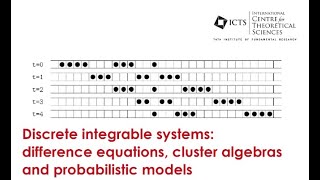
Colored Vertex Models, Orthogonal Functions and Probability - Lecture 2
Delve into advanced concepts of colored vertex models, exploring their connections to orthogonal functions and probability theory through expert mathematical analysis and demonstrations.
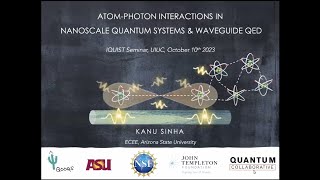
Atom-Field Interactions in Nanoscale Quantum Optical Systems
Delve into quantum optical phenomena at nanoscales, exploring atom-field interactions, Casimir-Polder forces, and non-Markovian dynamics for quantum networks and distributed sensing applications.
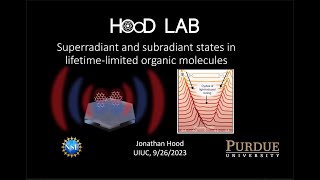
Superradiant and Subradiant States in Lifetime-Limited Organic Molecules
Explore groundbreaking research on superradiant and subradiant states in organic molecules, examining quantum light manipulation through coupled emitters and laser-induced tuning techniques.
Quantum Sensors Based on Matter-Waves
Explore cutting-edge matter-wave interferometry and its applications in precision metrology, from testing Einstein's equivalence principle to detecting gravitational waves in groundbreaking experiments.