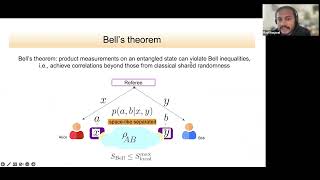
Contextuality in Composite Systems: The Role of Entanglement in the Kochen-Specker Theorem
Explore the interplay between contextuality and entanglement in composite quantum systems, examining implications for multiqubit quantum computation models with state injection.
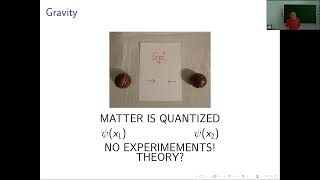
Quantum Control and Semiclassical Quantum Gravity
Explore quantum control and semiclassical quantum gravity, focusing on hybrid quantum-classical coupling and its implications for wave function collapse theory in the Newtonian limit.
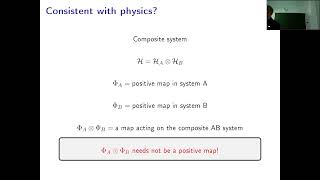
Beyond Quantum Markovian Semigroups
Explore open quantum systems, Markovian semigroups, and non-Markovian evolution. Gain insights into complete positivity, quantum channels, and connections to quantum stochastic processes.
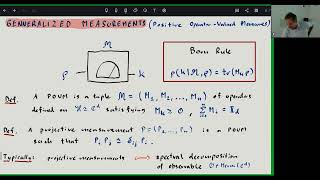
Good Simulation of All Quantum Measurements by Projective Measurements
Explore quantum measurement simulation, focusing on projective measurements in finite-dimensional systems. Learn about POVMs, depolarizing noise, and implications for quantum information processing.
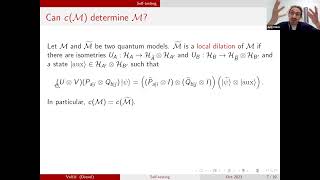
Constant-Sized Self-Tests for Maximally Entangled States and Single Projective Measurements
Explore self-testing in bipartite Bell scenarios, focusing on maximally entangled states and projective measurements. Learn about representation theory and spectral analysis in quantum systems.
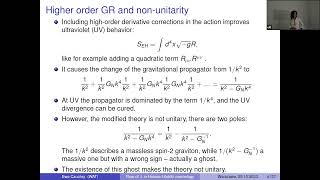
Energy Flow of λ in Hořava-Lifshitz Cosmology
Explore Hořava-Lifshitz cosmology, focusing on λ parameter's energy flow. Analyze two formulations using diverse datasets to bound cosmological parameters and compare with Einstein gravity.
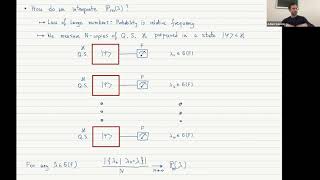
Geometry of Quantum Correlations
Explore the geometric description of quantum correlations using symplectic and algebraic tools. Gain insights into quantum entanglement and its unique features distinguishing quantum from classical systems.
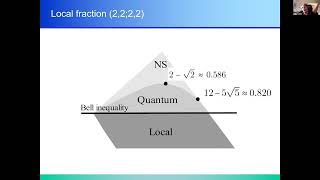
State-Independent Certification of Quantum Observables and Minimal Bipartite Full Nonlocality
Explore state-independent certification of quantum observables and minimal bipartite full nonlocality. Delve into recent findings on unique quantum observable sets and equivalences in quantum correlations.
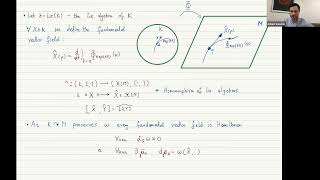
Geometry of Quantum Correlations - Part II
Explore quantum correlations using symplectic and algebraic geometry. Delve into entanglement, nonlocal properties, and the Einstein-Podolsky-Rosen analysis of quantum theory completeness.
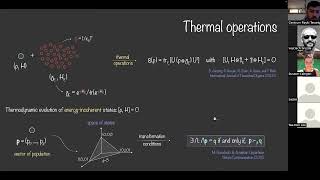
Geometric and Information-Theoretic Aspects of Quantum Thermodynamics
Explore geometric and information-theoretic aspects of quantum thermodynamics, focusing on state transformations, constraints, and practical applications of quantum catalysis in non-classical light generation.
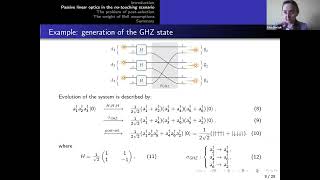
Generation of Entanglement in No-Touching Scenario: Causal Aspects and Protocols
Explore entanglement generation protocols, causal aspects, and quantum foundations. Delve into passive linear optical designs, post-selection issues, and Bell inequality violations in quantum information.
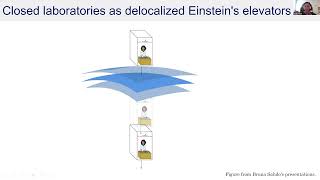
Indefinite Temporal Order on a Superposition of Spherical Shells
Explore indefinite temporal order in quantum theory through a new gravitational quantum switch protocol involving superposed spherical shells and entangled spacetime geometry.
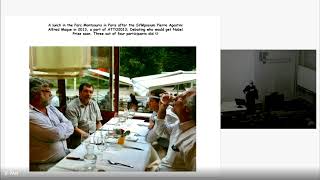
Attoscience, Nobel 2023 and Quantum Simulators
Explore attoscience, high harmonics generation, and quantum simulators. Delve into QED aspects and recent developments in the field, concluding with insights on Nobel 2023.
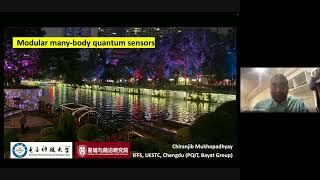
Modular Many-Body Quantum Sensors
Explore modular approaches for enhancing quantum sensing precision through multiple phase transitions in many-body systems, achieving Heisenberg scaling at phase boundaries.
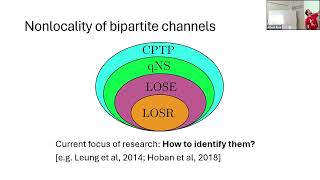
Nonlocality of Channels Under Decoherence
Explore nonlocality in quantum channels, focusing on its persistence under decoherence. Gain insights into identifying nonlocal properties of bipartite channels and their behavior in realistic setups.
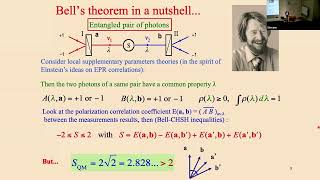
Experimental Tests of Bell's Inequalities: Past Achievements and Future Directions
Explore Bell's inequalities experiments, their historical impact, and future implications in quantum physics and technology. Gain insights from a Nobel Prize-winning research perspective.
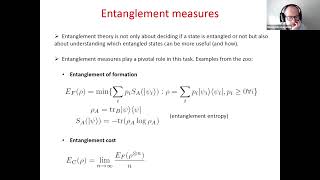
Maximally Entangled Mixed States: Do They Exist?
Explore the existence of maximally entangled mixed states in quantum information theory, examining their potential and implications for practical applications.
Spin-Orbit Related Phenomena in Magnets from Density Functional Theory
Explore spin-orbit physics in magnets using density functional theory. Understand electronic structure changes, magnetic interactions, and their impact on condensed matter phenomena.
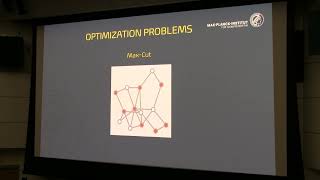
Quantum Computing in the Presence of Errors
Explore quantum computing's potential and challenges, focusing on error impacts in optimization and quantum many-body problems. Gain insights into achieving quantum advantage despite imperfections.
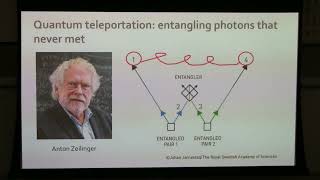
The Quantum Age - From Bell Pairs to Quantum Computers
Explore quantum mechanics' mysteries, from entanglement to recent advancements in neutral atom control, quantum simulation, and prospects for error-corrected quantum computers.
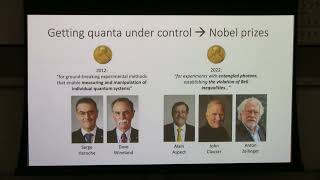
Programmable Control of Indistinguishable Particles: From Sampling to Clocks to Qubits
Explore quantum information science through optically-trapped neutral atoms, examining novel tools and applications in sampling, atomic clocks, and qubit development.