Verifiable Quantum Supremacy - What I Hope Will Be Done
Exploring quantum computations feasible on near-term devices, hard to simulate classically, and easy to verify. Discusses potential for demonstrating quantum superiority without relying on unproven assumptions.
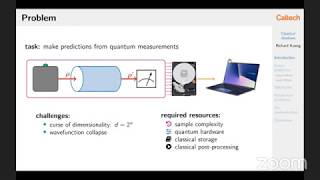
Predicting Many Properties of a Quantum System from Very Few Measurements
Explore quantum state prediction techniques, focusing on shadow tomography and its applications in efficiently estimating multiple properties of quantum systems with minimal measurements.
Classical Commitment to Quantum States
Explore quantum computing verification through interactive proofs and post-quantum cryptography, focusing on classical commitment to quantum states and delegating measurements.
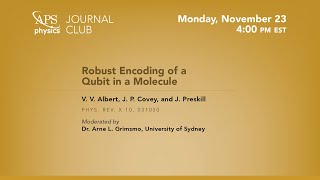
Robust Encoding of a Qubit in a Molecule
Explore robust qubit encoding in molecules with leading physicists, discussing GKP codes, rigid bodies, error correction, and innovative stabilizer techniques.
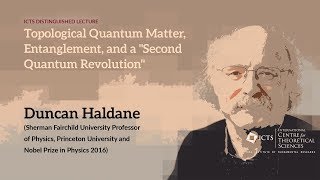
Topological Quantum Matter, Entanglement, and a "Second Quantum Revolution" by Duncan Haldane
Explore topological quantum matter, entanglement, and the "second quantum revolution" with Nobel laureate Duncan Haldane. Discover exotic states, quantum information theory, and potential applications in quantum computing.
Learning to Predict Arbitrary Quantum Processes
Explore quantum learning theory and its surprising ability to predict local properties of arbitrary quantum circuits, contrasting with classical limitations and highlighting potential for efficient quantum dynamics prediction.
Weakening Assumptions in Quantum Cryptography IV.a Part 1 of 2 - IPAM at UCLA
Explore quantum information's role in relaxing cryptographic assumptions, focusing on secure multiparty computation and oblivious transfer. Learn about advancements from Crepeau and Kilian to recent developments.
Commitments to Quantum States
Exploring quantum state commitments, their definition as erasure of sender's message, and applications in cryptography, including succinct arguments for NP and potentially QMA.
Panel on Quantum Machine Learning and Barren Plateaus
Expert panel explores quantum machine learning challenges, focusing on barren plateaus and their implications for algorithm design and practical quantum computing applications.
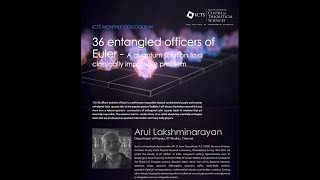
Entangled Officers of Euler: A Quantum Solution to a Classically Impossible Problem
Explore quantum solutions to Euler's 36 officers problem, a classically impossible combinatorial puzzle. Discover connections to orthogonal Latin squares, entanglement, and quantum information theory.
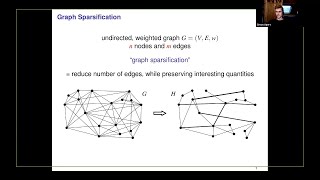
Quantum Computing Advancements - Session 5A, Part 2
Explore advanced quantum computing concepts and their applications in this IEEE conference session, delving into cutting-edge research and theoretical developments.
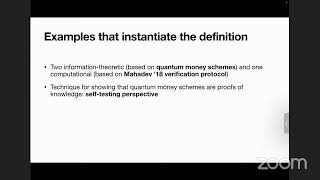
Quantum Constructions and Proofs - Session 193
Explore quantum constructions and proofs, delving into advanced concepts and methodologies in quantum computing and cryptography.
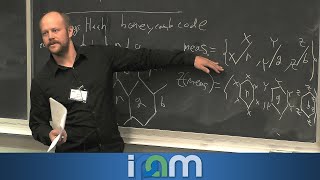
Quantum Computation From Dynamic Automorphism Codes - IPAM at UCLA
Explore dynamic automorphism codes for quantum computation, featuring low-weight measurement sequences for encoding, error correction, and logical gate application in quantum systems.
Let's Talk About Noise - IPAM at UCLA
Explore quantum error correction, noise models, and channels in quantum computing. Covers Lindbladians for single-bit and collaborative noise, with insights on return time estimates.
Circuit-to-Hamiltonian from Tensor Networks and Fault Tolerance - IPAM at UCLA
Explore a novel approach to mapping quantum circuits to local Hamiltonians using tensor networks, avoiding clock registers and incorporating fault tolerance for robust quantum computation.
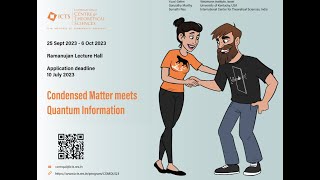
Introduction to Quantum Information Theory - Lecture 2
Explores quantum information theory fundamentals, covering entropy, reversible computation, quantum parallelism, and universal quantum computation principles for advanced physics and computing applications.
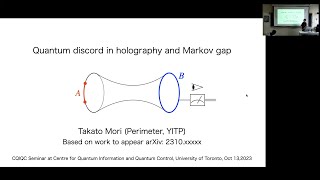
Quantum Discord in Holography and Markov Gap
Explore quantum discord in holography and its connection to the Markov gap, delving into advanced concepts in quantum information theory and their applications in theoretical physics.
Why You Should Believe in Quantum Computing
Explore quantum computing basics, advantages, and potential applications in cryptography and sensors. Gain insights into this revolutionary technology's impact on society and economy.
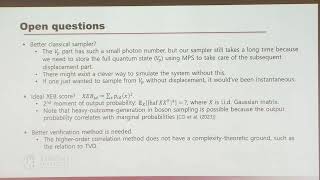
Classical Algorithm for Simulating Experimental Gaussian Boson Sampling
Explore a classical algorithm for simulating Gaussian boson sampling, challenging claims of quantum advantage in current experiments with high photon loss rates.
Introduction to Quantum Information Theory - Lecture 3
Explore quantum information theory foundations, including entropy, reversible computation, and universal quantum computation in this advanced physics lecture.
Improved Precision Scaling for Simulating Coupled Quantum-Classical Dynamics
Explore advanced techniques for simulating quantum-classical dynamics, focusing on improved precision scaling methods and their applications in quantum information research.