Efficient Quantum Circuits for Port-Based Teleportation
Explore efficient quantum circuit implementations for port-based teleportation, featuring novel methods from representation theory and innovative solutions for both probabilistic and deterministic protocols.
Quantum PCPs: On Adaptivity, Multiple Provers and Reductions to Local Hamiltonians
Delve into advanced quantum PCP theory, exploring adaptivity, multiple unentangled provers, and their connections to local Hamiltonians through rigorous mathematical frameworks and complexity theory analysis.
Polynomial-Time Classical Simulation of Noisy IQP Circuits
Explore groundbreaking research on classical simulation of noisy IQP circuits, revealing how quantum supremacy experiments may be more vulnerable to classical computation than previously known.
Constant-Depth Circuits for Uniformly Controlled Gates and Boolean Functions
Explore constant-depth quantum circuits using Fan-Out and Global Tunable gates, focusing on implementations for Uniformly Controlled Gates and quantum memory applications.
Quantum Cryptography Without One-Way Functions
Explore advanced quantum cryptography concepts and theoretical frameworks that challenge traditional one-way function dependencies in secure communication systems.
Majorization and Passivity in Quantum Information Theory - Lecture 4
Explore majorization and passivity concepts in quantum information theory, focusing on fundamental principles and their applications in advanced quantum systems.
Quantum Complexity of Testing Signed Graph Clusterability
Explore quantum algorithms for testing signed graph clusterability, featuring a novel approach with O(N^1/3) query complexity and proven advantages over classical methods.
Two Prover Perfect Zero Knowledge for MIP* - Theory of Quantum Computation
Delve into advanced quantum computing theory exploring perfect zero-knowledge protocols in MIP* systems, focusing on two-prover implementations and boolean constraint systems for quantum computation.
Tracial Embeddable Strategies - Lifting MIP* Tricks to MIPco
Delve into advanced quantum computation theory exploring tracial embeddable strategies and their applications in approximating two-party correlations in the commuting operator model.
Closed-form Analytic Expressions for Shadow Estimation with Brickwork Circuits
Explore closed-form analytical expressions for quantum shadow estimation using brickwork circuits, focusing on two-layer parallel two-local Haar-random unitaries and their practical implementations.
Shallow Shadows: Expectation Estimation Using Low-Depth Random Clifford Circuits
Explore quantum state measurement optimization through random Clifford circuits, focusing on efficient estimation techniques and practical applications in one-dimensional quantum systems.
Computational Quantum Secret Sharing
Discover groundbreaking advances in quantum secret sharing schemes, exploring computational security approaches that achieve efficient distribution and reconstruction of quantum states with reduced share sizes.
Trained Quantum Neural Networks are Gaussian Processes
Explore the mathematical foundations of quantum neural networks, focusing on their convergence to Gaussian processes and implications for training in supervised learning scenarios.
Quantum State Learning Implies Circuit Lower Bounds
Delve into groundbreaking research connecting quantum state tomography with circuit complexity, exploring implications for quantum learning algorithms and classical circuit lower bounds.

Concatenate Codes and Space Optimization for Fault-Tolerant Quantum Computation
Discover groundbreaking advances in fault-tolerant quantum computation through concatenated codes, achieving 90%+ reduction in space overhead while maintaining high threshold and modularity in quantum architectures.
Taming Quantum Time Complexity
Explore advanced quantum computing concepts focusing on time complexity, exactness, and thriftiness in quantum algorithms through novel transducer-based approaches and state conversion techniques.

Fault Tolerance of Stabilizer Channels in Quantum Computing
Explore rigorous analysis methods for fault tolerance in stabilizer channels, focusing on surface codes, LDPC codes, and Floquet codes for quantum computing applications.
The Connes-Kirchberg Problem, Quantum Correlations and Infinite Dimensional Phenomena in QIT
Explore quantum correlations and infinite-dimensional phenomena in quantum information theory, focusing on the Connes-Kirchberg Problem and its implications.
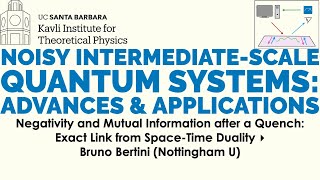
Negativity and Mutual Information After a Quench - Exact Link From Space-Time Duality
Explores the connection between negativity and mutual information in quantum systems after a quench, using space-time duality to derive exact results in integrable models.
Quantum Summer Cluster Workshop - Anand Natarajan
Explore quantum computing advancements with MIT researcher Anand Natarajan in this Simons Institute workshop, delving into cutting-edge developments and future implications.
Validated Quantum Advantage via Bell Sampling
Explore Bell sampling as a new model for demonstrating quantum computational advantage, discussing its potential for efficient verification and robustness against noise in quantum circuits.