React Native Navigation with Expo Router
Master React Native navigation using Expo Router, exploring links, stack and tab navigation, special files, and routing groups. Enhance your mobile app development skills with practical examples and techniques.

Next.js Full Stack Project with Next.js 15 and React 19
Master full-stack development with Next.js 15, React 19, TypeScript, Tailwind CSS, ShadCN/ui, Sentry, Kinde Auth, Neon Postgres, and Drizzle ORM. Build a comprehensive project covering key concepts and technologies.

Gradients for Everyone: A Quick Guide to Autodiff in Julia
Explore automatic differentiation in Julia, comparing approaches with Python frameworks and learning to make code differentiable for various backends. Gain insights into forward and reverse modes, custom rules, and performance optimization.
Docs, CI Tests, Error Messages, and Interfaces in Julia's SciML - JuliaCon 2024
Explore SciML's infrastructure practices in Julia, covering documentation, testing, error handling, and benchmarking. Gain insights into scalable and reproducible numerical ecosystems for Julia developers.
Enabling Spectral Indices Computation with SpectralIndices.jl
Explore SpectralIndices.jl, a Julia package simplifying spectral indices computation in remote sensing. Learn its features, data compatibility, and user-friendly interface for efficient Earth system research analysis.
Natural Science, Computer Modeling and Literate Programming
Explore literate programming techniques for enhancing reproducibility in scientific research, focusing on Entangled's approach to synchronizing code and documentation in natural science modeling.
RayTraceHeatTransfer.jl: 2D Enclosure Radiative Heat Transfer - JuliaCon 2024
Explore radiative heat transfer in 2D enclosures using RayTraceHeatTransfer.jl. Master Monte Carlo ray tracing, Exchange Factor matrices, and the Zonal Method for efficient problem-solving in high-temperature environments and engineering applications.
This is C++ - Uncompromised Performance, Undefined Behavior, and Move Semantics
Dive into C++'s superpower for uncompromised performance. Explore undefined behavior and move semantics to write better code and understand C++'s evolution, including current controversial issues.
Modern CI/CD Machine Learning Workflows Using Julia
Explore streamlined machine learning workflows in Julia, integrating package development principles and MLflow for robust, reproducible, and scalable model creation and management.
Attractors.jl - Next-Gen Multi-Stability Analysis for Dynamical Systems
Explore next-gen stability analysis in dynamical systems with Attractors.jl. Discover multistability detection, global stability quantification, and extendable interfaces for advanced applications in Julia.

Finite Element Modeling of Magnetic Fields in Julia
Explore finite element modeling of magnetic fields using Julia in this TU Delft master course. Implement mathematical models and collaborate on real-world projects with industry partners.
GreenSpeed: Sustainable Chemical Synthesis Right from the Start
Explore GreenSpeed, an innovative Julia-based application for calculating sustainability KPIs in chemical synthesis. Learn how it integrates lab data, visualizes material flow, and empowers informed decision-making for greener production practices.
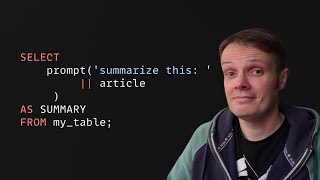
How to Call an LLM Directly from SQL
Learn to integrate LLM calls directly into SQL queries, enabling seamless AI-powered data processing and analysis within your database environment.

Building an Ecommerce App with React Native, Expo and Gluestack
Master building an ecommerce app UI with React Native, Expo, and Gluestack. Learn responsive design, REST API integration, and efficient data management using TanStack Query for a seamless user experience.

Fine-Tuning BERT for Text Classification - Python Code Tutorial
Dive into fine-tuning BERT for text classification, focusing on phishing URL detection. Learn key concepts and implement Python code to enhance your natural language processing skills.
Achieving vLLM Platform Portability with Triton Autotuning - Ray Summit 2024
Discover IBM Research's innovative approach to vLLM platform portability using Triton autotuning, enhancing LLM serving with improved cross-platform performance and reduced dependencies.
Databricks' vLLM Optimization for Cost-Effective LLM Inference - Ray Summit 2024
Discover strategies for optimizing vLLM to enhance LLM inference performance, reduce GPU idle time, and accelerate quantization, leading to cost-effective large-scale language model deployment.
How to Make Your First Open-Source Contribution - Featuring Gradio
Dive into open-source contribution with a step-by-step guide on fixing a real bug in Gradio and submitting your first pull request.

Klaviyo's Journey to Robust Model Serving with Ray Serve
Explore Klaviyo's journey in building DART, a model serving platform using Ray Serve. Gain insights into architecture, deployment strategies, and practical advice for implementing Ray Serve in your own projects.
The State of vLLM - Advancements in LLM Inference and Serving
Explore the latest advancements in vLLM, the open-source LLM inference engine. Gain insights into its growing adoption, new features, performance improvements, and future roadmap for efficient LLM deployment.

Cloudflare's 150ms Global Cache Purge System - Deep Dive
Dive into Cloudflare's innovative global cache purge system, exploring its evolution from core-based lazy purge to coreless active purge, and understand the engineering behind its impressive 150ms performance.