
Delphi Pascal Programming
Comprehensive guide to Delphi Pascal programming, covering data types, arrays, functions, OOP, and more. Ideal for beginners and intermediate programmers seeking to master this versatile language.
Statistics Tutorial - T Distribution and Hypothesis Testing
Learn to calculate and interpret T distributions, use T tables, understand degrees of freedom, and perform hypothesis testing with independent and dependent samples in this comprehensive statistics tutorial.
Statistics Tutorial - Real World Example with Python
Explore real-world data analysis using Python to maximize profits for a computer company. Learn to parse data, create functions, and gain insights for targeted marketing and product strategies.
Math4ML Exercises - Calculus
Hands-on calculus exercises for machine learning, covering little-o notation, gradients, linear approximations, and optimization techniques using Python and SymPy.
Math4ML Exercises - Linear Algebra, Continued
Hands-on linear algebra exercises for machine learning, covering matrix operations, shape-checking, composition, and practical applications in coding and ML contexts.
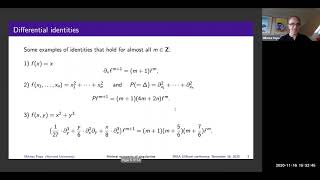
Minimal Exponents of Singularities
Explore advanced mathematical concepts like minimal exponents, Bernstein-Sato polynomials, and their connections to D-modules, Hodge theory, and birational geometry in this in-depth lecture.

Normal Distribution Excel Exercise - Probability and Statistics - Khan Academy
Explore how normal distribution approximates binomial distribution for large trials using Excel. Gain practical insights into probability concepts through hands-on spreadsheet analysis.
Formal Mathematics for Mathematicians and Mathematics Students - IPAM at UCLA
Explore formal mathematics' potential to revolutionize mathematical exposition, focusing on benefits beyond proof verification and its impact on mathematicians and students.
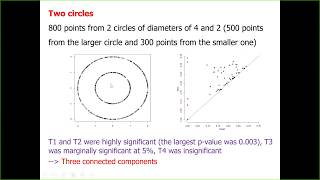
Modeling and Replicating Persistence Diagrams
Explore modeling and replicating persistence diagrams for statistical inference in topological data analysis. Learn about RST approach, parametric modeling, and improvements for clustered data.

Larry Wasserman - Robust Topological Inference
Explore robust topological inference with Larry Wasserman, covering persistence, confidence bands, bootstrap methods, and optimal tuning for data analysis and statistical modeling.
Axel Målqvist - Localization of Multiscale Problems
Explore multiscale problem-solving techniques, focusing on Local Orthogonal Decomposition for PDEs. Learn about convergence, high-contrast data, and applications to time-dependent problems.

Statistics and Data Analysis for Cosmology - Lecture 1
Explore probability concepts in cosmology, including joint and conditional probability, PDFs, independence, Bayes' theorem, and data modeling for analyzing cosmic phenomena.
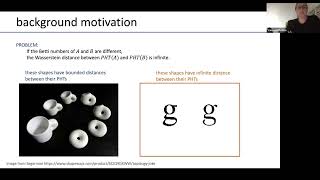
Vanessa Robins - The Extended Persistent Homology Transform for Manifolds with Boundary
Explore extended persistent homology transform for shape analysis, offering finite distances between shapes with different Betti numbers and applications in shape clustering.

Complex Rotation Numbers
Explore complex rotation numbers, their theory, dynamics, and applications in tame geometry and analysis. Delve into bubbles, self-similarity, and normalization concepts.
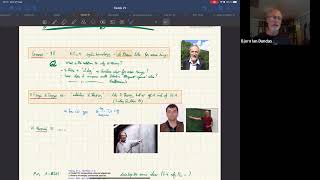
Applications of Topological Cyclic Homology in Algebraic K-Theory
Explore topological cyclic homology's applications in algebraic K-theory, covering key developments, impacts on number theory, and recent advancements in the field.
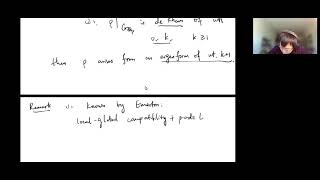
Some Differential Operators on the Modular Curves with Infinite Level at P and Applications
Explore differential operators on modular curves with infinite level at p, their applications, and related concepts in algebraic geometry and number theory.
Saecular Persistence
Explore saecular persistence, a method to decompose persistence modules with non-field coefficients. Learn about applications in topology, generalized persistence diagrams, and scientific data analysis.
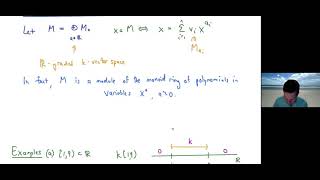
Homological Algebra for Persistence Modules
Introduction to persistence modules in algebraic topology, exploring tensor products, Hom operations, and their role in homological algebra. Insights into preserving exact sequences and advanced concepts.
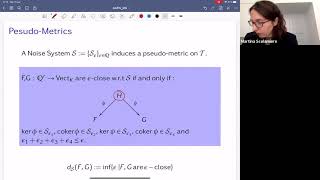
Extracting Persistence Features with Hierarchical Stabilisation
Explore hierarchical stabilisation for extracting stable invariants from persistence modules, focusing on the stable rank and its applications in data analysis and classification tasks.
Does Math Reveal Reality?
Explore the profound connection between mathematics and physical reality with leading thinkers. Delve into whether math is a human invention or an intrinsic part of the universe's fabric.

Vector Fields, Divergence, and Curl
Explore vector fields, divergence, and curl in mathematics. Learn about the del operator and its applications with dot and cross products to analyze vector field properties.