
Rays and Spheres- The Math! - Ray Tracing Series
Explore the mathematics behind ray tracing, focusing on rays, spheres, and their intersections. Learn key concepts and equations essential for implementing realistic 3D graphics rendering.

Welcome to Ray Tracing
Introduction to ray tracing techniques for generating photo-realistic digital imagery, covering setup, rendering, performance optimization, and GPU acceleration using C++ and Vulkan.

Vector-Dynamic Array - Making Data Structures in C++
Learn to implement a dynamic array data structure in C++, covering reallocation, push/pop operations, and memory management techniques.

Introduction to 2D Arrays in C++ - LeetCode Questions
Comprehensive tutorial on 2D arrays in C++, covering creation, input/output, searching, and solving LeetCode problems. Includes practical coding examples and problem-solving strategies for matrix operations.
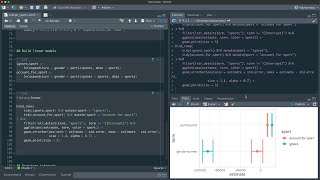
Handling Coefficients for Modeling Collegiate Sports Expenditures
Explore collegiate sports expenditures using linear modeling and tidymodels, focusing on handling coefficients and intervals for insightful analysis of financial patterns.
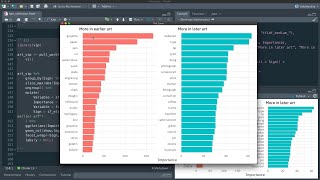
Explore Changes in Art Over Time With Tidymodels
Analyze art trends in the Tate collection using tidymodels for regression modeling, text feature engineering, and model diagnostics to uncover insights on changing art media usage over time.

Linear Mixed Model in R with lme
Learn to implement Linear Mixed Models in R using lme(). Understand statistical modeling concepts, fixed and random effects, and interpret results for complex data relationships.
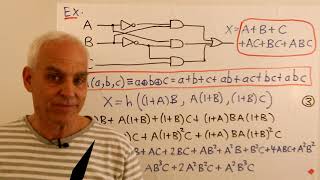
Boole Reduction - A Challenge for Programmers - MathFoundations - N J Wildberger
Exploring challenges in implementing Boole reduction for circuit analysis, including programming strategies and SAT solver development in the Algebra of Boole context.
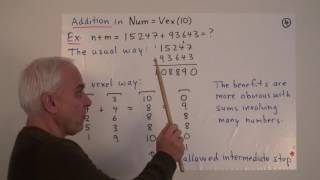
A New Look at Hindu Arabic Numbers and Their Arithmetic - Data Structures in Math Foundations
Exploring base-10 arithmetic using vexels, extending from binary to decimal systems. Covers addition, multiplication, and Hindu-Arabic numerals, providing insights into foundational mathematics.
Understanding Predictive Modeling with R
Learn to create predictive models using R, covering key concepts, training techniques, and practical demonstrations. Gain insights into model selection and explore various applications in data analysis.

Self-Study Computational Neuroscience - Coding, Textbooks, Math
Comprehensive guide to starting computational neuroscience: programming languages, coding practice, textbooks, math resources, project ideas, and datasets for self-study and skill development.

Solving Systems of Differential Equations with Eigenvalues and Eigenvectors
Learn to solve systems of linear ODEs using eigenvalues and eigenvectors. Covers problem setup, solution methods, and intuitive interpretation, with code examples in Python and MATLAB.
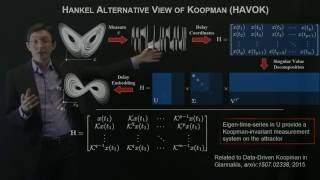
Hankel Alternative View of Koopman Analysis
Decomposing chaos into linear systems with intermittent forcing using HAVOK analysis. Explores eigen-time-delay coordinates for regression models, offering new insights into complex dynamical systems.
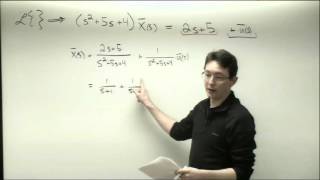
Laplace Transform and ODEs with Forcing and Transfer Functions
Explore Laplace transforms, ODEs, and transfer functions in engineering mathematics, focusing on spring-mass-damper systems and frequency response analysis.

FFT and Image Compression
Explore FFT-based image compression techniques, including natural image analysis, compression algorithms, and practical examples for efficient data representation.
Fourier Series
Explore Fourier Series: representation of functions, L2 integral norm, and MATLAB examples. Gain practical insights into engineering mathematics with real-world applications.
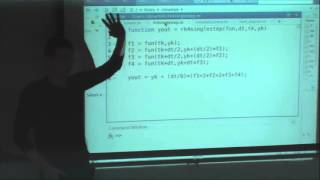
Vectorized Integration and the Lorenz Equation
Explore vectorized integration and the Lorenz equation, focusing on chaos, turbulence, and uncertainty in engineering mathematics, with practical MATLAB implementations.
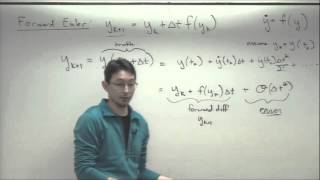
Runge-Kutta Integration of ODEs and the Lorenz Equation
Explore Runge-Kutta integration methods for ODEs and delve into the fascinating Lorenz equation, uncovering its chaotic behavior and applications in engineering mathematics.
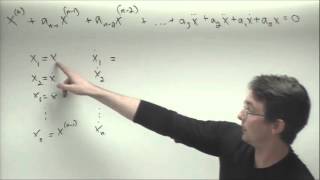
Matrix Systems of First Order Equations Using Eigenvectors and Eigenvalues
Explore matrix systems of first-order equations, diagonalization techniques, and higher-order linear ODEs. Learn to solve complex differential equations using eigenvectors and eigenvalues.
Overview of Engineering Mathematics
Explore engineering mathematics through weather modeling, covering fluid dynamics, disease networks, and systems of equations using MATLAB.
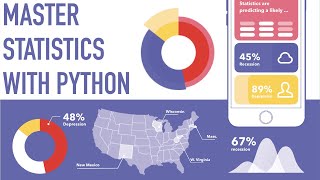
Statistics Tutorial with Python - Fundamentals and Data Analysis
Learn Python-based statistics: data types, visualization, measures of central tendency, dispersion, and relationships between variables. Gain practical skills for data analysis.