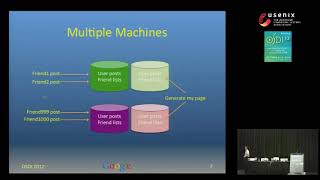
Spanner - Google’s Globally-Distributed Database
Explore Google's Spanner: a globally-distributed database with scalability, multi-version support, and synchronous replication. Learn about its structure, features, and innovative time API for external consistency.
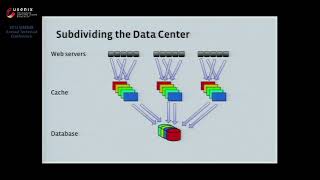
TAO - Facebook’s Distributed Data Store for the Social Graph
Explore Facebook's TAO, a distributed data store designed for efficient social graph access. Learn about its architecture, API, and how it handles billions of reads and millions of writes per second.
Is Big Data Performance Reproducible in Modern Cloud Networks?
Explores network variability in cloud computing, its impact on big data workloads, and provides guidelines for more repeatable and predictable performance experiments in cloud environments.
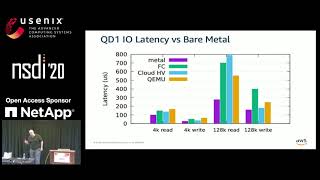
Firecracker - Lightweight Virtualization for Serverless Applications
Explore Firecracker, a lightweight VMM for serverless applications, offering strong security and minimal overhead. Learn about its design, deployment, and impact on AWS Lambda and Fargate services.
Experiences with Modeling Network Topologies at Multiple Levels of Abstraction
Explores MALT, a multi-layer topology representation for network management, covering its benefits, implementation challenges, and lessons learned in creating a comprehensive topology model.
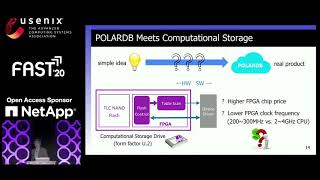
POLARDB Meets Computational Storage - Efficiently Support Analytical Workloads in Cloud
Explore how computational storage drives enhance cloud-native relational databases for analytical workloads, focusing on POLARDB's implementation and deployment in Alibaba Cloud.
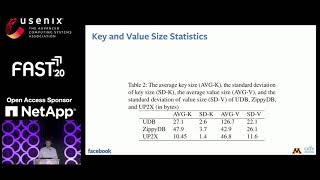
Characterizing, Modeling, and Benchmarking RocksDB Key-Value Workloads at Facebook
Detailed analysis of RocksDB workloads at Facebook, revealing key-value usage patterns and proposing improved benchmarking methods for more accurate representation of real-world scenarios.
Speeding Up Linux Disk Encryption
Explore techniques to optimize Linux disk encryption performance, focusing on dm-crypt architecture and potential improvements for faster transparent data protection.
Linux Systems Performance
Comprehensive overview of Linux systems performance, covering tools, methodologies, and techniques for analysis and tuning. Ideal for developers and sysadmins seeking to optimize Linux environments.

When -bin-sh Attacks - Revisiting "Automate All the Things"
Explores human factors in automation, challenges for system administrators, and strategies for coping with complex socio-technical systems. Discusses resilience, expertise development, and the ironies of automation.
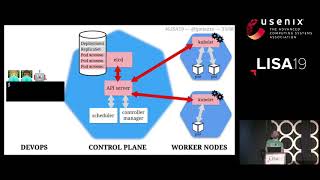
Deep Dive into Kubernetes Internals for Builders and Operators
Explore Kubernetes internals, components, and communication for operators. Learn about control plane, kube-proxy, CNI plugins, and cluster setup through live demonstrations and practical insights.
What Happens When You Type en.wikipedia.org
Explore Wikipedia's server-side architecture, from routers to microservices, and learn how open-source technologies power one of the world's top websites.
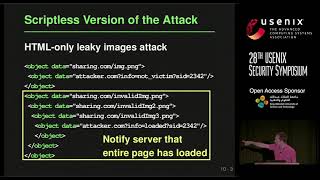
Leaky Images - Targeted Privacy Attacks in the Web
Unveils a novel privacy attack exploiting shared images on popular websites, allowing attackers to track user visits and link identities across platforms without using scripts.
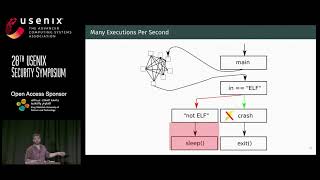
AntiFuzz - Impeding Fuzzing Audits of Binary Executables
Explore techniques to protect binary executables against automated bug-finding tools, focusing on impeding fuzzing, symbolic execution, and hybrid fuzzing approaches while maintaining performance.
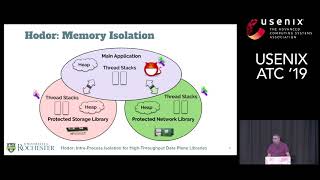
Hodor - Intra-Process Isolation for High-Throughput Data Plane Libraries
Explores intra-process isolation for high-throughput data plane libraries, proposing protected libraries as a new OS abstraction to achieve safety and performance in kernel-bypass approaches for managing high-speed devices.
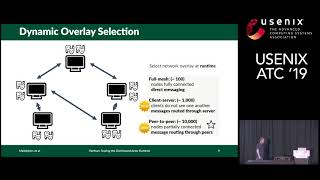
Scaling the Distributed Actor Runtime - PARTISAN
Presentation on PARTISAN, a runtime system for actor applications offering improved scalability and reduced latency through dynamic overlay selection, named channels, and affinitized parallelism.
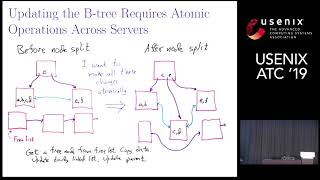
Everyone Loves File - File Storage Service in Oracle Cloud Infrastructure
Explore Oracle Cloud's File Storage Service architecture, featuring scalable block store, B-tree implementation, and nonblocking programming for efficient, elastic NFS service with predictable performance.
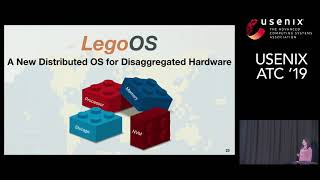
LegoOS - A Disseminated, Distributed OS for Hardware Resource Disaggregation
Explore LegoOS, a revolutionary distributed OS for disaggregated hardware resources in datacenters. Learn about its splitkernel model, improved resource utilization, and enhanced failure handling capabilities.
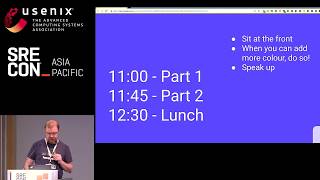
Building Blocks of Distributed Systems - Parts 1 & 2
Interactive class exploring orchestration, load balancing, databases, and storage in distributed systems. Covers key concepts and design principles for large data processing pipelines through collaborative exercises.
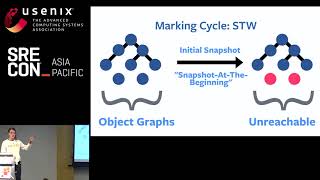
Tuning Java's G1 Garbage Collector for Realtime Services
Explore Java's G1 Garbage Collector tuning for realtime services, focusing on performance measurement, latency optimization, and effective settings for large heaps.
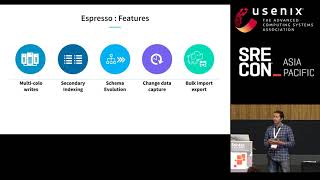
How We Used Kafka to Scale Database Infrastructure
Explore LinkedIn's NoSQL database scaling journey, from MySQL replication challenges to Kafka-based solutions, offering insights on reliable data delivery and infrastructure optimization.