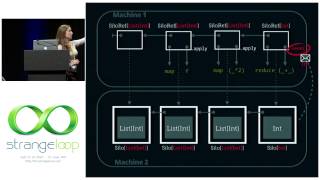
Function Passing Style - Typed, Distributed Functional Programming
Explore function-passing style for distributed programming, leveraging Scala's type system and language features to enable safe, asynchronous computation on immutable data across distributed environments.
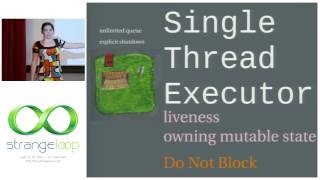
Concurrency Options on the JVM
Explore JVM concurrency options, from Java's ExecutorService to Scala's akka actors and Clojure's core.async. Learn design strategies for deadlock-free, efficient concurrent applications.
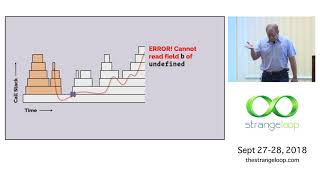
Contracts for Getting More Programs Less Wrong
Explore contracts in programming: preconditions, postconditions, and invariants. Learn to write correct algorithms, improve testing, and use tools like JML and C0 for better code quality.
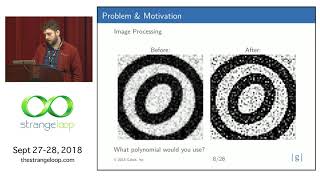
Your Secrets Are Safe with Julia - A Compiler for Secure Computation
Explore Ramparts, a compiler translating Julia code for homomorphic encryption, enabling secure computation on encrypted data without cryptography expertise.
Hackett - A Metaprogrammable Haskell
Explore Hackett, a language combining Haskell's type system with Racket's macro system. Learn about interleaved macroexpansion and typechecking, and discover new possibilities for metaprogramming and DSLs.
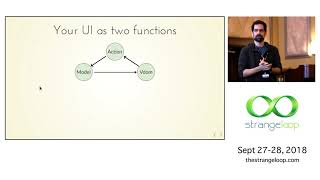
Data Driven UIs, Incrementally
Explore efficient data-driven UI development using Incremental, an OCaml library for dynamic computations. Learn techniques for building responsive applications that handle large data streams in real-time.
Running With Scissors - Live Coding With Data
Explore Clojure's unique features for effective programming and development processes through live coding demonstrations and practical examples.
Rosie Pattern Language - Improving on 50-Year Old Regular Expression Technology
Explore Rosie Pattern Language, an alternative to regular expressions offering improved scalability, readability, and composability for efficient data processing and pattern matching.
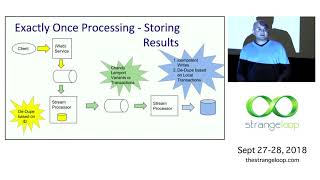
Chasing the Stream Processing Utopia
Explore stream processing challenges and solutions at internet scale, covering event ingestion, real-time data processing, and performance optimization techniques for large-scale applications.
Reactive Programming - A Better Way To Write Frontend Applications
Explore functional reactive programming for simplified frontend development, treating data as asynchronous streams and transforming values over time to handle events more effectively.
Observability for Emerging Infra - What Got You Here Won't Get You There
Explore modern infrastructure challenges and the shift from traditional monitoring to observability. Learn about event-driven approaches, complexity management, and the future of debugging distributed systems.
How Supporting Right-to-Left Can Expose Your Bad UX
Explore how supporting right-to-left languages can reveal UX issues and improve interfaces for all users. Learn challenges and solutions in internationalization for inclusive software design.
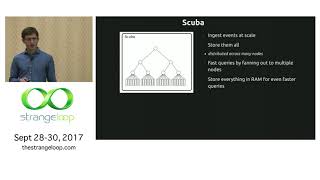
Why We Built Our Own Distributed Column Store
Explore the architecture and implementation of Retriever, a custom-built distributed column store database inspired by Facebook's Scuba, designed for efficient querying of large-scale event data.
Level Up Your Concurrency Skills With Rust
Explore Rust's approach to safe concurrent programming, learning how it catches errors at compile time and enhances your skills across languages. Gain insights into race conditions and memory safety.
How to Be a Compiler
Explore how compiling code parallels language learning and creative practices, revealing insights into software engineering and fostering an inclusive tech environment.
The Holy Grail of Systems Analysis - From What to Where to Why
Explore advanced distributed tracing techniques to pinpoint latency issues in complex microservice architectures, moving beyond traditional monitoring approaches for more effective system analysis.
Algorithms That Teach You Math
Explore algorithms designed to teach math step-by-step, optimizing for intuitive explanations rather than speed. Learn about mathsteps, an open-source library for solving and explaining algebra problems.
Key to the City - Writing Code to Induce Social Change
Exploring how software development can address social inequalities through open data, collaboration, and civic tech, with a focus on verifiable solutions and empathy-driven approaches.
The Lux Programming Language
Explore Lux: a functional, statically-typed Lisp for multiple platforms. Learn about its features, philosophy, and potential impact on programming paradigms and meta-programming.
Empowering the Next Billion with OSTree, Flatpak, NDN, and the Cloud
Explorando herramientas innovadoras como OSTree, Flatpak y NDN para empoderar a la próxima generación de usuarios en regiones con conectividad limitada y reducir la brecha digital global.

Stop Rate Limiting - Capacity Management Done Right
Explore capacity management alternatives to rate limiting, using Little's Law and concurrency control for better API performance and resource isolation in microservices architectures.