Type-Checking CRDT Convergence
Explore Propel, a language with a type system for verifying algebraic properties in CRDT implementations. Learn about its case analysis and induction approach for ensuring correctness.
A Type System for Safe Intermittent Computing
Explore a novel type system approach for safe intermittent computing in energy-harvesting devices, addressing idempotence requirements and improving programmability for batteryless systems.
Concurrent Mutation Must Go
Explore concurrent mutation challenges and solutions in programming languages, focusing on innovative approaches to enhance system reliability and performance.
Offloading-Efficient Sparse AI Systems
Explore offloading-efficient sparse AI systems to optimize performance and resource utilization in artificial intelligence applications.
Supporting End-Users in Realizing Quantum Computing Applications
Explore tools and methods for automating quantum computing tasks, shielding end-users from complex concepts and supporting application development across diverse domains.
Dataflow-Based Optimization for QIR Programs
Explore QDFO, a dataflow-based optimization approach for Microsoft QIR, improving code efficiency and readability through preprocessing and redundancy reduction in quantum computing programs.
A Probabilistic Choreography Language for PRISM
Explore a choreographic framework for modeling and analyzing concurrent probabilistic systems using PRISM. Learn about a new choreography language and its encoding into PRISM for enhanced system reliability.
Verifying Quantum Circuits in GAP
Explore quantum circuit verification using GAP, focusing on equivalence checking, ancilla management, and rotational gate validation in the Quantum GAP library.
Continuous Arrays - SPARSE 2024 Workshop
Explore continuous arrays in programming, focusing on their implementation and applications in modern software development.
Exploring Algebraic Placement in Multiparty Languages - CP 2024
Explore the relationship between type systems and placement systems in distributed programming languages, focusing on modular reasoning and algebraic placement structures.
Compiling Probabilistic Programs for Variable Elimination with Information Flow
Explore a novel approach to variable elimination and marginal inference in probabilistic programming, featuring bounded recursion and discrete distributions, with compiler-based optimization techniques.
Predicting Dynamic Properties of Heap Allocations using Neural Networks Trained on Static Code
Explore neural network models predicting heap allocation properties from static code, examining trade-offs, promising directions, and challenges in this innovative approach to memory management.
Wait-Free Weak Reference Counting - ISMM 2023
Explore a wait-free algorithm for weak reference counting, improving performance in high-contention scenarios. Learn about implementation, correctness proofs, and performance benchmarks for memory management optimization.
Automatic Differentiation for Sparse Tensors
Explore efficient automatic differentiation for sparse tensors, leveraging novel DSLs and optimizations to outperform existing frameworks in data-intensive applications.
ISVABI: In-Storage Video Analytics Engine with Block Interface
Explore ISVABI, a software/firmware approach for efficient video analytics using SSD block I/O interface. Learn about its implementation, performance improvements, and real-world applications.
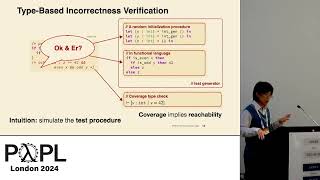
Type-Based Incorrectness Reasoning - Integrating Underapproximate Analysis in Refinement Types
Explore coverage types and their connection to Incorrectness Logic, integrating underapproximate reasoning within refinement type systems for enhanced program analysis and verification.
Specifying Smart Contracts with Hax and ConCert
Explore high-assurance smart contracts using Hax toolchain and ConCert for embedding, specifying security properties, and verification in Rust.
Inductive Program Synthesis via Iterative Forward-Backward Abstract Interpretation
Explore a novel approach to inductive program synthesis using iterative forward-backward abstract interpretation, enhancing search space pruning and improving synthesis efficiency.
An Automata-Based Framework for Verification and Bug Hunting in Quantum Circuits
Explore a novel automata-based approach for analyzing quantum circuits, enabling efficient verification and bug detection in large-scale quantum systems using tree automata and algebraic representations.
Mosaic: An Interoperable Compiler for Tensor Algebra
Explore Mosaic, an innovative compiler for sparse tensor algebra that combines external function calls and code fusion, offering flexibility and performance gains in tensor computations.
Mostly Automated Proof Repair for Verified Libraries
Explore automated proof repair for higher-order imperative functions, combining dynamic program alignment, enumerative invariant synthesis, and proof-driven testing to maintain verified software efficiently.