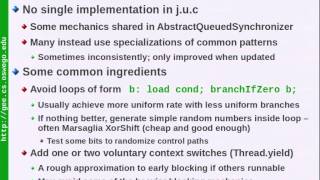
Engineering Concurrent Library Components
Explore concurrent algorithms, hardware trends, and Java Memory Model intricacies for engineering robust library components in multi-threaded environments.

Kubernetes Crash Course
Comprehensive Kubernetes crash course covering core concepts, installation, networking, deployments, storage, and resource management for efficient container orchestration.
Everything You Need to Know About Kubebuilder - Write Operators Like a Pro
Learn to create Kubernetes operators using Kubebuilder, covering project setup, API creation, code generation, custom resources, and validation techniques for efficient cluster management.
Introduction to Rust Operators for Kubernetes
Explore Rust for Kubernetes operators: write a concise operator in under 100 lines, compare with Golang, and learn about custom resources and data fetching in this quick introduction.
How to Write a MicroK8s Addon
Learn to create and share custom MicroK8s addons, extending Kubernetes functionality for your team or community. Covers architecture, development process, and best practices.
Deep Dive - Kubescape by ARMO
Explore Kubescape by ARMO for active threat scanning in Kubernetes clusters, featuring image scanning, RBAC visualization, and continuous risk analysis for enhanced security and compliance.
Kubernetes in Kubernetes - Leveraging Hardware Virtualisation on GCP
Explore GCP's KVM hypervisor for nested virtualization, enabling Kubernetes-in-Kubernetes clusters with Kubevirt. Learn installation, use cases, and practical implementation steps.
Deep Dive - Komodor Kubernetes Troubleshooting Platform
Explore Komodor's Kubernetes troubleshooting platform, simplifying debugging and enabling broader team involvement in analysis through integrations, service insights, and custom workflows.
Unterminating Kubernetes Resources - Avoiding Unintentional Data Loss
Learn to build a Golang program interfacing with ETCD to prevent data loss by reversing termination of bound PVCs in Kubernetes, with step-by-step guidance on implementation and key concepts.
Writing Your Own Kubernetes Operator - Part 2: ConfigMap Monitoring and Pod Updates
Learn to extend a controller with operator behaviors, monitoring ConfigMap annotations and applying changes to pods in Kubernetes environments.
Writing Your Own Kubernetes Operator from Scratch - Part 1
Comprehensive tutorial on creating a Kubernetes Operator from scratch, covering key concepts, libraries, and implementation steps with practical coding examples and explanations.
From Rails to Elm and Haskell - Transitioning to a Purely Functional Stack
Explore the journey from Ruby on Rails to Elm and Haskell at NoRedInk, discussing adoption strategies, challenges, and benefits of transitioning to functional programming languages.
Less Code, More Impact - User-Centric Software Design Workshop
Interactive workshop on user-centric software design, focusing on listening to users, wireframing ideas, and testing work. Learn practical methods for effective collaboration and alignment in product development.
Machine Learning: From ABCs to DEFs
Explore machine learning fundamentals, from basic concepts to practical applications, focusing on people, data, and code. Learn to build simple AI models and understand key ML principles.
Free as in Monads - Understanding and Applying Free Monads - Lecture 44
Explore the Free monad concept through live coding, understanding its origins, applications, and powerful impact on software development. Learn how to derive and utilize this abstraction for solving complex problems.
Building for Operability: Stateful Applications in Containers with the Autopilot Pattern - Philly ETE 2017
Explore stateful container applications using the Autopilot Pattern for improved operability, flexibility, and minimal human intervention in deployment, scaling, and recovery processes.
Stream All Things - Patterns of Modern Data Integration
Explore patterns for modern data integration using Apache Kafka. Learn to build fast, scalable, and manageable data pipelines for reliable stream processing and low-latency applications.
Cost-effective Telemetry Solutions: Balancing Between Blind and Broke - Lecture 6
Explore cost-effective telemetry strategies for modern operations, balancing between blindness and financial constraints through multi-provider solutions and innovative approaches.
How Your Organization Is Killing Your Software - Improving Team and Product Architecture
Explore organizational impact on software development, team dynamics, and strategies to enhance productivity and product quality. Learn to navigate technical debt, rewriting challenges, and team structuring.
Tools for Building the Real-Time Organization
Explore tools and architectures for processing real-time data streams, enabling organizations to make faster, better decisions through event-based systems and reactive platforms.

How CPUs Read Machine Code - 6502 Part 2
Explore the inner workings of CPUs and machine code interpretation, focusing on the 6502 processor. Gain insights into low-level computer architecture and assembly language programming.