Cython to Speed Up Your Python Code
Discover how to significantly accelerate Python code using Cython, a powerful tool that translates Python to C/C++, enabling static optimizations and seamless integration of Python, C, and C++ features.
Asyncio in Practice - We Did It Wrong
Explore common pitfalls and best practices in asyncio programming, including avoiding callback hell, ensuring thread safety, and achieving true concurrency in Python.
Getting Started with Mypy and Type Checking
Learn how to introduce type checking in Python projects using mypy, with insights from Dropbox's experience in annotating large codebases. Discover step-by-step approaches to improve code clarity and catch bugs early.
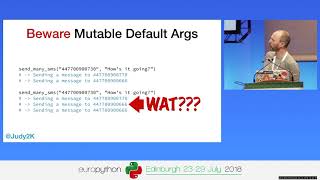
More Than You Ever Wanted to Know About Python Functions
Dive deep into Python functions, exploring parameters, closures, methods, callables, introspection, and bytecode. Gain advanced insights and practical techniques for mastering function usage in Python.
Type Annotations with Larger Codebases
Practical strategies for implementing type annotations in large Python codebases, addressing challenges, best practices, and solutions for common roadblocks encountered during the process.
10 Years of EuroPython and the Python Community
A journey through a decade of EuroPython conferences, exploring the evolution of Python, its community, and the event itself, with insights and aspirations for the future.
PEP 557 Versus the World
Exploración profunda del módulo dataclasses de Python 3.7, comparándolo con alternativas existentes y analizando su diseño, propósito y beneficios para los desarrolladores.
Microservices and Serverless in Python Projects
Explore microservices and serverless architecture in Python, focusing on AWS Lambda. Learn advantages, use cases, and practical implementation using frameworks like Chalice and Zappa.
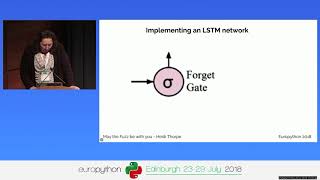
May the Fuzz Be with You
Explore how LSTM neural networks and Python can generate AI-driven test inputs for software testing and network security, improving upon traditional fuzzing techniques.
How to Write Deployment-Friendly Applications
Learn techniques for creating environment-agnostic Python applications that are easier to test, deploy, handle, and scale. Discover tools and best practices for structuring and configuring apps independent of their runtime environment.

JavaScript for Python Developers
Learn modern JavaScript from a Python developer's perspective, covering language basics, development tools, popular frameworks, and new features like TypeScript. Gain confidence in using JavaScript and its ecosystem.
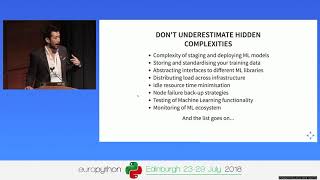
Industrial Machine Learning Pipelines with Python & Airflow
Learn to build scalable, distributed machine learning data pipelines using Airflow with Celery backend. Gain insights on industry challenges, comparisons with other technologies, and practical knowledge for implementation.
Understanding and Applying CQRS
Learn to implement Command Query Responsibility Segregation (CQRS) in Python using Nameko framework to enhance database performance and scalability in high-traffic applications.
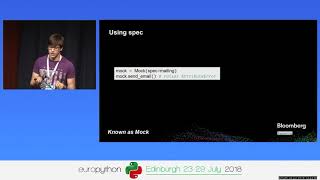
Mocks, Dummies, Stubs & Spies
Explore testing doubles in Python: mocks, fakes, dummies, stubs, and spies. Learn their differences, use cases, and implementation techniques for effective unit testing and dependency isolation.
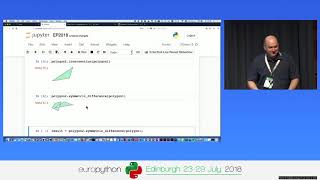
Processing Geodata Using Python and Open Source Modules
Learn to analyze, manipulate, and visualize geospatial data using Python and open-source modules like Shapely, Fiona, rasterio, and GeoPandas. Explore vector and raster data handling, spatial reference systems, and map creation.
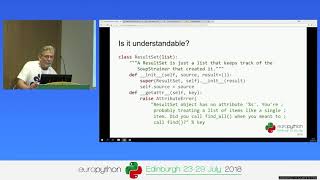
Writing Good Error Messages
Learn to craft clear, actionable error messages for better code readability and user experience. Explore common pitfalls and effective techniques for writing informative error messages in Python.
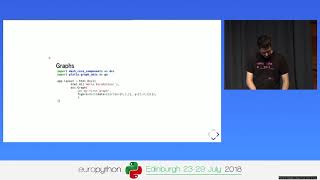
Easy Interactive Data Applications with Dash
Learn to create interactive dashboards and web data applications using Plotly Dash, a Python framework. Discover how to build a small interactive web app with Twitch API data, using only Python.
Exploring the Python AST Ecosystem
Dive into Python's abstract syntax tree ecosystem, exploring tools for visualization, creation, and transformation. Learn practical applications in static analysis and metaprogramming for enhanced code manipulation.
A Tale of Refactoring
Explore a practical approach to refactoring large, complex functions using Python's dynamic features, improving code maintainability and performance through real-world examples.
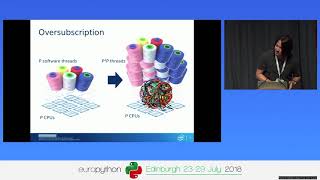
Addressing Multithreading and Multiprocessing in Transparent and Pythonic Ways
Explore advanced Python techniques for efficient multithreading and multiprocessing, including GIL management, static multiprocessing, and thread pool control for optimal performance on multi-core systems.
System Testing with Pytest, Docker, and Flask
Learn to combine Pytest fixtures with Docker for high-level integration testing of microservices, and embed mock web services using Flask to control and verify system component interactions.