
Coroutines - C++ vs Rust
Explore the design differences between C++ and Rust coroutines, comparing their implementations, trade-offs, and approaches to asynchronous programming in systems languages.

Embracing the Noexcept Operator and Specifier Safely
Explore the noexcept operator and specifier in C++, their benefits for high-performance computing, potential pitfalls, and proposed improvements for C++23 with expert John Lakos.
Throwing Graphs at COVID
Live coding session exploring graph-based modeling for contact tracing during the pandemic, using Go and data structures. Suitable for those interested in Go, graphs, or pointer manipulation.

Documentation in the Era of Concepts and Ranges
Explore how concepts and ranges revolutionize C++ documentation, balancing code-based and textual descriptions for effective interface specification and user comprehension.

Kill All Mutants! - Intro to Mutation Testing
Discover mutation testing: a powerful technique to evaluate and improve test suites by creating altered code versions. Learn benefits, drawbacks, tools, and practical examples.

C++ MythBusters
Debunking popular C++ myths with detailed analysis, providing verdicts and fostering discussions on controversial topics within the C++ community.

Many an `any` - std::any
Explore implementation strategies for std::any, examining ABI restrictions, performance impact, compile time effects, and C++20 modules influence. Includes micro-benchmarks and complete implementations.
Contractual Disappointment in C++
Explore effective strategies for handling run-time failures in C++ through contracts, interfaces, and modern tools. Learn to enhance software robustness and reliability.

Sandbox Games - Using WebAssembly and C++ to Make a Simple Game
Explore WebAssembly for C++ programmers, learn to create a browser-based game, and overcome unique challenges. Gain insights into this emerging technology for web development.
Level Up Your Debugging Workflow with CMake Presets, Disassembly View, & GitHub Actions
Enhance debugging workflow using CMake Presets, remote debugging, and CI pipelines. Learn to optimize embedded projects on Raspberry Pi with Visual Studio Code and GitHub Codespaces.
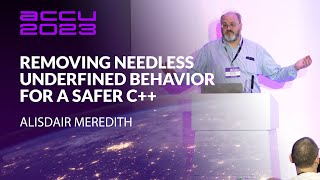
Removing Needless Undefined Behavior for a Safer C++
Explore strategies to eliminate undefined behavior in C++, enhancing safety and security. Learn about potential fixes, well-defined behavior, and the role of contracts in mitigating risks.
Design Patterns - Examples in C++
Explore essential C++ design patterns to enhance code robustness and readability. Learn practical techniques for efficient software development and improve your programming skills.

Lessons from 20 Years of Debugging C++ Code
Comprehensive guide to debugging C++ code, covering crash analysis, reproducibility, bug localization, and effective fixes. Insights from real-world examples and practical tools for efficient problem-solving.
A Tour of C++ Recognised User Type Categories
Explore C++ user type categories, their advantages, and pitfalls. Learn about trivial, standard layout, implicit-lifetime, aggregate, literal, and structural types to write better code and avoid undefined behavior.

Standard Attributes in C and C++
In-depth exploration of standard attributes in C and C++, covering syntax, semantics, use cases, and guidelines for effective implementation across various language versions.

Test-Driven Development of C++ Embedded and System-Level Software
Learn TDD techniques for C++ embedded and system-level software, covering design principles, unit testing, dependency injection, and integration testing strategies to improve code quality and developer productivity.
Improving C++ Compilation Times - Tools & Techniques
Explore practical tools and techniques to enhance C++ compilation speed, including benchmarking, precompiled headers, unity builds, and reducing dependencies between components.
C++23 Ranges - Functional Programming With New View Adaptors and Other Utilities
Explore C++23 Ranges' conceptual changes and practical utilities, including owning views, new algorithms, and adaptors like std::generator for implementing range adaptors and printing ranges.

Programming in Modern C with a Sneak Peek into C23
Explore modern C programming features, including compound literals, flexible array members, and upcoming C23 additions. Enhance code readability, safety, and performance in low-level programming.

Low-Latency Trading Systems in C++ - Templated Meta-State Machines in HFT
Explore advanced C++ techniques for optimizing low-latency trading systems using templated meta-state machines in high-frequency trading environments.

C++ And Beyond - Discussion
Expert panel discusses C++'s future, evolution, and challenges in the face of new programming languages, exploring topics like backward compatibility, standardization, and community-driven progress.