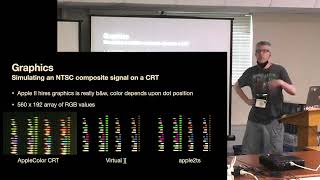
Apple II Emulator in TypeScript and React - Development Journey
Explore the journey of creating an Apple II emulator using TypeScript and React, including challenges faced, community collaboration, and future development plans.

Heap Size Adjustment with CPU Control
Explore automatic heap sizing in JVM garbage collection, trading memory for computation based on CPU utilization. Learn about implementation in ZGC and its impact on performance and energy.

Synthesizing Specifications - Automatic Generation of Program Behavior Descriptions
Explore automatic synthesis of program specifications using Spyro, a tool that generates precise L-properties based on user queries and domain-specific languages, applicable in various programming contexts.

Mutually Iso-Recursive Subtyping - OOPSLA 2023
Explore mutually iso-recursive subtyping, addressing challenges in type recursion for programming languages. Gain insights into efficient type checking and subtyping for intermediate code representations.

Type-Safe Dynamic Placement with First-Class Placed Values
Explore type-safe dynamic placement in distributed systems using first-class placed values. Learn about Dyno, a language enabling static reasoning with dynamic placement flexibility.

Validating IoT Devices with Rate-Based Session Types
Explore a novel framework for implementing and validating rate-based message passing systems in IoT domains using session types, ensuring rate error freedom and type preservation.
A Dependently Typed Language with Dynamic Equality
Explore a novel dependently typed language with dynamic equality, addressing usability issues in type systems and providing clearer error messages through runtime equality checking.

Powerful Machine Learning at Your Fingertips - ElixirConf EU 2023
Explore efficient numerical computation and Neural Networks in Elixir using Nx, Axon, and Bumblebee. Learn to implement powerful machine learning models with minimal code.

Little Things and Big Things - Lessons for Building Large Systems
Explore essential lessons for designing large-scale systems, covering crucial rules, buffer management, distributed system challenges, and effective strategies for maintaining system stability and performance.

Tackling Technical Debt at Adobe: A Story from Frame.io - Scaling for Enterprise Software Development
Discover strategies for managing technical debt, improving scalability, and integrating enterprise software. Learn from Frame.io's experience transitioning post-Adobe acquisition and enhancing their Elixir codebase.

Zero Trust RabbitMQ with HashiCorp Vault
Implement Zero Trust security for RabbitMQ using HashiCorp Vault. Learn to manage access, ensure data confidentiality, and simplify cryptography for secure messaging in a demo-driven exploration.

The Unbearable Weight of Glue - Tackling Complexity in Software Development
Explore how type-safe functional programming exposes and tackles glue code complexity, with insights from Elm community projects and interactive audience participation.
Introducing BRAT: A Functional Programming Language for Quantum-Classical Hybrid Programs
Explore BRAT, a functional language for quantum-classical hybrid programming, featuring unique syntax and type-level parameters for enhanced safety and composition.
Facilitating the Bootstrapping of a New Instruction Set Architecture
Explore tools and verification mechanisms for developing new instruction set architectures, focusing on semi-automated approaches to streamline system software and simulator infrastructure creation.
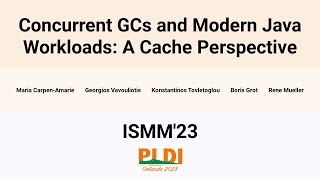
Concurrent GCs and Modern Java Workloads - A Cache Perspective
Explore the impact of concurrent garbage collectors on Java workloads, focusing on cache pollution and performance implications for modern server applications.
Mechanizing Refinement Types
Explore the mechanization of refinement types, combining semantic subtyping and parametric polymorphism. Learn about λRF calculus, data propositions, and metatheory proofs in LiquidHaskell and Coq.
Weak Memory Demands Model-based Compiler Testing
Explore compiler bugs arising from relaxed hardware memory models and their implications for testing, using an LLVM toolchain bug as a case study.
Compositional Verification of Concurrent C Programs with Search Structure Templates
Explore compositional verification of concurrent C programs using search structure templates, separating concurrency-control and data-structure components for modular proof combination.
Vehicle - A Specification Language for Neural Network Properties
Explore Vehicle, a functional DSL for specifying neural network properties. Learn to express, compile, and verify specifications across platforms, enhancing safety in ML-enhanced systems.
Homotopy Type Theory for Sewn Quilts
Explore PieceWork, an innovative programming language for quilt design inspired by Homotopy Type Theory. Learn how computational methods can enhance diversity in sewn designs and bridge programming theory with quilting craft.
Weighted Refinement Types for Counterpoint Composition
Explore weighted refinement types for music composition, blending programming concepts with music theory to create flexible counterpoint systems.