Enhancing Markov Chain Monte Carlo Sampling Methods with Deep Learning
Explore advanced techniques combining Markov Chain Monte Carlo sampling with deep learning, focusing on importance sampling, normalizing flows, and non-equilibrium methods for enhanced efficiency in high-dimensional problems.
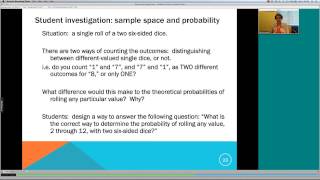
Probability Topics in Middle Grades - Simulation and Data Collection
Explore probability concepts through simulations and data collection, using various technologies to enhance understanding of middle-grade mathematics topics.
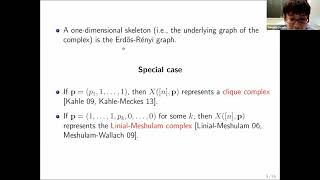
Takashi Owada - Limit Theorems for Topological Invariants of the Dynamic Multi-Parameter Simplicial Complex
Explore topological invariants in dynamic multi-parameter simplicial complexes, covering connectivity, probability, and limiting processes in applied algebraic topology.
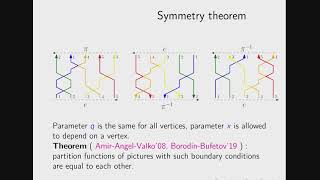
Color-Position Symmetry in Interacting Particle Systems
Explore color-position symmetry in particle systems, covering probability, partition functions, and stochastic processes. Gain insights into ASEP and simulation techniques.
Alexander Volberg - Poincaré Inequalities on Hamming Cube - Analysis, Combinatorics, Probability
Explore improved L^1-Poincaré inequality constants on Hamming cube, comparing with Gaussian space. Discuss proofs, estimates, and related mathematical concepts in analysis, combinatorics, and probability theory.
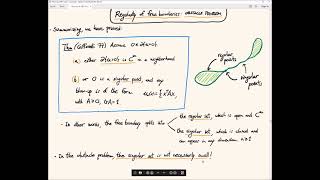
Regularity of Free Boundaries in Obstacle Problems - Lecture III
Explore free boundary problems in PDE, focusing on regularity of solutions and interfaces. Learn about Stefan and obstacle problems, key results, and current research challenges.
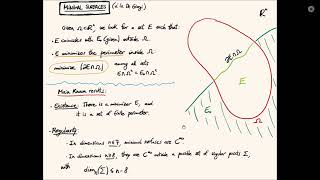
Regularity of Free Boundaries in Obstacle Problems Lecture I
Explore regularity of free boundaries in obstacle problems, covering key concepts, proofs, and current research in this mathematical field of PDE and Geometric Measure Theory.
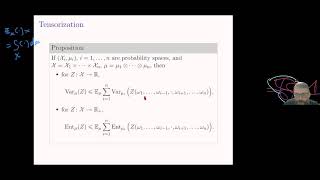
Functional Inequalities and Concentration of Measure I
Explore concentration inequalities in probability and geometric analysis, focusing on functional inequalities and their applications to Lipschitz functions in continuous and discrete settings.
Statistics and Data Analysis for Cosmology - Lecture 1
Explore probability concepts in cosmology, including joint and conditional probability, PDFs, independence, Bayes' theorem, and data modeling for analyzing cosmic phenomena.
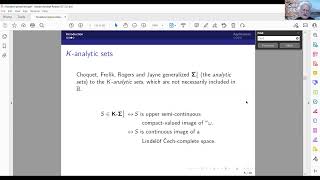
World Logic Day - Set Theory Seminar Series Extended
Explore advanced topics in set theory with expert speakers, covering topological generalizations, compact-valued functions, countable models, torus flows, and infinitesimals in probability theory.
Deterministic Approximation of the Ising Partition Function
Explore advanced techniques for approximating the Ising partition function, focusing on deterministic methods and their applications in statistical physics and computational complexity.
Why Study Fluid Mechanics?
Explore the importance and applications of fluid mechanics in this engaging lecture by Rama Govindarajan, offering insights into this fundamental field of physics and engineering.
Introduction to the Normal Distribution and Continuous Random Variables
Explore continuous random variables and the normal distribution, key concepts in statistical analysis for understanding data patterns and probability distributions.

The Addition Rule for Probability
Learn the Addition Rule for Probability, a fundamental concept in statistics. Understand how to calculate probabilities for multiple events and apply this rule to solve real-world problems.

Win a Small Fortune With Counting Cards - The Math of Blackjack and Co.
Explore the mathematics behind casino games like blackjack and roulette, including card counting techniques and strategies for gaining an edge over the house.
What Is a Random Surface?
Explore the theory of random surfaces, from finite triangles to complex mathematical constructs. Discover connections to physics, probability, and geometry through accessible explanations and visual illustrations.
On Ulam's Problem 19 and Related Problems - IPAM at UCLA
Explore uniqueness problems related to Ulam's Problem 19 from the Scottish book, presented by Dima Ryabogin at IPAM's Calculus of Variations workshop.
On a Conjectural Symmetric Version of the Ehrhard Inequality
Explores a conjectural symmetric version of Ehrhard's inequality for Gaussian measures, discussing minimizers, equality cases, and connections to Brascamp-Leib inequality on convex sets.
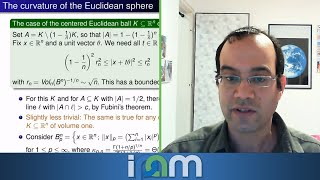
Size of Line Intersections in High Dimensional L_p-Balls and Product Measures
Explore high-dimensional geometry with Bo'az Klartag as he discusses line intersections in L_p-balls and product measures, examining the isodiametric inequality and its implications.
Variational Proofs of Isoperimetric Inequalities
Explore variational proofs of isoperimetric inequalities, their generalizations, and open problems in this advanced mathematics lecture by Steven Heilman at IPAM's workshop.
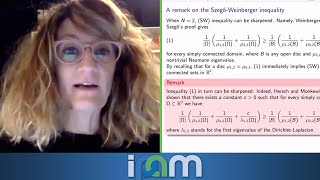
Eigenvalue Estimates for P-Laplace Problems & Domains in Fermi Coordinates
Explore explicit and sharp eigenvalue estimates for Neumann p-Laplace eigenvalues in domains represented in Fermi coordinates, presented by Barbara Brandolini at IPAM's Calculus of Variations workshop.