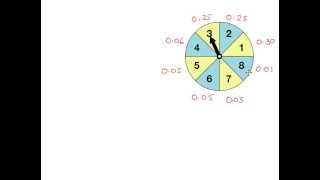
Discrete Probability Tables
Learn to create, analyze, and modify discrete probability distribution tables, including calculating mean, variance, mode, and median.
Basic Probability
Explore fundamental probability concepts, from problem-solving with shapes to experimental probability and Venn diagrams, enhancing your mathematical reasoning skills.
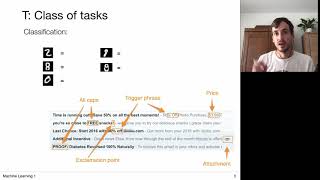
Machine Learning 1 - 2020
Comprehensive introduction to machine learning fundamentals, covering probability theory, regression, classification, neural networks, clustering, and advanced topics like kernels and Gaussian processes.

Central Limit Theorem - Sampling Distribution of Sample Means - Stats & Probability
Comprehensive exploration of the Central Limit Theorem, covering sampling distributions, statistical concepts, and probability problems with practical examples and various distribution types.

The Monty Hall Problem
Explore the Monty Hall Problem through JavaScript and p5.js, learning probability concepts, DOM manipulation, and coding techniques while building an interactive simulation.
Excel Statistical Analysis - Build Discrete Probability Distributions with Worksheet Formulas
Learn to create discrete probability distributions using Excel formulas. Master expected value, standard deviation, charting, and applying these concepts to real-world business scenarios for data-driven decision-making.
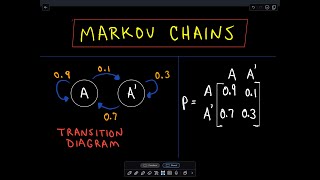
Markov Chain
Comprehensive exploration of Markov chains, covering transition diagrams, steady states, regular and absorbing chains, with applied problems and limiting matrices.

Quantum Physics - Quantum Mechanics Course
Comprehensive exploration of quantum mechanics, covering fundamental concepts, mathematical foundations, and advanced topics for a deep understanding of atomic and subatomic physics.
Normal Distribution Probability - Standard Normal Distribution - Normal Distribution and Z Scores
Comprehensive exploration of normal distribution, probability, and sampling, covering key concepts and applications in various fields. Includes practical examples and problem-solving demonstrations.
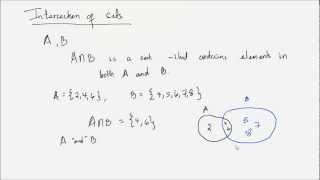
Probability for Actuarial Science
Comprehensive preparation for actuarial probability exams, covering key concepts from set theory to multivariate distributions with practical examples and visual explanations.
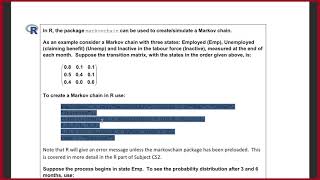
Actuarial Science
Comprehensive exploration of actuarial concepts, covering statistics, economics, and mathematical modeling for risk assessment in insurance and finance.
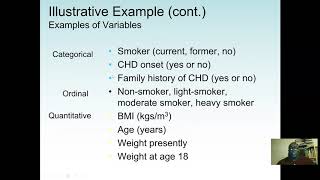
Biostatistics
Comprehensive introduction to biostatistics covering key concepts, probability, distributions, hypothesis testing, and statistical analysis methods for healthcare and research applications.
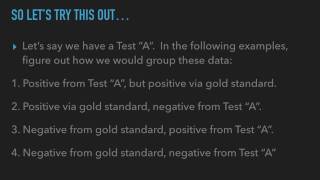
Classic Biostatistics Videos
Comprehensive video series covering key biostatistics concepts for medical exams, including study designs, risk assessments, and diagnostic test evaluations.
Discrete and Continuous Mathematics - MIT Computational Thinking Spring 2021 - Lecture 14
Explore discrete and continuous mathematics, bridging concepts through indexing, function evaluation, area calculation, and random walks in computational thinking.
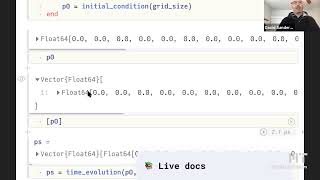
Random Walks II - Lecture 13
Explore random walks, Pascal's triangle, and probability distributions using Julia programming. Learn to implement time evolution of probabilities and understand cumulative sums in computational thinking.
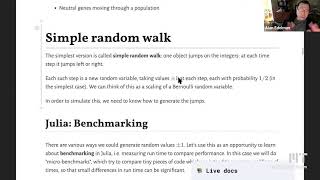
Random Walks in Computational Thinking - Lecture 12
Explore random walks in computational thinking, covering visualization, Julia concepts, benchmarking, and advanced topics like mutable structs and type parameters.
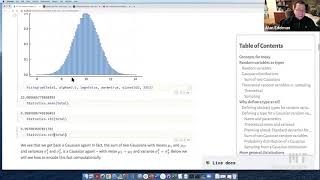
Random Variables as Types - Lecture 11
Explore random variables as types in Julia programming, covering Gaussian distributions, sampling, abstract types, and generic programming for probability distributions.
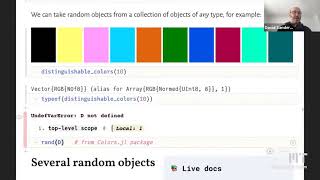
Sampling and Random Variables in Julia - Lecture 9
Explore random sampling, probability distributions, and data visualization techniques using Julia, covering topics from basic coin tosses to complex probability densities and histogram normalization.
Macroscopic Models of Epidemic Dynamics - Week 6
Explore macroscopic epidemic models, transitioning from stochastic to deterministic approaches. Learn about SIR models, continuous-time dynamics, and differential equations in epidemiology.
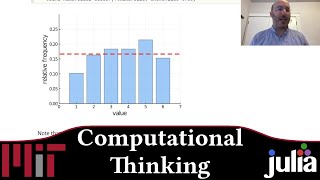
Probability via Computation - Week 4
Explore probability concepts through computational methods, covering random sampling, Monte Carlo simulations, Bernoulli trials, and the Central Limit Theorem with practical examples and visualizations.
Crash Course on Naive Bayes Classification
Comprehensive introduction to Naive Bayes classification, covering theory and practical applications through R coding examples, from probability basics to real-world predictive models.