
Equilibrium is Inference - Lessons from Liquid-Liquid Phase Separation Models
Delve into the relationship between equilibrium systems and information processing, exploring neural computation models and their applications in molecular systems and phase separation dynamics.
A Markov Chain Theory of Self-Organization in Nonequilibrium Systems
Explore the groundbreaking theory of 'rattling' in nonequilibrium systems and its role in predicting ordered states across scientific domains, from living systems to statistical mechanics.

Threshold for a Random Graph to Contain a Triangle - MIT 18.226
Explore probabilistic methods to determine when random graphs develop triangles, using first and second moment analysis techniques in combinatorial mathematics.

Linearity of Expectations in Combinatorics - Applications to Permutations and Hamilton Paths
Master probabilistic combinatorics through practical applications, exploring random permutations and Hamilton paths in tournaments while learning key concepts of linearity of expectations.

Markov, Chebyshev, and Chernoff Inequalities in Probabilistic Analysis
Master fundamental probabilistic inequalities - Markov, Chebyshev, and Chernoff - and their applications in combinatorial analysis through clear mathematical explanations and examples.

Bounded Differences Inequality and Azuma-Hoeffding Inequality
Master probabilistic analysis through the Bounded Differences Inequality, exploring its applications in coupon collection and random graph coloring, with focus on Lipschitz functions and concentration bounds.
Applications of Extreme Statistics to Cellular Decision Making and Signaling
Explore how extreme statistics influence cellular behavior and decision-making processes, focusing on mathematical approaches in biological signaling systems.
Waking Up in the Universe - Part 1: Origins of Life
Explore the fascinating journey of life's evolution with Richard Dawkins as he examines human ancestry, probability of existence, and scientific understanding of life's origins through engaging demonstrations.

On Gilles Pisier's Approach to Gaussian Concentration, Isoperimetry, and Poincare-Type Inequalities
Explore advanced mathematical concepts in measure concentration, isoperimetry, and Poincaré-type inequalities through Pisier's approach and its extensions to rotationally invariant distributions.

Symmetrization Resistance in Random Variables and Entropy
Delve into advanced probability theory exploring symmetrization resistance in random variables, focusing on Bernoulli distributions and entropy-based extensions of classical results.

Minimum Entropy of a Log-Concave Random Variable with Fixed Variance
Delve into the mathematical analysis of log-concave random variables, exploring entropy minimization, channel capacities, and improved entropy power inequalities with practical applications.

Learning in a Dynamic World: From PAC to Prospective Learning Theory
Explore dynamic learning theory and its evolution beyond PAC learning, examining how AI systems can adapt to changing data distributions and goals while maintaining performance over time.
Detecting Stationary Measure Classes in Hyperbolic Groups
Delve into geometric statistics for analyzing stationary measures in hyperbolic group theory, focusing on random walks and boundary convergence in cocompact fuchsian groups.
Computing Poisson Boundaries without Moment Conditions
Delve into advanced group theory concepts, focusing on Poisson boundaries and random walks without moment conditions, exploring applications in acylindrically hyperbolic groups and wreath products.

Combinatorial Applications of the Shearer and Han Inequalities in Graph Theory and Boolean Functions
Explore the powerful applications of Shearer's and Han's inequalities in information theory, focusing on their role in solving complex problems in graph theory and Boolean functions.

A Rényi Entropy Interpretation of Anti-Concentration
Explore advanced mathematical concepts in concentration functions, examining multivariate entropic settings and volume bounds in isotropic convex bodies through Rényi entropy interpretation.

Negative Feedback as a Noise Suppression Mechanism in Collective Foraging
Explore how social insects use negative feedback signals in foraging behavior, examining their role in variance reduction and system robustness through stochastic dynamics analysis.
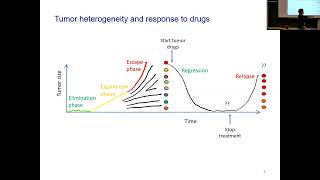
Statistical Dynamics of Tumor Initiation and Progression
Explore the mathematical modeling of tumor development through statistical dynamics, focusing on glioma invasion patterns and microtube-driven cancer progression mechanisms.

Spectral Gap for Random Schottky Surfaces
Delve into advanced mathematical concepts exploring spectral gaps in random Schottky surfaces, examining the behavior of Laplace eigenvalues and their relationship to hyperbolic geometry and probability theory.
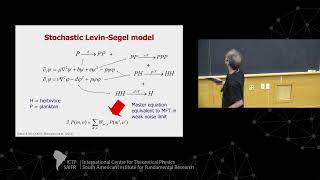
Stochastic Pattern Formation in Space and Time: From the Brain to the Biosphere - Class 5
Explore stochastic pattern formation principles across biological systems, from neural networks to ecosystem dynamics, with insights into spatial-temporal mathematical modeling.
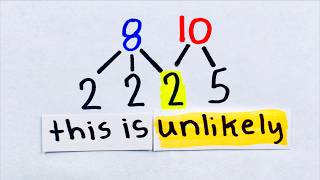
The Probability of Relatively Prime Numbers - A Mathematical Analysis
Explore the fascinating probability of coprime numbers through infinite series, the Basel problem, and fundamental probability laws - all explained with clear mathematical reasoning.