
Patterns and Order in Randomness
Explore patterns in randomness through physics experiments and discussions, fostering interconnected understanding and problem-solving skills for women pursuing physics careers.
Universality of Dynamic Processes Using Drinfel'd Twisters
Explore universality in dynamic processes using Drinfel'd twisters, examining long-time asymptotics and Tracy-Widom fluctuations through quantum group duality and asymptotic analysis.
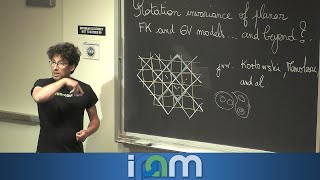
Rotational Invariance of Planar Random Cluster Models and Beyond
Exploration of rotational invariance in planar random cluster models, discussing its applications and potential for new insights into critical models on Z^2.
Interacting Polya Urns - Statistical Mechanics Beyond 2D
Explore interacting Polya urns on graphs, their asymptotic behavior, and convergence to equilibrium in this statistical mechanics presentation by Omer Angel at UCLA's IPAM workshop.
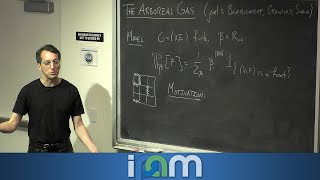
The Arboreal Gas - Percolative Properties of Random Forests
Explore the percolative properties of random forests in the arboreal gas model, examining the formation of giant trees and its applications to branched polymer gelation.
Poisson-Dirichlet Distribution for the Interchange Process in Five Dimensions
Explores the emergence of macroscopic cycles in the interchange process on high-dimensional tori, proving convergence to Poisson-Dirichlet distribution for cycle lengths in dimensions 4 and above.
On the Higher-Rank Dimer Model
Richard Kenyon explores the higher-rank dimer model, discussing GL(n) local systems, Kasteleyn operators, and n-multiwebs. He presents scaling limit results for SL(3) and their conformal invariance in this advanced mathematics talk.
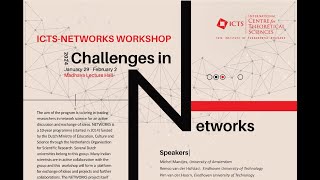
The Grapheme-Valued Wright-Fisher Diffusion With Mutation by Anita Winter
Explore grapheme-valued Wright-Fisher diffusion with mutation in population genetics. Gain insights into mathematical models for genetic variation and evolutionary processes.
Inhomogeneous Multispecies t-PushTASEP and Macdonald Polynomials
Explore connections between inhomogeneous multispecies t-PushTASEP's stationary distribution and Macdonald polynomials at q=1 in this advanced mathematics lecture by Harvard's Lauren Williams.
The Inhomogeneous Multispecies PushTASEP
Explore multispecies PushTASEP variants, stationary distributions, and symmetry properties. Discover explicit formulas for correlations using Schur functions in this advanced mathematical presentation.
Compact Formula for Symmetric Macdonald Polynomials via ASEP and TAZRP
Explore connections between particle models and Macdonald polynomials, unveiling a new compact tableau formula with applications in probability and integrable systems.
Is It Dark Matter, or Is Spacetime Undergoing a Random Walk?
Explore a theory combining classical and quantum systems, applying it to general relativity to explain galactic rotation curves without dark matter through stochastic spacetime processes.
Geometry and Physics of Covalent Network Glasses
Explore the mathematical modeling of glass transition in covalent network glasses, focusing on molecular agglomeration and stochastic processes to predict glass transition temperatures.
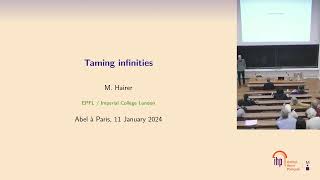
Taming Infinities: Renormalisation Techniques in Physics and Mathematics
Explorez les techniques de renormalisation pour maîtriser les infinis en physique et mathématiques, avec des applications récentes en théorie des probabilités.
Transition from Fractional Diffusion to Normal Diffusion in Kinetic Models
Explore the transition between fractional and normal diffusion in kinetic models, examining mathematical principles and applications in complex systems.
Range Dynamics for a Spatially Structured Asexual Population
Explore range dynamics of spatially structured populations, considering spatial propagation and evolutionary dynamics in heterogeneous environments.
Ancestors' Genetic Weights in Biparental Populations
Explore genetic composition in biparental populations using a Moran model. Analyze ancestral genome proportions and their convergence as population size increases.
Filling the Gap Between Individual-Based Evolutionary Models and Hamilton-Jacobi Equations
Explore Hamilton-Jacobi equations in quantitative genetics, bridging stochastic individual-based models and phenotypic density analysis through asymptotic derivations and population dynamics.
A Multiple Time Renewal Equation for Neural Assemblies with Elapsed Time Model
Explore neural assemblies through a multiple time renewal equation, focusing on the elapsed time model and its implications for understanding brain dynamics.
Fokker-Planck Equations of Neuron Networks: Understanding Time Periodic Solutions
Explore Fokker-Planck equations in neuron networks, focusing on time periodic solutions and their implications for neural dynamics.
Noise-Driven Bifurcations in Neural Field Systems Modeling Grid Cell Networks
Explore noise-driven bifurcations in neural field systems, focusing on grid cell network modeling and their implications for spatial navigation.