Harmonic Maps and Random Walks on Countable Groups
Explore harmonic maps and random walks on countable groups, focusing on CAT(0) spaces and group actions with zero escape rate.
The Simplest Proof of Cayley's Formula and Its Connection to Statistical Mechanics
Explore Cayley's Formula's simplest proof and its statistical mechanics connection in this insightful lecture by Alexei Rebenko from the National Academy of Sciences, Kiev.
Dynamical Subsets in Iterated Function Systems
Explore dynamical subsets in iterated function systems with Henna Koivusalo's in-depth analysis of rare events in dynamical systems.
Rare Events Point Processes in Infinite Measure Dynamical Systems
Explore rare events point processes in infinite measure dynamical systems, focusing on hitting and return time statistics and their applications to Manneville-Pommeau maps.
Generalized Law of Iterated Logarithm in the Infinite Horizon Lorentz Gas
Explore the behavior of infinite horizon Lorentz gas, focusing on chaotic dynamics, long flights, and non-standard scaling in limit theorems for billiard particle positions.
Quantitative Recurrence for Z-Extension of Three-Dimensional Axiom A Flows
Explore quantitative recurrence in Z-extension of Axiom A flows, focusing on first return time behavior and applications to geodesic flows on Z-cover of compact surfaces.
Averaging Result for Differential Equations Perturbed by a Z-Periodic Lorentz Gas
Explore averaging results for differential equations perturbed by Z-periodic Lorentz gas, examining asymptotic behavior and convergence rates in infinite measure-preserving systems.
Poisson Limit Theorems for Systems with Product Structure
Explore Poisson Limit Theorems for product systems, focusing on return times to small sets and applications to various map combinations, including Anosov and skew products.
Multilevel Monte Carlo Methods for the Dean-Kawasaki Equation from Fluctuating Hydrodynamics
Explore Multilevel Monte Carlo methods for Dean–Kawasaki equation, analyzing efficiency and convergence in stochastic PDEs of Fluctuating Hydrodynamics for many-particle systems.
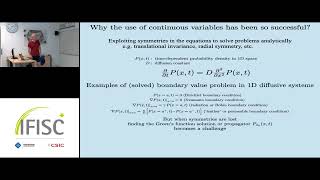
Resolution of a Hundred Year Old Problem on Lattice Random Walks and Its Application to Study Inelastic Collisions
Explore a century-old lattice random walk problem and its implications for inefficient diffusion in complex systems.
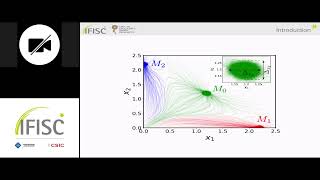
Generation of Stochastic Trajectories - Applications to Complex Systems
Explore stochastic trajectory generation and its applications in complex systems, focusing on interdisciplinary physics concepts and advanced modeling techniques.
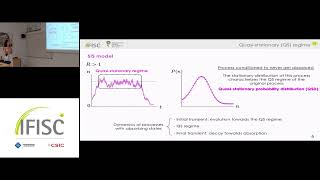
Numerical Methods for Quasi-Stationary Distributions
Explore numerical techniques for calculating quasi-stationary distributions in complex systems, enhancing understanding of long-term behavior in stochastic processes.
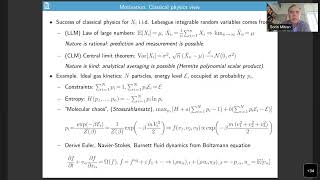
Data-Driven Information Geometry Approach to Stochastic Model Reduction
Explore data-driven information geometry for stochastic model reduction, extending least squares to curved statistical manifolds. Learn adaptive computation techniques for rapidly varying stochastic phenomena.

Expanders in Higher Dimensions: From Local to Global Properties and Applications
Explore high-dimensional expanders, their local-to-global properties, and applications in coding theory, networking, and computational complexity.
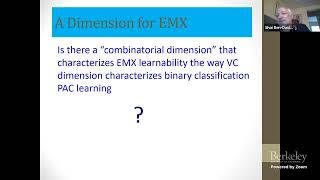
Learning Probability Distributions: What Can and Can't Be Done
Explore statistical learning, focusing on guaranteed generalizations from finite samples and characterizing learnable distribution families. Gain insights into modern paradigms in generalization.
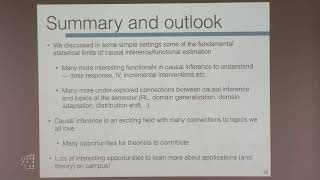
Statistical Limits of Causal Inference
Explore fundamental limits of causal effect estimation in observational data, examining personalized effects, non-smooth settings, and discrete scenarios without assuming prior causal inference knowledge.

Probability and Statistics: An Introductory Overview
Explore probability and statistics fundamentals, from basic concepts to advanced topics, covering applications, history, and key principles in data science and machine learning.

Statistical Methods for Data Analysis in Particle Physics - Lecture 2
Explore advanced statistical techniques for particle physics data analysis, focusing on hypothesis testing, confidence intervals, and likelihood methods in experimental research.
An Introduction to Intertwining via Strong Stationary Duality - Developments and Open Problems
Explores advanced applications of dual chains in random walks, focusing on less symmetric scenarios and statistical applications, with examples from hyperplane arrangements and non-uniform duals.
Dynamical Spectral Transition for Optimization in Very High Dimensions
Explore dynamical spectral transitions in high-dimensional optimization, examining mathematical concepts and their applications in complex systems and data analysis.
Applications of Duality - Lecture 3
Explore applications of dual processes in Markov chains, including strong stationary times, eigenvalue interpretation, and solutions to the Peres conjecture for Birth and Death chains.