Probability for Data Science
Comprehensive introduction to probability concepts for data science, covering fundamental principles, distributions, hypothesis testing, and practical applications in statistical analysis.
Probability Statistics
Comprehensive probability and statistics course covering basic to advanced concepts for business students, including distributions and probability laws.
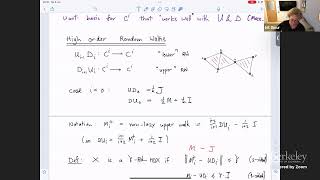
High-Dimensional Expanders - Lecture 1
Explore high-dimensional expanders with Irit Dinur, delving into advanced concepts in analysis and theoretical computer science.
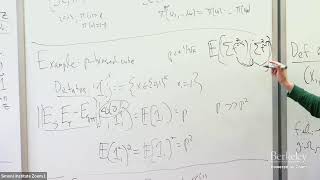
High-Dimensional Expanders - Lecture 4
Explore advanced concepts in high-dimensional expanders, focusing on analysis techniques and applications in theoretical computer science.
High-Dimensional Expanders - Lecture 3
Explore advanced concepts in high-dimensional expanders, focusing on analysis techniques and applications in theoretical computer science.
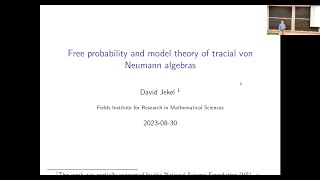
Probability and Model Theory of Tracial von Neumann Algebras
Explore connections between free probability and model theory in von Neumann algebras, examining their interplay and applications in operator algebra research.
Localization Schemes
Explore innovative localization schemes for analyzing Markov chain mixing times in continuous and discrete spaces, with applications to Ising models and Glauber dynamics.
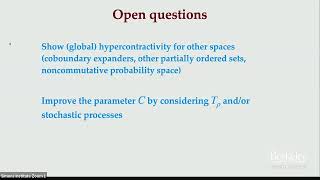
Hypercontractivity Inequality on Epsilon-Product Spaces
Explores hypercontractivity inequality on ε-product spaces, generalizing previous results and capturing new spaces like spectral high-dimensional expanders. Applications include small-set expansion theorems.
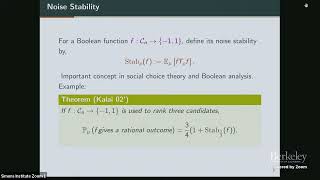
Noise Stability - Beyond the Boolean Cube
Explore noise stability beyond the Boolean cube, analyzing stochastic processes and Brownian motion to derive new quantitative forms of Boolean analysis theorems.
Optimal Transport Theory in Free Probability, Part II
Explore advanced concepts in free probability theory, focusing on optimal transport and its applications in operator algebras and random matrices.
Optimal Transport Theory in Free Probability, Part I
Explore the intersection of optimal transport theory and free probability with David Jekel, delving into advanced mathematical concepts and their applications in operator algebras.
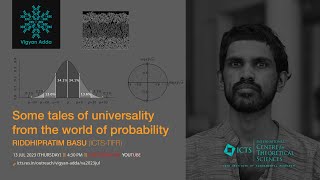
Some Tales of Universality from the World of Probability by Riddhipratim Basu
Explore universality in probability theory, from the central limit theorem to contemporary research, examining how complex systems share large-scale features despite microscopic differences.

Statistics for Data Analysis with Exercises - Lecture 3
Explore advanced statistical methods for data analysis in high-energy physics, focusing on practical applications and exercises to enhance understanding and skills in this specialized field.
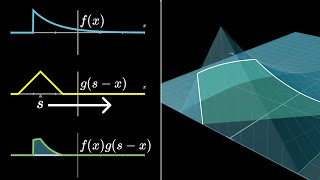
Convolutions and Adding Random Variables, Visually Explained
Visual explanation of convolutions and adding random variables, exploring discrete and continuous cases, with connections to the central limit theorem and practical examples.

Queuing Theory and Poisson Process
Introduction to M/M/1 queue model and Poisson process, covering fundamental concepts of queuing theory. Explores key principles and applications in simple queuing systems.
Jason Miller- Conformal Removability of SLEκ for κ∈[4,8)
Explores conformal removability of SLEκ curves, focusing on κ=4. Presents new conditions for conformal removability and discusses applications to SLEκ for κ∈(4,8). No prior SLE or LQG knowledge required.
Random Musings on Stochastics - Lorenz Lecture
Explore stochastic processes in geophysics with insights on nonlinear dynamics, chaos theory, and their applications in climate and hydrology modeling.
Random Monomial Ideals - Seminar on Applied Geometry and Algebra
Explore probabilistic models of random monomial ideals, their properties, and applications in algebraic geometry. Gain insights into average behavior of ideals and potential for generating algebraic objects.
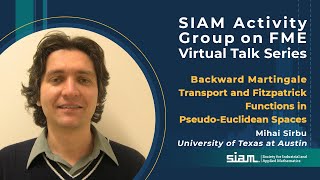
Backward Martingale Transport and Fitzpatrick Functions in Pseudo-Euclidean Spaces
Explore backward martingale transport and Fitzpatrick functions in pseudo-Euclidean spaces, focusing on a one-period multidimensional problem with quadratic objective and its applications in financial mathematics.
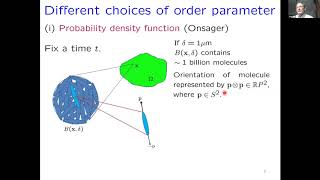
Energy Minimization Problems for Liquid Crystals - SIAM PDE Seminar
Explore energy minimization in liquid crystals through probability density, tensor averages, and molecular orientation theories with Sir John Ball.
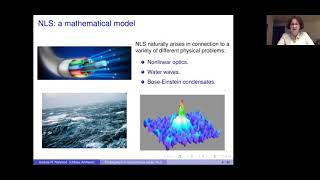
Propagation of Randomness Under the Flow of Nonlinear Dispersive Equations
Explore the propagation of randomness in nonlinear dispersive equations with Andrea R. Nahmod, delving into advanced mathematical concepts and their applications in this insightful lecture.