Compiling Probabilistic Programs for Variable Elimination with Information Flow
Explore a novel approach to variable elimination and marginal inference in probabilistic programming, featuring bounded recursion and discrete distributions, with compiler-based optimization techniques.
Equivalence and Similarity Refutation for Probabilistic Programs
Explore a novel method for refuting equivalence and similarity in probabilistic programs, offering automated analysis with formal guarantees for infinite-state systems.
Scaling Decision-Theoretic Probabilistic Programming Through Factorization
Explore dappl, a new probabilistic programming language for decision-making, offering scalable MEU reasoning and expressive modeling of complex real-world tasks.
Automated Expected Value Analysis of Recursive Programs
Explore automated inference of expected result values in probabilistic programs with recursion, procedures, and local variables. Learn about term representation and first-order constraints for analysis automation.
Formally Verified Samplers from Probabilistic Programs with Loops and Conditioning
Explore Zar: a verified compiler for discrete probabilistic programs, transforming cpGCL to executable samplers. Learn about choice-fix trees, interaction trees, and sampling equidistribution theorem.
Caesar: A Verifier for Probabilistic Programs - Dafny'24
Explore Caesar, a verifier for probabilistic programs, featuring an intermediate verification language and real-valued logic for quantitative property verification in programming.
Decalf: A Directed, Effectful Cost-Aware Logical Framework
Explore Decalf, a logical framework for analyzing quantitative aspects of effectful functional programs, focusing on cost-aware type theory and its applications to algorithm analysis.
Probabilistic Programming Interfaces for Random Graphs: Markov Categories, Graphons, and Nominal Sets - POPL 2024
Explore semantic models of probabilistic programming languages over graphs, connecting graphons to equational theories through Markov categories, measure-theoretic probability, and nominal sets.
Programmatic Strategy Synthesis: Resolving Nondeterminism in Probabilistic Programs
Explore programmatic strategy synthesis for resolving nondeterminism in probabilistic programs using deductive verification techniques and weakest precondition-style frameworks.
Higher Order Bayesian Networks, Exactly - POPL 2024
Explore a higher-order programming language for Bayesian networks, combining advanced techniques from linear logic, intersection types, and rewriting theory for efficient probabilistic modeling and inference.
Positive Almost-Sure Termination: Complexity and Proof Rules
Explore complexity and proof rules for Positive Almost-Sure Termination in probabilistic programming, including recursion-theoretic analysis and novel proof techniques using transfinite ordinals.
Toward Probabilistic Coarse-to-Fine Program Synthesis
Explore probabilistic coarse-to-fine program synthesis, a novel approach using iterative refinement of stochastic programs to efficiently search and generate programs matching specifications.
Guaranteed Bounds for Discrete Probabilistic Programs with Loops via Generating Functions - LAFI'24
Explore a technique for finding guaranteed bounds on posterior distributions in probabilistic programs with loops using probability generating functions and inductive invariants.
Probabilistic Programming in Python - Conf42 Python 2024
Explore Bayesian statistics, probabilistic modeling, and MCMC in Python. Learn key concepts and practical applications through demonstrations and workflow explanations.
Probabilistic Programs Which Make Common Sense
Explore probabilistic programming as a step towards machines with common sense. Learn about Sigma, a language for functional probabilistic models, and its applications in automated reasoning and inference.
The Metrics Manifesto
Discover predictive analytics for security, including decision science, Bayesian methods, and quantitative risk management. Learn to measure attack surface and present advanced metrics to boards.
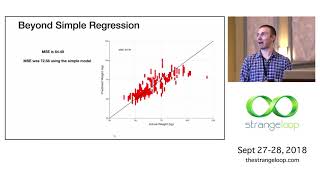
Scala DSLs and Probabilistic Programming
Explore ScalaStan, a type-safe DSL for statistical modeling with Stan, enabling programmatic manipulation and generation of Stan programs within Scala for efficient Bayesian inference and data analysis.
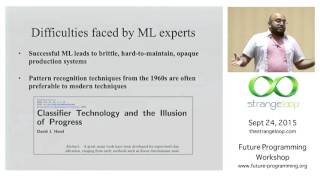
An Overview of Probabilistic Programming
Explore probabilistic programming through BayesDB, Picture, and Venture platforms. Learn about Bayesian databases, 3D scene perception, and general-purpose probabilistic computing for data analysis and AI applications.
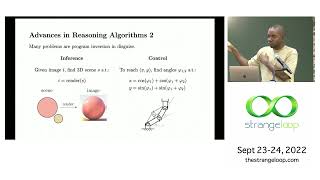
Blueprints for a Universal Reasoning Machine
Exploring the concept of a universal reasoning machine, combining probabilistic and causal inference, computational languages, and deep learning to automate all forms of inference across domains.
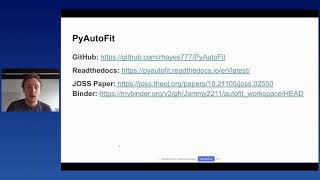
PyAutoFit - A Classy Probabilistic Programming Language For Data Science
Explore Bayesian inference with PyAutoFit, a probabilistic programming language for data science. Learn core features, model composition, and advanced tools for big data analysis and parallel computing.
Probabilistic Programming in Python
Learn probabilistic programming in Python using PyMC3 for flexible statistical modeling, automated parameter estimation, and uncertainty quantification in data science and scientific research.