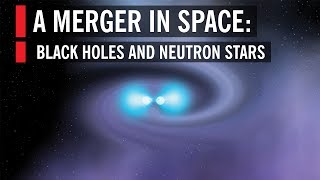
Black Holes and Neutron Stars - A Merger in Space
Explore the groundbreaking detection of colliding black holes and neutron stars, their implications for astrophysics, and how they're revolutionizing our understanding of the universe through gravitational wave astronomy.
Precision Studies at the Neutrino Frontier
Exploration of neutrino physics advancements, from solar neutrino anomalies to precision measurements in oscillation experiments, highlighting key discoveries and future research directions.
Superposition, Entanglement, and Raising Schroedinger's Cat
Nobel Laureate Dr. Wineland explores quantum information experiments with trapped ions, covering superposition, entanglement, and the famous Schrödinger's Cat thought experiment.
Creating the Primordial Quark-Gluon Plasma at the LHC
Explore the creation of quark-gluon plasma in heavy ion collisions at LHC and RHIC. Learn about QCD behavior, particle formation, and probing hot QCD matter with hard probes.
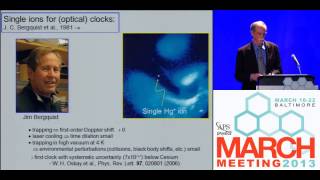
Superposition, Entanglement, and Raising Schroedinger's Cat
Explore quantum mechanics concepts like superposition and entanglement, and their applications in spectroscopy, clocks, and quantum computing, presented by Nobel laureate David J. Wineland.
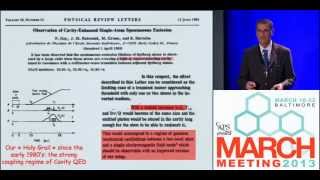
Controlling Photons in a Box and Exploring the Quantum to Classical Boundary
Explore quantum physics through photon control experiments, examining the boundary between quantum and classical realms with Nobel laureate Serge Haroche.
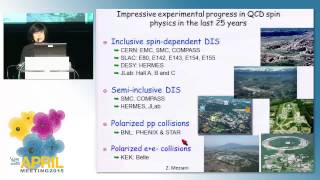
Proton - A Fascinating Relativistic Many-Body System - Remains Puzzling
Explore the puzzling nature of protons, from their mass and spin to their size, in this talk by Haiyan Gao. Discover recent findings and ongoing efforts to unravel the mysteries of this fundamental particle.
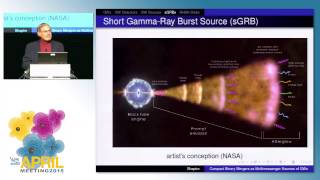
Compact Binary Mergers as Multimessenger Sources of Gravitational Waves
Exploration of compact binary mergers as sources of gravitational waves, electromagnetic radiation, and neutrinos. Discusses detection methods, simulations, and implications for multimessenger astronomy.
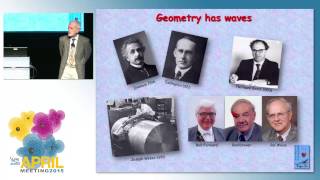
Was Einstein Right? A Centennial Assessment
Explore Einstein's general relativity through diverse experiments, from solar system observations to gravitational waves, assessing its validity and potential limitations a century after its formulation.
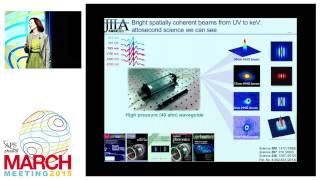
The Light Science of Coherent X-rays
Explore cutting-edge developments in coherent X-ray science, including femtosecond lasers, quantum nanoscale antennas, and advanced imaging techniques with physicist Margaret Murnane.
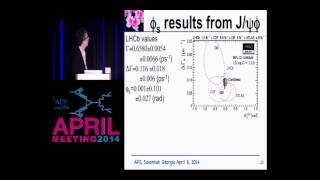
Weak Decays as a Window to New Physics
Explore weak decays and their potential to reveal new physics beyond the Standard Model, focusing on flavor problems, CP violations, and future experiments.
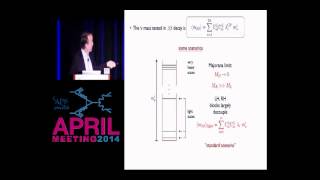
The Nuclear and Particle Physics of Neutrinoless Double Beta Decay
Explore neutrinoless double beta decay: its physics, significance for neutrino properties, and ongoing experimental efforts to detect this rare process and probe fundamental particle interactions.
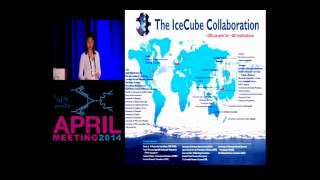
Cosmic Neutrinos in the IceCube Detector
Explore high-energy cosmic neutrinos, their detection using IceCube, and the birth of neutrino astronomy in this talk on astrophysical neutrino observations and their implications for understanding cosmic phenomena.
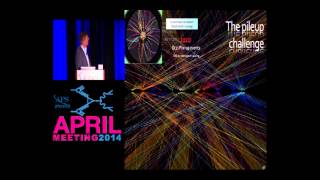
The Discovery and Characterization of a Higgs Boson
Explore the discovery and characterization of the Higgs boson, its significance in particle physics, and its implications for our understanding of the universe. Learn about the LHC, ATLAS, and CMS experiments.
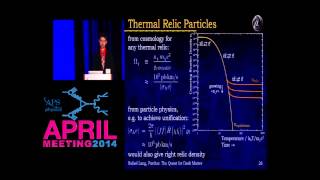
The Quest for Dark Matter
Explore the mystery of Dark Matter with Rafael Lang, covering its evidence, potential composition, and ongoing experimental efforts to unravel this cosmic enigma.
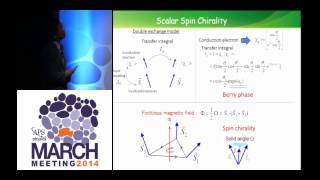
Magnetism as the Emergent Phenomena
Explore emergent magnetism phenomena, from spin-orbital superstructures to magnetic skyrmions, and their applications in novel materials and quantum effects.
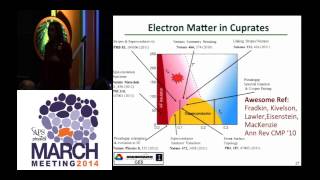
Deciphering Electron Matter in Novel Superconductors
Explore electron behavior in novel superconductors, focusing on unconventional materials, pseudogap phenomena, and electronic nematic phases. Gain insights into predictive design of superconductors beyond conventional rules.
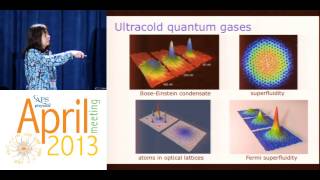
Ultracold Atoms and Molecules
Explore ultracold gases and molecules, their interactions, and applications in quantum physics. Learn about cooling techniques and recent advancements in creating ultracold polar molecules.
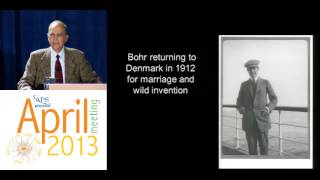
Bohr's Creation of His Quantum Atom
Explore Niels Bohr's groundbreaking quantum atom theory with Dr. John Heilbron, tracing its development and impact on modern physics in this insightful presentation from the APS April Meeting 2013.
Grow Your Own Planet
Explore how simulations advance our understanding of the Universe, from basic orbits to complex gas flows. Learn about state-of-the-art hydrodynamics programs and their applications in astronomy.
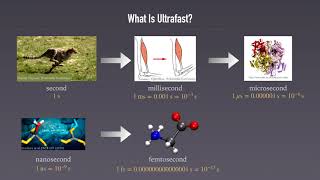
An Ultrashort History of Ultrafast Imaging
Explore the fascinating world of ultrafast imaging, from femtosecond-scale molecular dynamics to cutting-edge techniques using powerful lasers and X-ray free-electron lasers for capturing and controlling ultrafast processes.