Non-uniqueness in the Partial Differential Equations of Fluid Dynamics
Explore instability and non-uniqueness in fluid dynamics equations, focusing on recent advancements in Euler and Navier-Stokes equations and their implications for unpredictability.
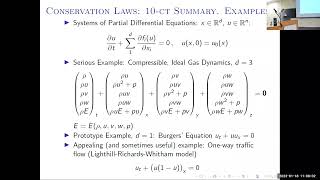
Can a Scalar Conservation Law Imitate a Diffeomorphism? - Lecture on Fluid Flow Geometry
Explore the representation of scalar convex conservation laws as paths in diffeomorphism spaces, examining weak solutions and their implications for fluid dynamics.
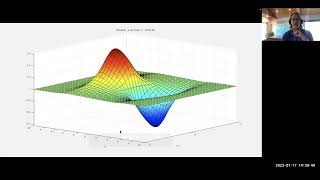
Geometry of Shock Formation and Maximal Development for Euler
Explore the geometry of shock formation and maximal development in Euler equations, focusing on fluid flow analysis and honoring David Ebin's contributions.
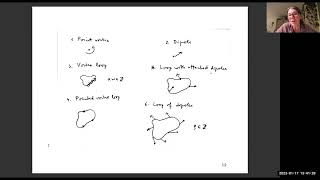
Singular Vortex Configurations and Coadjoint Orbits
Explore singular vortex configurations in 2D fluid dynamics, focusing on coadjoint orbits of area-preserving diffeomorphisms and their relation to vortex loops and dipoles.
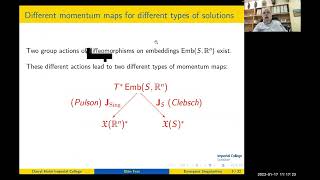
Emergent Singular Solutions of Nonlinear Wave Equations
Explore nonlinear wave equations and their emergent singular solutions with Imperial College London's Darryl Holm in this advanced mathematics workshop.
Stability of Twisting of Hamiltonian Flows and Applications
Explore Hamiltonian flow stability, twisting phenomena, and their applications in fluid dynamics with insights from Duke University researcher Tarek Elgindi.
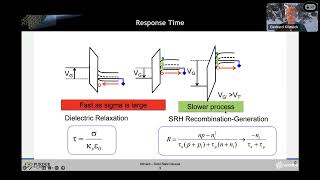
ABACUS Tool Suite and MOS Capacitors - Fall 2023
Explore MOS capacitors using ABACUS tool suite. Experiment with doping, structural parameters, and advanced effects in this hands-on semiconductor education session.
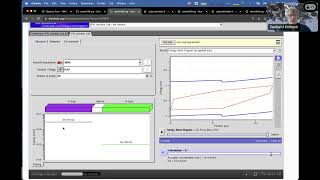
ABACUS Tool Suite and PN Junctions - Fall 2023
Explore PN junctions using ABACUS tool suite. Learn about band edge diagrams, charge distributions, and doping effects through interactive simulations powered by industrial-grade technology.
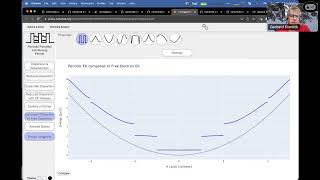
ABACUS Tool Suite: Bandstructure and Band Models - Fall 2023
Explore bandstructure tools in ABACUS, including Kronig-Penney model and sophisticated Tight Binding models. Gain insights into band formation, effective masses, and strain effects in bulk materials and nanowires.
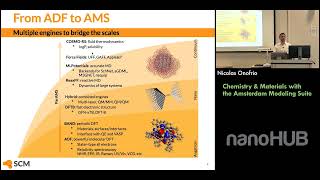
Chemistry and Materials with the Amsterdam Modeling Suite
Explore atomistic simulations using Amsterdam Modeling Suite. Learn about AMS driver, DFT engines, force fields, and PARAMS for novel molecular interactions. Gain insights through demos and practical applications.
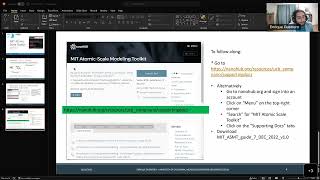
Teaching and Learning with the MIT Atomic Scale Modeling Toolkit - Classical and Quantum Atomic Modeling
Explore classical and quantum atomic modeling using MIT's toolkit. Perform molecular dynamics, Monte Carlo simulations, and quantum chemistry computations. Learn practical applications for various physics and chemistry courses.
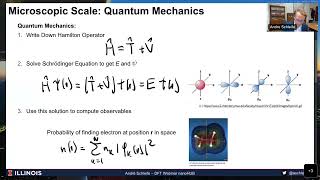
Density Functional Theory: Introduction and Applications
Explore Density Functional Theory fundamentals and applications using Quantum Espresso on nanoHUB. Learn to compute electronic structures, densities of state, total energies, and bulk modulus for materials.
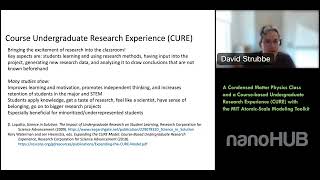
Condensed Matter Physics Class and Research Experience with MIT Atomic-Scale Modeling Toolkit
Explore condensed matter physics through simulations and research experiences using the MIT Atomic-Scale Modeling Toolkit. Learn about covalent bonding, bandstructure, phonons, and magnetic phase transitions.
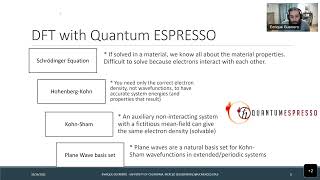
Interactive Modeling of Materials with DFT Using Quantum ESPRESSO - MIT Atomic Scale Toolkit
Explore interactive modeling of materials using density functional theory with Quantum ESPRESSO in the MIT Atomic-Scale Modeling Toolkit. Learn to compute and analyze various material properties through hands-on examples.
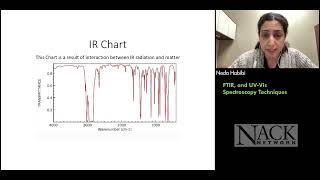
FTIR and UV-Vis Spectroscopy Techniques - Lecture 3
Explore FTIR and UV-Vis spectroscopy techniques, their principles, applications, and operational mechanisms. Gain insights into radiation interactions, vibration types, and spectrum analysis for nanoscale characterization.
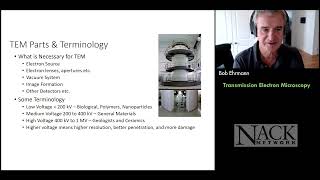
Transmission Electron Microscopy - Principles and Applications - Lecture 2
Explore transmission electron microscopy fundamentals, including microscope components, image formation, sample preparation techniques, and applications in materials science and biology.
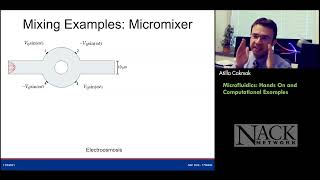
Microfluidics: Hands-On and Computational Examples
Explore microfluidics through hands-on demonstrations and computational simulations, focusing on mixing techniques, soft lithography, and practical applications like red blood cell separation in microfluidic channels.
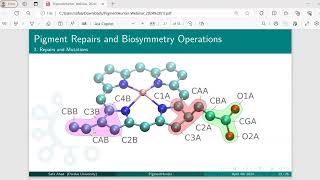
Building a Graphical Interface for Exploring Protein Dynamics and Spectroscopy - PigmentHunter
Explore protein dynamics and spectroscopy with PigmentHunter, a user-friendly nanoHUB tool for simulating excitonic spectra of chlorophyll proteins. Learn its interface, workflow, and applications in molecular dynamics and spectral analysis.
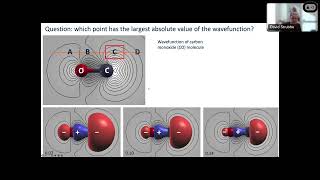
DFT with SIESTA, Data Visualization, and Sophomore-level CURE Using MIT Atomic-Scale Modeling Toolkit
Explore density functional theory, data visualization, and undergraduate research experiences using the MIT Atomic-Scale Modeling Toolkit for modern physics and condensed matter studies.
Simulation of Chemical Reactions on a Quantum Computer
Explore quantum computing algorithms for calculating scattering matrix elements in chemical reactions, focusing on the Møller operator formulation and its application to hydrogen exchange.
Quantum Energy Teleportation - Activating Ground State Energy
Explore quantum energy teleportation and its experimental demonstration using nuclear magnetic resonance. Discover how entanglement enables energy extraction from vacuum fluctuations.