Gravitational Wave Detectors - Part 2
Explore advanced concepts in gravitational wave detection, including interferometer design, noise sources, and data analysis techniques for LIGO and LISA projects.
Gravitational Waveforms - Part 2
Explore advanced concepts in gravitational waveform analysis, including theoretical models and data interpretation techniques for detecting cosmic phenomena.
Gravitational Waveforms - Part 1
Explore gravitational waveforms with expert Alessandra Buonanno, covering theoretical foundations and practical applications in astrophysics and cosmology.
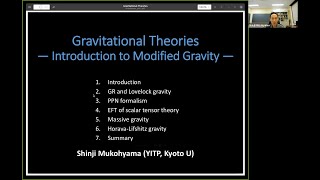
Gravitational Theories: Introduction to Modified Gravity - Part 2
Explore advanced concepts in modified gravity theories, focusing on alternative explanations for gravitational phenomena beyond general relativity.
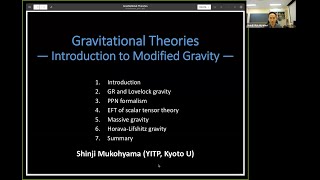
Gravitational Theories: Introduction to Modified Gravity - Part 1
Explore modified gravity theories and their implications for understanding the universe's fundamental forces and structure.
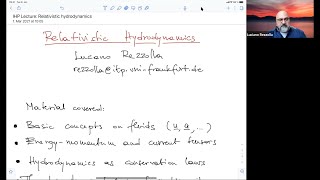
Relativistic Hydrodynamics
Explore relativistic hydrodynamics with expert Luciano Rezzolla, covering fundamental concepts and advanced applications in astrophysics and high-energy physics.
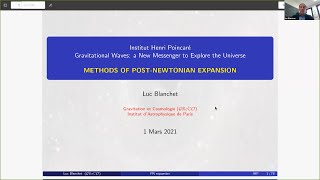
Methods of Post-Newtonian Expansion
Explore advanced techniques in gravitational physics, focusing on post-Newtonian expansion methods for understanding celestial mechanics and gravitational wave sources.
Mathematical Physics of Weakly Interacting Bosons
Explore mathematical physics of weakly interacting bosons with Jan Solovej, covering key concepts and recent developments in this advanced field.
Some Open Mathematical Problems Concerning Charged Quantum Particles
Explore open mathematical challenges related to charged quantum particles, delving into complex theoretical concepts and unsolved problems in quantum physics.
Fractional Quantum Hall Effect in Multicomponent Systems: Old and New
Explore the intricacies of fractional quantum Hall effect in multicomponent systems, covering both established and emerging concepts in quantum physics.
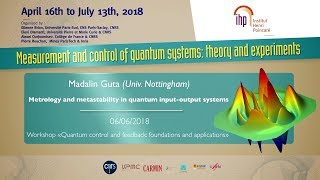
Metrology and Metastability in Quantum Input-Output Systems
Explore quantum metrology and metastability in input-output systems, focusing on parameter estimation, continuous measurements, and precision limits for open quantum dynamics.
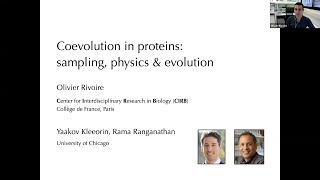
Models of Coevolution in Proteins: Sampling, Physics and Evolution
Explore protein coevolution models, examining sampling techniques, physical principles, and evolutionary dynamics in molecular biology.
Vortex Sheets and Groupoids in Ideal Hydrodynamics
Explore Arnold's group-theoretic approach to ideal hydrodynamics and its applications to vortex sheets, fluids with moving boundaries, and multiphase fluids using Lie groupoid symmetries.
The Nonlinear Stability of Black Holes: An Overview
Explore the mathematical properties of black holes, focusing on their stability as solutions to Einstein's equation and recent proof of nonlinear stability for slowly rotating Kerr black holes.
Supersymmetry and Trace Formulas: From Atiyah-Singer to Jacobi-Poisson and Selberg
Explore supersymmetry's mathematical origins and applications, from Atiyah-Singer formula to Jacobi-Poisson and Selberg trace formulas, in this advanced mathematics colloquium.
Supersymmetry and Trace Formulas: From Atiyah-Singer to Jacobi-Poisson and Selberg - Part 1
Explore supersymmetry's mathematical origins and applications, from Atiyah-Singer formula to Jacobi-Poisson and Selberg trace formulas, in this advanced mathematics colloquium.
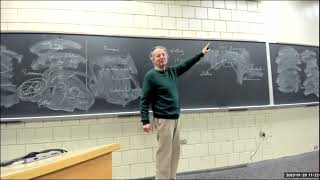
Combinatorial Approximations to the Continuum for Fluid Computation
Explore combinatorial approximations in fluid computation, featuring insights from Dennis Sullivan and Ruth Lawrence-Naimark in this geometry and analysis workshop.
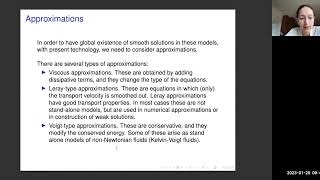
Voigt Boussinesq Equations - Global Regularity and Fluid Dynamics
Explore Voigt Boussinesq equations, their relation to fluid mechanics, and global regularity results for critical cases. Gain insights into incompressible fluid equations and their approximations.
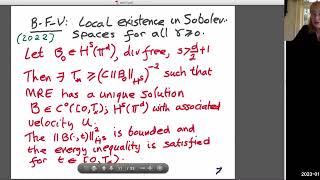
In Search of Euler Equilibria via the Magnetic Relaxation Equations
Explore geometric fluid dynamics, focusing on Euler equilibria and Moffatt's Magnetic Relaxation equations. Delve into recent findings on these mathematically challenging active vector equations with cubic nonlinearity.
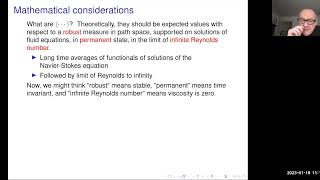
Turbulence and Singularities in Fluid Flows - Mathematical Considerations
Explore turbulence, singularities, and fluid dynamics through mathematical considerations, multiscale solutions, and incompressible fluid pressure. Gain insights into Navier-Stokes equations and regularity criteria.
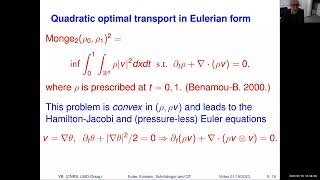
From the Monge Transportation Problem to Einstein's Gravitation Through Euler's Hydrodynamics
Explore the mathematical journey from Monge's transportation problem to Einstein's gravitation, connecting through Euler's hydrodynamics in this insightful lecture.