Quantum Continuum Mechanics for Many-Body Systems - IPAM at UCLA
Explore quantum continuum mechanics for many-body systems, focusing on anti-adiabatic approximation and its applications in calculating excitation energies and modeling quantum condensates.
Stochastic Vector Methods for Extended Systems - IPAM at UCLA
Explore stochastic vector approaches for electronic structure in condensed matter systems, reducing complexity and enhancing efficiency in computational quantum mechanics.
Lattice Models and Ab Initio Descriptions of Correlated Materials - IPAM at UCLA
Explore correlated electron materials through low-energy models and ab initio calculations, focusing on properties of cuprates and advanced quantum mechanics techniques.
Correlation Energy of Weakly Interacting Fermions - IPAM at UCLA
Explore fermionic systems in quantum mechanics, focusing on mean-field and semiclassical limits. Learn how Bogoliubov theory describes corrections to Hartree-Fock predictions and derives the Gell-Mann-Brueckner correlation energy formula.
Second-Quantization of Many-Body Dispersion Formalism - Modeling of Million Atom Systems
Explore second-quantization of many-body dispersion formalism for modeling large-scale systems, enhancing computational efficiency and enabling analysis of interactions with surrounding environments.
A Rigorous Framework for Embedding Realistic Interacting Quantum Systems
Explore a novel quantum embedding approach for coupling system fragments with long-range interactions, addressing limitations in current methodologies and offering systematic improvability for more reliable results.
Pure State V-Representability of Density Matrix Embedding - Augmented Lagrangian
Explores density matrix embedding theory for quantum systems, proposing an augmented Lagrangian method to improve accuracy by relaxing assumptions and allowing flexible occupation profiles.
Quantum Electrodynamic Modeling of Superconducting Quantum Systems - IPAM at UCLA
Explore quantum electrodynamic modeling of superconducting systems with Princeton's Hakan Tureci, covering multiscale approaches in quantum mechanics and their applications.
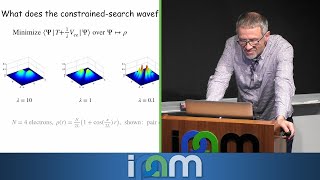
Fast Algorithm for the Strong-Interaction Limit of Density Functional Theory
Explore a novel algorithm for computing the strong-interaction limit in density functional theory, enhancing accuracy in modeling strongly correlated systems and overcoming computational challenges.

Twisted Transition Metal Dicalcogenides - Tests of Quantum Embedding and Theories
Explore quantum embedding theories and their application to twisted transition metal dicalcogenides, focusing on the Hubbard model and its relevance to experimental observations in materials science.
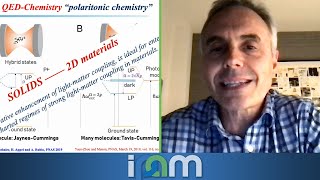
Polaritonic Quantum Materials: A First Principles QEDFT Perspective
Explore the potential of light-matter hybrid states to create new phases of matter, focusing on cavity-QED in 2D materials and introducing QEDFT as a predictive framework for light-matter interactions.
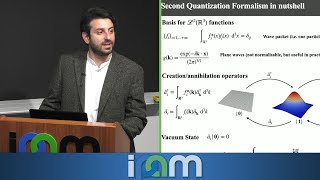
Field Theory Methods for Multiscale Description of Quantum Systems - IPAM at UCLA
Explore quantum field theory's role in multiscale phenomena, from fundamental interactions to condensed matter physics and biology. Learn about inequivalent Hilbert space representations and their applications.
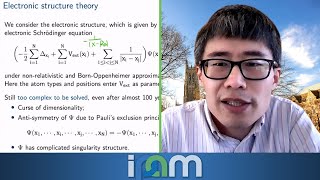
Mathematical Models of Electronic Structure - IPAM at UCLA
Explore mathematical models of electronic structure, focusing on quantum mechanics applications in materials science and chemistry, presented by Duke University expert Jianfeng Lu.
Christian Bogner: The Analytic Continuation of the Kite and the Sunrise Integral
Explores advanced Feynman integrals using elliptic generalizations of polylogarithms, discussing properties through periods of elliptic curves and the Picard-Lefschetz theorem.
6j-Symbols for SL(2,C) Group and Feynman Diagrams
Explore 6j-symbols for SL(2,C) group using Feynman diagrams, deriving Racah coefficients for infinite-dimensional unitary principal series representations and expressing results as complex integrals or Mellin-Barnes type sums.
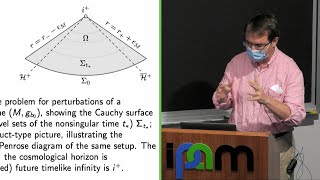
The Black Hole Stability Problem - IPAM at UCLA
Explore analytic and geometric tools for understanding black hole stability in Kerr-de Sitter and Kerr spacetimes, presented by Stanford's András Vasy at IPAM's Workshop on Mathematical Aspects of Gravitation.
A New Approach to the Binary Inspiral Problem - IPAM at UCLA
Explore modern scattering theory applications to gravitational wave calculations, focusing on advances in quantum scattering amplitudes and their relevance to binary black hole inspiral problems.
The Memory Effect and Infrared Divergences - IPAM at UCLA
Explores memory effect in gravitational radiation, infrared divergences in quantum field theory, and challenges in quantum gravity scattering. Discusses solutions and limitations in describing incoming/outgoing states.
Global Existence for a System of Wave Equations on a Product Space - IPAM at UCLA
Explore global existence for wave equations on product spaces, a model for Einstein equations with compact dimensions in Kaluza-Klein theory. Presented by Cécile Huneau at IPAM's gravitation workshop.
On Naked Singularities for the Einstein Vacuum Equations - IPAM at UCLA
Explore the construction of naked singularities in Einstein vacuum equations with Yakov Shlapentokh-Rothman, delving into cutting-edge research in mathematical aspects of gravitation.
Multi-Oscillating Boson Stars - IPAM at UCLA
Explore multi-oscillating boson stars in general relativity, examining their characteristics, frequencies, and comparisons to single-frequency configurations in this advanced physics presentation.