Quantum Field Theory of Exotic Systems - IPAM at UCLA
Explore quantum field theory of exotic systems, focusing on fracton phases and their challenges to conventional understanding. Delve into subsystem symmetries, tensor gauge theories, and peculiar UV/IR mixing phenomena.
Topological Defect Networks for Fracton Models - IPAM at UCLA
Explore topological defect networks in fracton models, covering fundamental concepts, excitations, and their implications in topological phases of matter.
Local Response in Bulk-Gapped Interacting Systems - IPAM at UCLA
Explore quantum Hall effect in thin Hall bars, interacting fermion systems' response to local perturbations, and adiabatic theorems for extended many-body systems with bulk gaps.
The Hartree-Fock Approximation and Its Generalizations - IPAM at UCLA
Explore Hartree-Fock approximation in quantum mechanics, covering accuracy, variational principles, generalizations, and symmetries. Gain insights into advanced theoretical concepts and applications.

Multiscale Approaches to Dispersion Modelling - IPAM at UCLA
Explore multiscale approaches to dispersion modelling, focusing on van der Waals physics in materials with one- or two-dimensional interactions and the challenges in mathematical techniques used to model them.
Message Passing Neural Networks for Atomistic Systems - Materials - IPAM at UCLA
Explore message passing neural networks for atomistic systems, focusing on thermal transport simulations and diffusion in materials science, with practical examples and convergence tests.
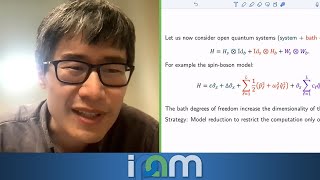
Taming the Dynamical Sign Problem in Diagrammatic Algorithms for Open Quantum Systems
Explore diagrammatic algorithms for open quantum systems, focusing on balancing dynamical sign problems and error amplification in numerical integration through partial resummation techniques.
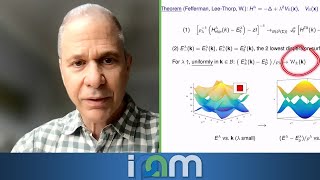
Discrete Honeycombs, Rational Edges and Edge States - IPAM at UCLA
Explore tight binding models, graphene edges, and edge states in quantum mechanics. Discover classifications, proofs, and formulas for zero energy states and dispersive edge curves.
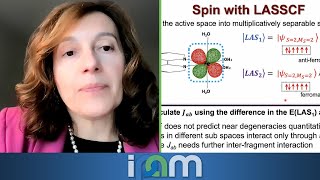
Localized-Wave-Function Methods in Quantum Chemistry and Their Extension to Quantum Computers
Explore localized wave-function methods in quantum chemistry, their applications to large systems, and potential extensions to quantum computing algorithms for improved efficiency and accuracy.
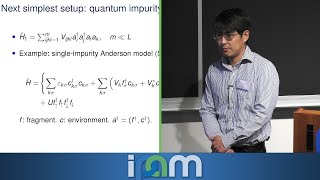
Quantum Impurity and Quantum Embedding Theory - IPAM at UCLA
Explore quantum impurity and embedding theories, from non-interacting systems to advanced concepts like DMET and DMFT, enhancing understanding of quantum many-body problems.
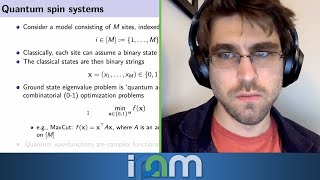
Quantum Embedding with Lower Bounds - IPAM at UCLA
Explore quantum embedding theories and optimization approaches for solving relaxations of many-body ground state problems, focusing on quantum marginals and impurity problems for fermions.
Post-DFT Green's Function Embedding - IPAM at UCLA
Explore post-DFT Green's function embedding for correlated solids, focusing on self-energy embedding theory (SEET) and its applications in molecular systems and periodic solids.
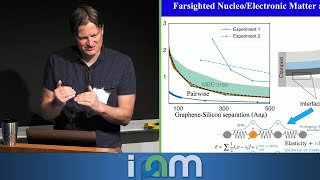
Multiscale Approaches to Quantum Mechanics - Vacuum, Atoms, Engineering-Scale
Explore multiscale quantum mechanics from vacuum to engineering structures, covering experimental evidence, theoretical models, and future research directions in this comprehensive lecture.
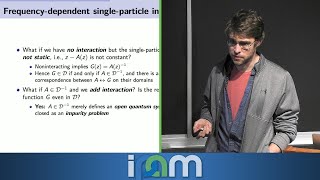
Many-Body Perturbation Theory and Green's Function Methods - IPAM at UCLA
Explore Green's functions and many-body perturbation theory in quantum physics, covering Feynman diagrams, self-energy, and applications like GW method and DMFT. Gain insights into mathematical structures and open problems.
A Mathematical Introduction to Quantum Embedding Theory - IPAM at UCLA
Explore quantum embedding methods for strongly-correlated materials, focusing on computational challenges at the single-particle level and recent optimization approaches.
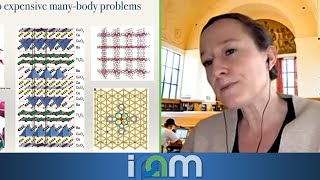
A Physical-Chemical Motivation Behind Quantum Embedding Theories - IPAM at UCLA
Explore quantum embedding theories, their physical motivations, and applications in many-electron problems. Learn about Green's function embedding and other approaches for accurate, controlled approximations.
Randomized Methods for Quantum Many-Body Problems - A Mathematical Primer
Explore randomized methods for quantum many-body problems, focusing on Monte Carlo techniques to approximate ground and excited states in large systems. Learn about VMC and FCIQMC algorithms.
Many-Body Perturbation Theory and Wavefunction Methods: A Physics Perspective
Explore many-body perturbation theory and wavefunction methods from a physics perspective, covering applications, multiscale modeling, and advanced quantum mechanics concepts.
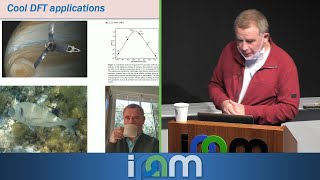
Elements of Electronic Structure Calculations - HF and DFT - IPAM at UCLA
Explore fundamental concepts of electronic structure calculations, including Hartree-Fock and Density Functional Theory, with insights on modern methodologies and applications in quantum mechanics.
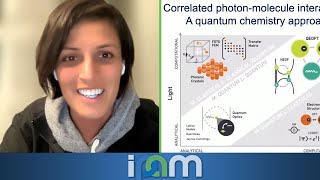
Ab Initio Quantum Chemistry Approaches to Nonequilibrium Interactions in Molecules
Explore ab initio quantum chemistry approaches for nonequilibrium interactions in molecules and materials, covering correlated photon-molecule interactions, molecular strong coupling, and polariton dynamics.
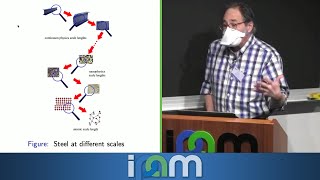
Mesoscale Models and Many-Body Systems - IPAM at UCLA
Explores mesoscale structures in many-body systems, explaining the autonomy of continuum equations and their connection to lower-scale physics, with implications for deep neural networks.