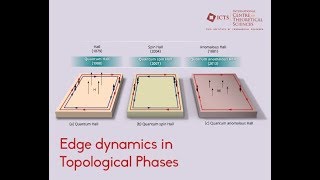
Theory of Disorder-Induced Half-Integer Thermal Hall Conductance by Mitali Banerjee
Explores disorder-induced half-integer thermal Hall conductance in fractional quantum Hall systems, focusing on experimental techniques, theoretical models, and implications for topological states of matter.
Metamaterials and Topological Mechanics - Lecture 2
Explores classical elasticity, free energy, and stress in metamaterials. Covers isotropic materials, Lame coefficients, and uniaxial crystals. Discusses forces and stresses in topological mechanical systems.
Universe or Multiverse? - Neutron Stars and Black Holes Lecture 14
Explore the universe's expansion, cosmic microwave background, and inflationary theories. Delve into cosmological phase transitions, gauge theories, and the concept of multiverses in this comprehensive lecture.
Metamaterials and Topological Mechanics - Lecture 1
Explore metamaterials and topological mechanics, focusing on engineered structures with unique properties like negative refraction and protected edge states. Learn about applications in optics and elasticity.
Phenomenology of the Quark Gluon Plasma by Rajeev Bhalerao
Explore the properties and behavior of Quark-Gluon Plasma in high-energy collisions. Learn about hydrodynamic models, lattice QCD, and recent developments in understanding this extreme state of matter.
Perturbative QCD for Colliders - Lecture 1
Comprehensive introduction to perturbative QCD for colliders, covering quantum chromodynamics, color theory, gluon fields, asymptotic freedom, and renormalization group equations with practical examples.
Neutron Stars and Black Holes - Recycled Pulsars - Lecture 10
Explore recycled pulsars, neutron star spin-up, and magnetic field evolution in binary systems. Gain insights into the Hulse-Taylor pulsar, accretion processes, and the physics of neutron star interiors.
Integrability in Planar AdS/CFT - Yangian Symmetry and Applications - Lecture 1
Explore Yangian symmetry in AdS/CFT correspondence, focusing on N=4 supersymmetric Yang-Mills theory and its applications to scattering amplitudes, correlation functions, and Wilson loops.
The QCD Axion - Lecture 1
Comprehensive lecture on QCD axions, covering theoretical foundations, strong CP problem, spontaneous symmetry breaking, and axion models. Explores potential solutions to dark matter mysteries.
Introduction to Primordial Black Hole Dark Matter - Lecture 2
Explore primordial black holes as dark matter candidates through gravitational wave detection, microlensing, and fast radio bursts. Discover constraints, observational prospects, and implications for cosmology.
Physics of Life by Vijaykumar Krishnamurthy
Explore the physics of living systems, focusing on soft condensed matter and emergent self-organization in cells and tissues. Gain insights into the fascinating intersection of physics and biology.

The Inflationary Paradigm by Nicola Bartolo
Explore the inflationary paradigm, its observational predictions, and implications for fundamental physics. Delve into non-Gaussianity, gravitational waves, and future observational strategies in cosmology.
Essential Cosmological Perturbation Theory by David Wands
Explore essential cosmological perturbation theory, from metric perturbations to gravitational waves, and its role in understanding cosmic structure and the early universe.
Statistical Mechanics of Developed Turbulence - Lecture 1
Explore turbulence through statistical mechanics, covering energy cascades, Kolmogorov's hypotheses, and connections to phase transitions. Learn about predator-prey dynamics in pipe flow and directed percolation in laminar-turbulent transitions.
Topology in Statistical Physics - Lecture 1
Explore topology's role in statistical physics, from Maxwell's equations to magnetic monopoles. Learn about topological quantum numbers and path integral formulation in this advanced lecture.
Statistical Physics of Rare Events and Large Deviations - Lecture 1
Explore statistical physics of rare events and large deviations, covering mathematical foundations, equilibrium concepts, coin toss problems, blackbody radiation, and applications in physics and beyond.
Nonequilibrium Response Theory - Lecture 1
Explore nonequilibrium response theory, covering fluctuations, linear response, and the fluctuation-dissipation theorem. Gain insights into equilibrium and dynamic responses in statistical physics.
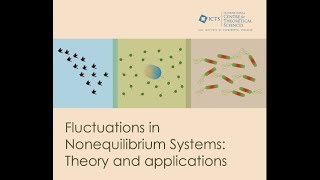
Motility-Regulation and Self-Organization in Active Matter by Julien Tailleur
Explore self-organization principles in active matter systems, from bacterial colonies to colloids. Learn about motility regulation, quorum sensing, and pattern formation in non-equilibrium physics.
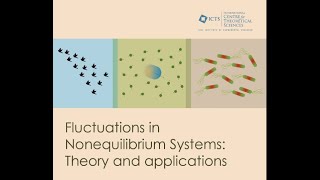
Mesoscopic Aspects of Classical Transport - Lecture 1
Explore mesoscopic aspects of classical transport, covering equilibrium models, time reversal, entropy, and non-equilibrium states. Gain insights into fluctuations in nonequilibrium systems and their applications.
Light and Beyond - Lecture 2: Optical Phenomena and Wave Propagation
Explore advanced concepts in optics, from electromagnetic waves to quantum physics, through lectures, demonstrations, and simulations. Gain insights into optical phenomena in nature and technology.
Light and Beyond - Lecture 1: Introduction to Optics and Geometrical Principles
Explore light as electromagnetic waves, optical phenomena, and underlying concepts through math, experiments, and simulations. Covers geometrical optics, least action principle, and introduces quantum physics.