Alloys - Artificial Intelligence and Scientific Computing for Fluid Mechanics
Explore the fusion of AI and scientific computing for predicting and controlling complex fluid systems, with insights on novel algorithms and the importance of interdisciplinary expertise.
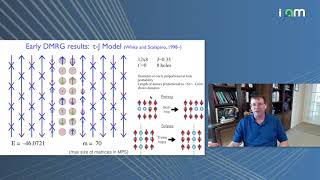
Phase Diagram of the 2D T-T'-J Model
Explore the phase diagram of the 2D t-t'-J model, including novel striped phases and coexistence of pairing and antiferromagnetic order. Gain insights into cuprate physics and superconductivity.
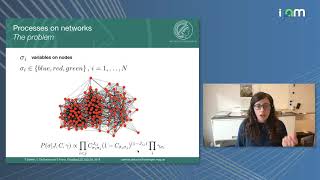
Matrix Product States for Modeling Dynamical Processes on Networks
Explore matrix product states and dynamic message-passing algorithms for modeling network dynamics, reducing computational complexity from exponential to polynomial in system size and duration.
Matrix Product States for Real Materials
Explore recent advances in combining MPS algorithms with DMFT and DFT to study strongly correlated materials, focusing on applications to transition metal and rare earth oxides.
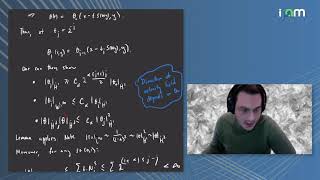
Anomalous Dissipation for Passive Scalars
Explore anomalous dissipation in hydrodynamic turbulence for passive scalars, examining a rough divergence-free velocity field and its connections to scalar turbulence theories and inviscid mixing.
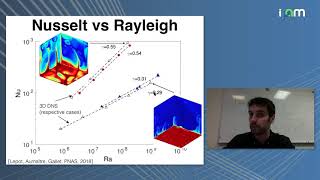
Heat Transport Efficiency Beyond the So-Called 'Ultimate' Regime
Explores innovative approaches to thermal convection, challenging traditional Rayleigh-Bénard models with radiative heating techniques to achieve more efficient heat transport in turbulent flows.
Polymer Partition Functions and the Geometric RSK Correspondence
Explore geometric RSK correspondence, polymer partition functions, and their connections to discrete Gibbs fields in this advanced mathematics lecture by Ivan Corwin.
Uncertainty-Aware Machine Learning Models of Many-Body Atomic Interactions
Explore symmetry-aware machine learning models for atomic interactions, focusing on E(3)-equivariant neural potentials and Bayesian force fields for improved accuracy in materials modeling.
Density Functional Theory - IPAM at UCLA
Comprehensive exploration of density functional theory, covering advanced concepts and applications in materials science, presented by Prof. Vikram Gavini at IPAM's exascale mathematics workshop.
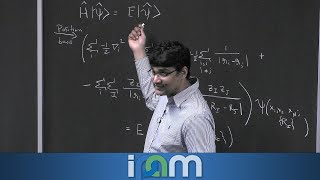
Density Functional Theory - IPAM at UCLA
Comprehensive introduction to density functional theory, exploring its principles and applications in materials science and computational physics.
Fully Quantum (Bio)Molecular Simulations: Dream or Reality?
Explore the convergence of quantum mechanics and machine learning in molecular simulations, addressing challenges and future developments for complex (bio)molecular systems.
Machine Learning for Scientific Discovery, with Examples in Fluid Mechanics
Explore machine learning for nonlinear dynamical systems modeling, focusing on the SINDy algorithm and its applications in fluid dynamics, with emphasis on interpretable and physics-respecting solutions.

Respiratory - Surface Tension and Surfactant in Alveoli
Explore surface tension and surfactant in alveoli, their impact on lung function, and related pathologies like infant respiratory distress syndrome in this comprehensive lecture.

Respiratory - Compliance & Elasticity
Explore factors influencing lung compliance and elasticity, including surface tension, lung elasticity, thoracic cage flexibility, and surfactant production. Learn about clinical scenarios where compromised elasticity leads to pathology.
Self-Force and Radiation Reaction in General Relativity - Lecture 1
Explore gravitational radiation from compact binaries, focusing on self-force and radiation reaction in general relativity. Learn about EMRIs, waveforms, and black hole perturbation theory.
Advanced Course in General Relativity - Lecture 2
Explore advanced general relativity concepts, including test particle equations, orbits, light behavior, and gravitational radiation in this in-depth lecture on theoretical physics.
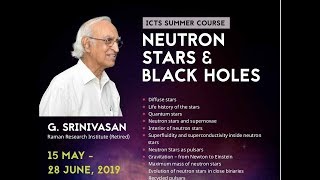
Einstein's General Theory of Relativity - Lecture 7
Explore Einstein's General Theory of Relativity, from its historical context to key concepts like the principle of equivalence, gravitational redshift, and field equations. Gain insights into this revolutionary theory of gravity.
How Well Do We Know Our Universe? by Jayant Narlikar
Explore the evolution of our understanding of the universe, from ancient ideas to modern cosmology, challenging current theories and advocating for alternative perspectives in astrophysics.
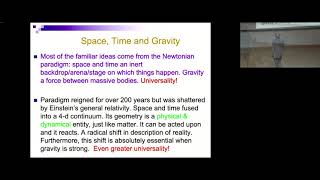
Big Bang, Black Holes & Gravitational Waves by Abhay Ashtekar
Explore the fascinating history and paradigm shifts in cosmology, black holes, and gravitational waves. Gain insights into scientific progress and learn valuable lessons for aspiring researchers.
Phase Transitions in Hard-Core Systems - Lecture 1
Explore phase transitions in hard-core systems, from basic concepts to advanced topics like fluid-solid transitions in hard spheres and phase changes in long rods. Includes theoretical foundations and computational approaches.
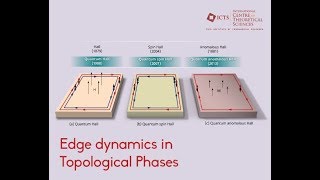
Introduction to Integer Quantum Hall Effect by Ganpathy Murthy
Comprehensive introduction to integer quantum Hall effect, covering classical Hall effect, Hamiltonian, Landau gauge, and conductivity equations. Includes gauge arguments and practical applications.