Data Access Monitoring Operator (DAMO) - User-Space Tool for Access-Aware Profiling and Optimization in Linux
Explore DAMON for efficient data access monitoring and optimization in Linux systems. Learn to use DAMO for profiling, tuning, and developing custom tools using Python.
Using Hardware Hints for Optimal Page Placement
Exploring hardware-provided memory access information for kernel optimization, focusing on NUMA balancing and hot page promotion using AMD EPYC's Instruction Based Sampling mechanism.
5 Steps to Deploy Cloud Native Sustainable Foundation AI Models
Explore deploying high-performance, energy-efficient AI foundation models on Kubernetes. Learn containerization, deployment, energy measurement, consumption reduction, and performance-energy tradeoffs.

Memoptimizer: Automated Memory Usage Monitoring and Optimization - Linux Foundation Session
Explore Memoptimizer, a tool that monitors and optimizes memory usage in systems, enhancing performance and efficiency through advanced techniques and kernel implementation.
Towards High-availability for Virtio-fs
Explore high-availability features for Virtio-fs, including crash recovery, request resubmission, and state preservation techniques to enhance virtual machine file system reliability.

Making CI/CD Builds Faster
Learn strategies to optimize CI/CD builds, including resource allocation, parallel processing, caching, and selective execution, to enhance development efficiency and productivity.
AI Model Efficiency Toolkit
Explore cutting-edge techniques for optimizing AI models with Qualcomm's toolkit, enhancing performance and efficiency in machine learning applications.

Optimizing a Ray Tracer by Building a Bounding Volume Hierarchy (BVH)
Optimize ray tracing performance by building a Bounding Volume Hierarchy (BVH). Learn techniques like GPU-friendly data structures, iterative traversal, and surface area heuristics to render complex scenes efficiently.
How Prometheus Halved Its Memory Usage
Discover how Prometheus significantly reduced its memory usage, enabling efficient monitoring of millions of metrics. Learn about data structures, profiling, and impacts on related projects.
Toolchain-Agnostic Build Time Improvements for Linux Kernel
Explore strategies for improving Linux kernel compile and build times, including header optimization, automated refactoring, and link-time de-duplication techniques.
Unified Compaction Strategy in Cassandra 5.0 - Key Features and Benefits
Discover Cassandra 5.0's Unified Compaction Strategy, solving existing deficiencies, improving performance, and offering easy reconfiguration. Learn about its flexible SSTable sharding and prioritization for enhanced read and write throughput.
Mastering Argo Workflows at Scale - A Practical Guide to Scalability Excellence
Practical strategies for scaling Argo Workflows, covering infrastructure optimization, resource management, workflow design, and observability. Learn from real-world experience handling 18,000+ pods per workflow.
Kubernetes SIG-Scheduling Introduction and Deep Dive
Explore Kubernetes kube-scheduler: functionality, customization, best practices for large clusters. Learn about ongoing SIG projects and latest developments in scheduling.
Scaling up Without Slowing Down: Accelerating Pod Start Time in Kubernetes
Explore techniques to optimize Kubernetes pod start times, addressing cold starts and scaling challenges. Learn about various approaches tailored to different workload types and system scales.

DAMON Updates and Plans - Automation of Tuning, Tiering, and VM Guest Scaling
Explore updates on DAMON, focusing on automated tuning, tiering, and VM guest scaling for enhanced memory management and system performance optimization.
Symbiosis: The Art of Application and Kernel Cache Cooperation - FAST '24
Explore Symbiosis, a framework optimizing key-value storage systems by dynamically configuring cache sizes. Learn how it improves performance across various workloads and environments.
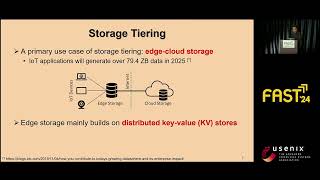
ELECT: Enabling Erasure Coding Tiering for LSM-tree-based Storage
Innovative distributed key-value store design combining replication and erasure coding for efficient data storage and access in tiered systems, balancing performance and storage savings.

DAMON: Implementing Self-Driven Data Access-Aware Efficient Linux System
Explore DAMON, a Linux kernel subsystem for efficient data access monitoring, and DAMO, its user-space tool. Learn about access-aware system operations and self-driving optimizations through live demonstrations.
Software Optimization for Early Linux Boot in Time-Critical Applications
Explore techniques for optimizing Linux boot process in automotive applications, focusing on multi-threaded bootloaders, kernel tuning, and driver optimization to meet stringent time requirements.
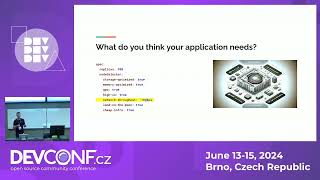
K8s Workload Autoscaling Performance Dimensions
Explore K8s workload autoscaling challenges, learn optimization strategies for CPU, memory, and network bandwidth, and discover solutions for efficient cloud cost management.

Tuning and Automating for Telco 5G Containerized Workloads
Optimize Kubernetes clusters for 5G workloads. Learn to deploy, tune, and manage distributed clusters using Red Hat products, focusing on performance and latency for Telco operators.