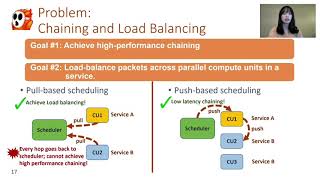
PANIC - A High-Performance Programmable NIC for Multi-tenant Networks
Explores Frenzy, a novel programmable NIC design with high-performance switching interconnect and hybrid push/pull packet scheduler, addressing limitations in multi-tenant networks and diverse offloads.
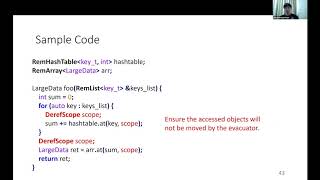
AIFM - High-Performance, Application-Integrated Far Memory
Explore AIFM, a high-performance system enabling efficient use of remote memory in datacenters. Learn about its API, runtime, and benefits for applications facing memory constraints.
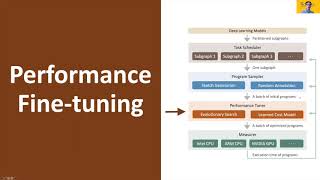
Ansor - Generating High-Performance Tensor Programs for Deep Learning
Ansor: A framework for generating high-performance tensor programs in deep learning, improving execution speed across various hardware platforms through innovative search strategies and optimization techniques.
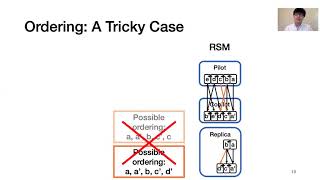
Tolerating Slowdowns in Replicated State Machines Using Copilots
Innovative consensus protocol for replicated state machines that maintains normal latency despite slowdown of any single replica, using pilot and copilot for redundancy and fast takeovers.
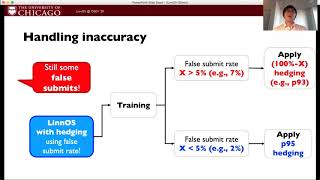
LinnOS - Predictability on Unpredictable Flash Storage with a Light Neural Network
Explore LinnOS, an OS using neural networks to predict SSD performance, enhancing storage application efficiency and outperforming industrial mechanisms with minimal overhead.
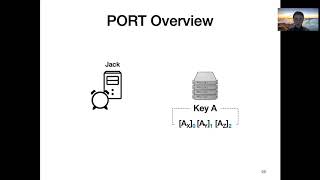
Performance-Optimal Read-Only Transactions
Explores performance-optimal read-only transactions in distributed storage systems, introducing PORT design with version clocks for improved consistency and efficiency in applications like Scylla-PORT and Eiger-PORT.
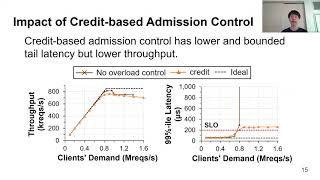
Overload Control for µs-scale RPCs with Breakwater
Overload control scheme for microsecond-scale RPCs, using server-driven admission control with credits based on queueing delay. Employs demand speculation and piggybacking to optimize performance.
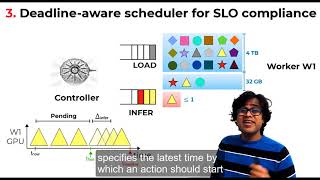
Serving DNNs like Clockwork - Performance Predictability from the Bottom Up
Explore a novel approach to machine learning inference systems that achieves predictable end-to-end performance, supporting thousands of models while meeting strict latency targets and request-level SLOs.
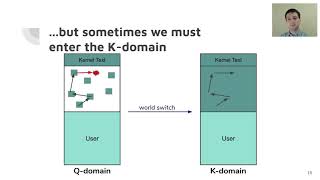
Efficiently Mitigating Transient Execution Attacks Using the Unmapped Speculation Contract
Explores efficient mitigation of transient execution attacks using the unmapped speculation contract, presenting Ward kernel design for improved performance without compromising security.
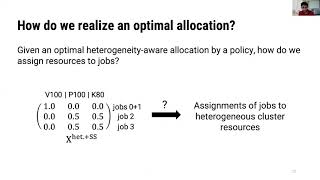
Heterogeneity-Aware Cluster Scheduling Policies for Deep Learning Workloads
Explores heterogeneity-aware scheduling for deep learning workloads, introducing Gavel to optimize resource allocation in clusters with diverse accelerators, improving efficiency and performance.
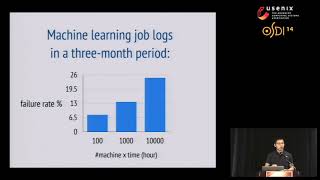
Scaling Distributed Machine Learning with the Parameter Server
Explore a framework for distributed machine learning using parameter servers, enabling scalable processing of petabyte-scale data with billions of examples and parameters across various algorithms.
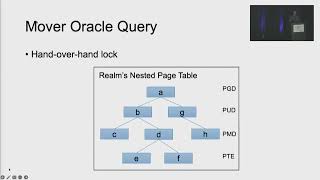
Design and Verification of the Arm Confidential Compute Architecture
Explores Realms, a new confidential computing abstraction protecting data privacy in virtual machines. Introduces novel verification techniques for secure firmware in complex, concurrent systems.
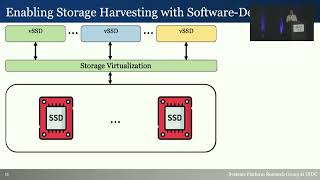
BlockFlex - Enabling Storage Harvesting with Software-Defined Flash in Modern Cloud Platforms
Explore BlockFlex, a learning-based framework for efficient storage harvesting in cloud platforms, enabling fine-grained resource utilization while ensuring performance and security isolation.
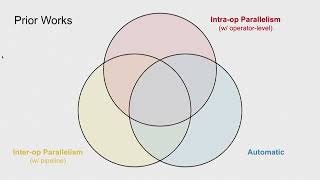
Alpa - Automating Inter- and Intra-Operator Parallelism for Distributed Deep Learning
Automating model-parallel training for large deep learning models through a hierarchical approach, unifying data, operator, and pipeline parallelism for efficient distributed execution.
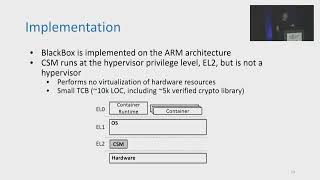
BlackBox - A Container Security Monitor for Protecting Containers on Untrusted Operating Systems
Innovative container security architecture using a trusted monitor to protect data confidentiality and integrity from untrusted operating systems, with minimal performance impact.
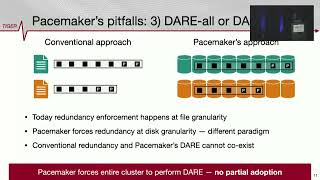
Tiger - Disk-Adaptive Redundancy Without Placement Restrictions
Innovative storage system that tailors redundancy to disk failure rates, offering space savings and improved robustness without placement constraints. Introduces eclectic striping for efficient data management.
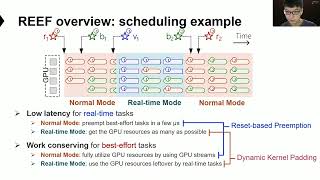
Microsecond-scale Preemption for Concurrent GPU-accelerated DNN Inferences
Innovative GPU scheduling system enabling microsecond-scale preemption for DNN inferences, improving real-time task latency and overall throughput in intelligent applications like autonomous driving and virtual reality.
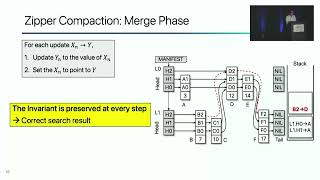
ListDB - Union of Write-Ahead Logs and Persistent SkipLists for Incremental Checkpointing on Persistent Memory
Explore innovative techniques for optimizing key-value stores on non-volatile main memory, addressing write stalls and improving performance through novel data structures and compaction methods.
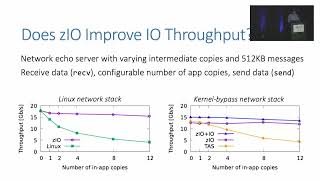
zIO - Accelerating IO-Intensive Applications with Transparent Zero-Copy IO
Explore zIO, a transparent zero-copy IO mechanism that enhances performance of IO-intensive applications by eliminating unnecessary data copies and optimizing data consistency management.
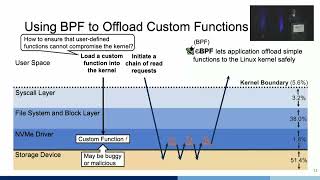
XRP - In-Kernel Storage Functions with eBPF
Explore XRP, a framework enabling user-defined storage functions in the NVMe driver using eBPF, bypassing kernel overhead for improved throughput and latency in microsecond-scale storage devices.

NrOS - Effective Replication and Sharing in an Operating System
Explores NrOS, a novel OS kernel using node replication for improved scalability and simplified development, outperforming Linux while maintaining sequential kernel simplicity.