
From Objects to Functions - Rethinking OOP Principles
Explore the journey from OOP to functional programming, challenging traditional coding principles for more modular and maintainable solutions.

Understanding DDD and Clean Architecture Through "The Three Little Pigs" - A Java Implementation
Explore DDD and Clean Architecture through "The Three Little Pigs" fairy tale, with Java code examples for practical implementation insights.
The Data Abstraction Talk
Explore data abstraction's impact on code design, information hiding, and software architecture across programming paradigms. Learn to balance visibility and encapsulation for better dependency management and API evolution.

Spring Modulith – Spring for the Architecturally Curious Developer
Explore architectural patterns and tools for building maintainable Spring applications, focusing on code organization, bean relationships, and domain events to enhance modularity and testability.
When Virtual Hell Freezes Over - Reversing C++ Code
Automated techniques for reversing complex C++ code, focusing on rebuilding inheritance, identifying templates, and tracing program flow to simplify the reverse engineering process.
How to Get Started With Functional Programming
Explore functional programming concepts and learn how to transition from object-oriented to functional paradigms for more reliable and readable code.
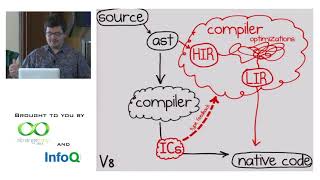
Building Optimising Compiler for Dart
Explore the development of Dart VM's new compilation pipeline, focusing on language features' impact and lessons from V8. Learn about JIT compiler design for object-oriented languages with optional static typing.
ATGP - radBIOS - Wireless Networking with Audio
Explore wireless networking using audio signals, covering PSK31 encoding, Fourier transforms, and data structures. Learn innovative techniques for airgap communication and content-addressable storage.
OO RE with HexraysCodeXplorer
Explore object-oriented reverse engineering techniques for modern malware analysis, focusing on C++ code reconstruction and tools like HexRaysCodeXplorer for tackling complex malware frameworks.
Threat Modeling With Architectural Risk Patterns
Explore efficient threat modeling using architectural risk patterns, emphasizing software-centric methods to enhance speed and consistency in identifying security risks across enterprise environments.
When Virtual Hell Freezes Over - Reversing C++ Code
Explore advanced C++ code reversing techniques, focusing on dynamic object creation, vtables, and multiple inheritance. Learn automated methods for efficient analysis.
Fractal Architecture
Explore fractal architecture to write more readable code. Learn encapsulation, aggressive thresholds, and referential transparency to improve software development productivity.
Exercises in Style
Explore diverse programming styles through one simple program, showcasing the richness of computational thought and its impact on large-scale systems design.
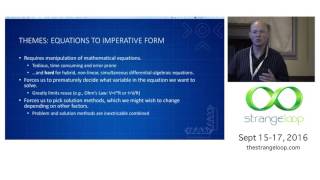
Modelica - Component Oriented Modeling of Physical Systems
Explore component-oriented modeling of physical systems using Modelica, a language for simulating complex devices in various industries. Learn about compilation processes and algorithms.
Designing Cypher - A Graph Query Language
Explore the journey of designing Cypher, a graph query language for Neo4j. Learn about language design principles, implementation challenges, and lessons learned in creating a specialized yet expressive tool.
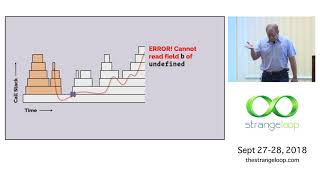
Contracts for Getting More Programs Less Wrong
Explore contracts in programming: preconditions, postconditions, and invariants. Learn to write correct algorithms, improve testing, and use tools like JML and C0 for better code quality.
Vertical Slice Architecture
Explore vertical slice architecture's benefits, patterns, and techniques for building maintainable systems. Learn to organize code around business functionality and adapt to different application types.
Functional Patterns for the Object Oriented
Explore functional programming patterns in OO languages, comparing Haskell approaches with traditional OO solutions. Learn about lambda expressions, stream processing, tuples, and pattern matching.
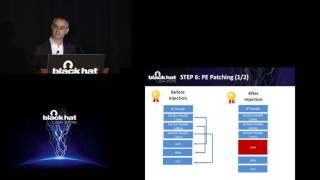
ROPInjector - Using Return Oriented Programming for Polymorphism and Antivirus Evasion
Explore advanced polymorphism techniques using Return Oriented Programming for antivirus evasion, with practical demonstrations of the ROPInjector tool and its effectiveness against detection methods.
Winning the Online Banking War
Explore advanced techniques to combat banking malware, including evasion methods and a novel Zero Knowledge Protocol-based approach for securing client-server communications.
Control Methods Like a Pro - A Guide to Ruby's Awesomeness
Explore Ruby's metaprogramming capabilities, focusing on method manipulation, from basics to advanced techniques. Learn to leverage method objects for enhanced code flexibility and power.