
Why p-adic Numbers Are Better Than Real for Representation Theory
Explore p-adic numbers and their application in representation theory, focusing on SL(2) group and nilpotent orbits in Lie algebra.
Weyl-Strength Subconvexity for Dirichlet L-Functions
Explore Weyl-strength subconvexity for Dirichlet L-functions, examining the subconvexity problem and progress on obtaining the Weyl exponent via the method of moments.
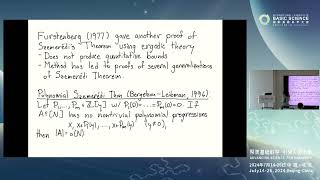
Quantitative Bounds in the Polynomial Szemerédi Theorem and Related Results
Explore quantitative bounds in polynomial Szemerédi theorem and related problems in additive combinatorics, harmonic analysis, and ergodic theory.
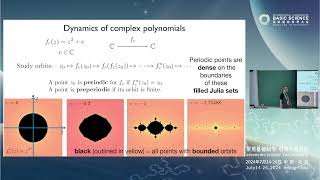
Rigidity and Uniformity in Algebraic Dynamics
Explore connections between algebraic dynamics and arithmetic geometry, focusing on preperiodic points and torsion points in abelian varieties. Learn about recent breakthroughs in uniform bounds and conjectures.
Symplectomorphism Invariants of Open Domains
Explore symplectomorphism invariants of open domains, focusing on zeta functions, Reeb dynamics, and equivariant symplectic homology to distinguish toric domains.
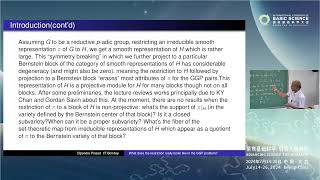
Homological Aspects of Branching Laws in p-adic Groups
Explore homological aspects of branching laws for p-adic group representations, focusing on restriction to subgroups and projective representations in Bernstein blocks.
Rectifiable-Reifenberg and the Regularity of Stationary and Minimizing Harmonic Maps
Explore sharp rectifiability results for singular sets of minimizing harmonic maps, with uniform Minkowski bounds and integrability. Analyze quantitative stratification and dimension-reduction techniques.
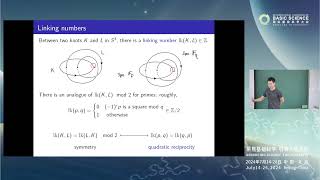
Structure in the Search for Structure - Algebraic Number Theory and Motivic Cohomology
Explore algebraic number theory through analogies between numbers and shapes, including quadratic reciprocity and linking numbers, leading to insights on Tate's 1966 conjecture.
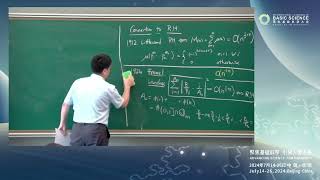
Dynamics of BCZ Cocycles and the Riemann Hypothesis
Explore the BCZ map's connection to Farey fractions, horocycle flow, and the Riemann Hypothesis. Gain insights into recent developments in BCZ cocycles and their dynamical implications.
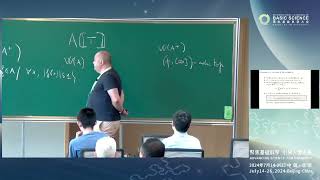
New Geometric Structures in the Langlands Program
Explore new geometric structures in the Langlands program, including the moduli space of G-bundles on the curve, and their role in constructing the semi-simple local Langlands correspondence.
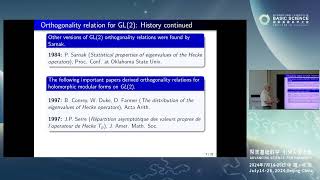
Asymptotic Orthogonality Relation for GL(n,R) - ICBS 2024
Explore generalized Dirichlet character orthogonality for GL(n,R), extending classical number theory to higher dimensions with applications.
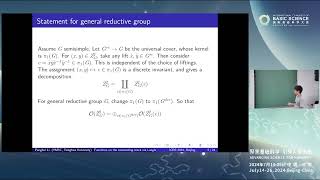
Functions on the Commuting Stack via Langlands Duality - ICBS 2024
Explore complex reductive group theory, analyzing cocenters of affine Hecke categories and calculating Whittaker object endomorphisms to derive formulas for commuting stacks.
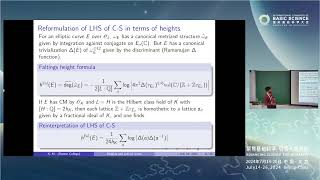
Average Heights of Abelian Varieties with Complex Multiplication
Explore the arithmetic properties of abelian varieties with complex multiplication, focusing on Colmez's conjecture and its implications for periods and L-functions.
Heights of Algebraic Cycles and Special Values of L-Series - ICBS 2024
Explore heights of algebraic cycles and their connections to L-series special values, focusing on CM points and Gross-Schoen cycles on elliptic curves.
Applications of Additive Combinatorics to Problems in Fractal Geometry
Explore applications of additive combinatorics in fractal geometry, focusing on self-similar sets with overlaps and recent advancements in the field.
Homogeneous Dynamics and Probabilistic Diophantine Approximations - Cauchy Limit Laws for Linear Forms
Explore homogeneous dynamics and probabilistic Diophantine approximations, focusing on Cauchy limit laws for linear forms with random coefficients and lattice counting problems.
Euler's Constant and Exponential Motives
Explore Euler's constant in exponential motives, examining its role in Q(-1) extensions and E-function differential equations.
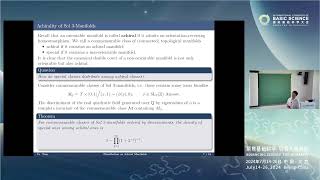
Distribution on Achiral Manifolds
Explore distribution of commensurable classes in geometric models, focusing on Sol and hyperbolic 3-manifolds. Delve into related number theory concepts and recent research findings.
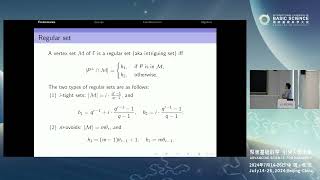
The Combinatorics of Finite Simple Groups - ICBS 2024
Explore the interplay between finite simple groups, combinatorics, and group theory, examining recent developments and introducing algebraic tools for geometric structures.
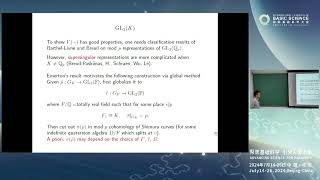
Multivariable (φ, Γ)-Modules and Local-Global Compatibility
Explore multivariable $(\varphi, \Gamma)$-modules, extending Colmez's construction to $\mathrm{GL}_2(K)$ representations and comparing with Galois representations in mod $p$ cohomology of Shimura curves.
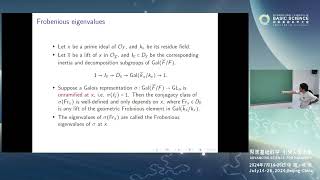
The Global Unramified Geometric Langlands Equivalence
Explore the global unramified geometric Langlands conjecture, its history, motivation, and recent proof, along with remaining open questions in the field.