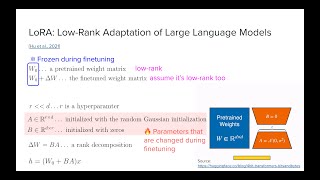
Parameter-Efficient Finetuning - QLoRA and LoRA Methods
Explore parameter-efficient fine-tuning techniques with LoRA and QLoRA, learning how to optimize large language models while maintaining performance and reducing computational costs.
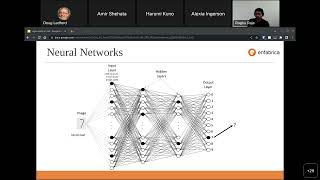
Designing Networking Stacks for Machine Learning Frameworks
Dive into networking stack design for machine learning frameworks, exploring challenges, solutions, and real-world applications through NCCL case studies and prototype implementations.
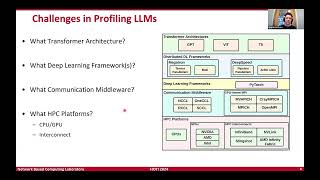
Demystifying the Communication Characteristics for Distributed Transformer Models
Explore communication patterns and optimization strategies for distributed transformer models, focusing on collective operations and performance characteristics in large-scale deployments.
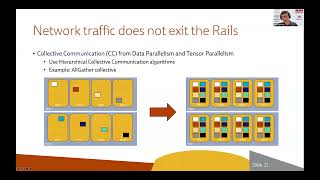
Rail-only: A Low-Cost High-Performance Network for Training LLMs with Trillion Parameters
Discover a groundbreaking network architecture designed for efficient training of large language models, optimizing performance while reducing infrastructure costs.
Rethinking Bias Mitigation: Fairer Architectures Make for Fairer Face-Recognition
Explore groundbreaking research on addressing bias in face recognition systems through neural architecture optimization, revealing how architectural choices impact fairness more than data preprocessing alone.
Neural Fine-Tuning Search for Few-Shot Learning
Explore advanced neural architecture search techniques for optimizing few-shot learning adaptation strategies, focusing on meta-training and meta-testing trade-offs in multi-domain contexts.
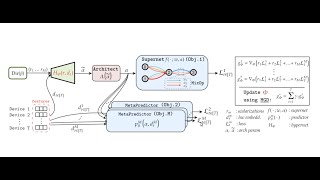
Multi-objective Differentiable Neural Architecture Search
Explore advanced techniques in neural architecture optimization across multiple objectives and hardware devices, focusing on Pareto front profiling and hypernetwork-based solutions.
Mixture-of-Supernets - Improving Weight-Sharing Supernet Training with Architecture-Routed MoE
Explore cutting-edge research on Mixture-of-Supernets architecture that enhances neural architecture search efficiency and improves BERT and MT model performance through innovative weight-sharing techniques.
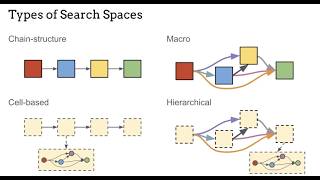
Searching for Neural Architectures from Fundamental Operations - An Introduction to einspace
Explore neural architecture search through einspace, a novel approach using fundamental operations to discover diverse and competitive network architectures for machine learning tasks.
Recently Engineered Variants of Split Learning - Seminar 87
Explore advanced variants of split learning techniques in federated systems, focusing on recent engineering developments and applications in distributed machine learning architectures.
The Future of Consumer Edge-AI Computing - Seminar 111
Explore the evolving landscape of consumer edge-AI computing with insights on emerging technologies, challenges, and future directions in mobile and distributed computing systems.
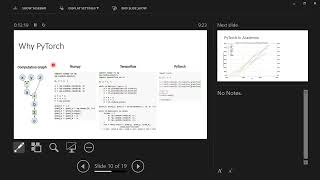
PyTorch Tutorial: Deep Learning Framework Fundamentals - Fall 2022
Master PyTorch fundamentals and deep learning concepts, from tensor operations to GPU acceleration, autograd, and data loading - all through hands-on coding examples and practical implementations.
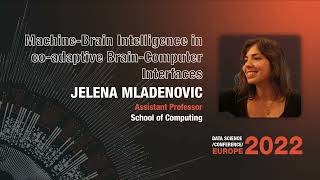
Machine-Brain Intelligence in Brain-Computer Interfaces - Understanding Neural Networks and Human Learning
Explore the symbiotic relationship between neural networks and brain-computer interfaces, discovering how machine and human learning combine to extend neural control to external devices.
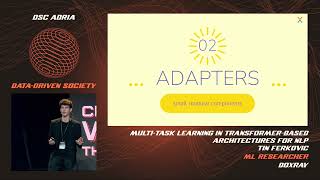
Multi-Task Learning in Transformer-Based Architectures for Natural Language Processing
Explore multi-task learning in transformers, covering adapter techniques, hypernetworks, and efficient solutions for training multiple NLP tasks with shared architectures and reduced computational costs.
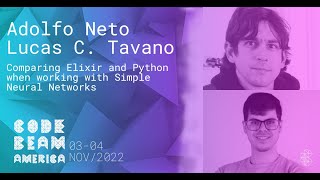
Comparing Elixir and Python for Simple Neural Networks
Compare Elixir's Nx library with Python's machine learning ecosystem for training neural networks. Explore development experiences and performance differences using MNIST and CIFAR-10 datasets.

Understanding and Using AI and Machine Learning 101
Explore AI and ML applications in business, focusing on Oracle's tools for database management, analytics, and generative AI. Learn about algorithms, AutoML, and the future of AI in various industries.
Use of Python for Cutting-Edge Language Model Research
Explore Python's role in cutting-edge language model research, focusing on mechanistic interpretability, causal interventions, and practical examples using interpretability libraries.
Superposition in LLM Feature Representations
Explore mechanistic interpretability and superposition in LLM feature representations, focusing on neural network qualities, linearity, and sparsity to uncover hidden features and improve model understanding.
Integrating -omic Data Across Datasets and Layers
Explore techniques for integrating -omic data across datasets and layers, focusing on redundancy, neural networks, and genetic associations in cancer research.
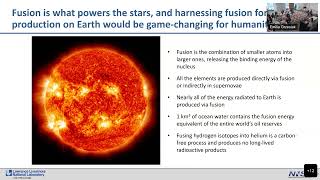
Machine Learning Applications in Scientific Problems with Sparse Data - Afternoon Address
Explore Dr. Kelli Humbird's career in data science, focusing on inertial confinement fusion and machine learning applications in scientific problems with sparse data.
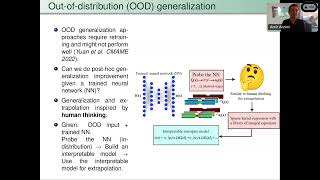
DDPS - A Flexible and Generalizable XAI Framework for Scientific Deep Learning
Explore a flexible XAI framework for scientific deep learning, enhancing interpretability and generalization in physics-based modeling through integral equations and sparse regression techniques.