
Neural Nets for NLP - Document Level Models
Explore advanced NLP techniques for document-level analysis, including coreference resolution, discourse parsing, and hierarchical neural networks for improved language understanding.
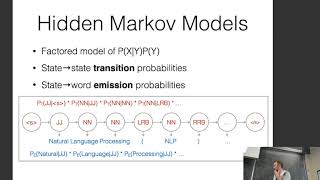
Neural Nets for NLP 2017 - Unsupervised Learning of Structure
Explore unsupervised learning methods for NLP, covering feature and structure learning, design decisions, and practical examples. Gain insights into advanced techniques for neural network-based language processing.
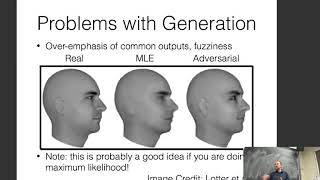
Neural Nets for NLP 2017 - Adversarial Learning
Explore adversarial learning in NLP, covering generative adversarial networks, feature vs. output adversaries, discrete outputs, and applications to language tasks.
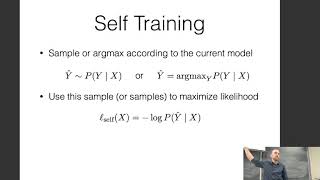
Neural Nets for NLP 2017 - Reinforcement Learning
Explore reinforcement learning for NLP, covering policy gradient, REINFORCE, value-based methods, and practical applications in dialogue systems and user simulators.

Neural Nets for NLP - Latent Variable Models
Explore latent variable models in NLP, covering variational autoencoders, discrete variables, and practical applications. Gain insights into generative modeling and advanced neural network techniques.
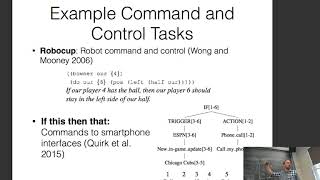
Neural Nets for NLP 2017 - Neural Semantic Parsing
Comprehensive lecture on neural semantic parsing, covering graph-based parsing, structured training, and dynamic programming methods for phrase structure parsing. Explores advanced NLP concepts and techniques.
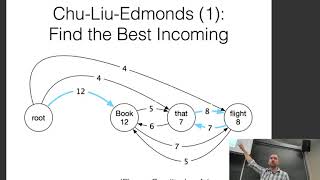
Neural Nets for NLP 2017 - Parsing With Dynamic Programs
Explore graph-based parsing, dynamic programming for phrase structure parsing, and neural network approaches in natural language processing. Covers algorithms, models, and practical implementations.
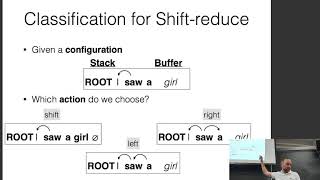
Neural Nets for NLP 2017 - Transition-Based Dependency Parsing
Explore transition-based dependency parsing, including shift-reduce parsing with feed-forward nets, stack LSTM, and linearized trees. Learn key concepts and techniques in neural network-based natural language processing.

Neural Nets for NLP 2017 - Attention
Comprehensive exploration of attention mechanisms in neural networks for NLP, covering various types, improvements, and applications, with a focus on the Transformer model.
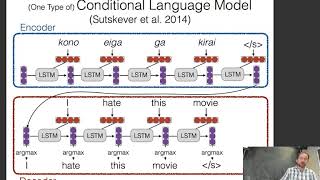
Neural Nets for NLP 2017 - Conditioned Generation
Explore encoder-decoder models, conditional generation, ensembling, and evaluation techniques for neural networks in natural language processing. Gain insights into advanced NLP concepts and practical applications.
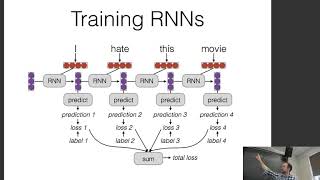
Neural Nets for NLP 2017 - Recurrent Neural Networks
Comprehensive lecture on recurrent neural networks, covering their architecture, challenges, and applications in NLP, with emphasis on LSTMs and practical implementation techniques.

Neural Nets for NLP 2017 - Convolutional Networks for Text
Comprehensive lecture on convolutional networks for text, covering bag-of-words, n-grams, applications, stacked and dilated convolutions, structured convolution, sentence pair modeling, and CNN visualization techniques.
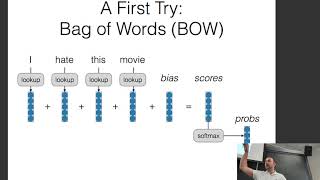
Neural Nets for NLP - Class Introduction & Why Neural Nets?
Introduction to neural networks for NLP, covering tasks, challenges, and potential solutions. Explores basic concepts, algorithms, and implementations using examples like sentence classification and continuous bag of words models.
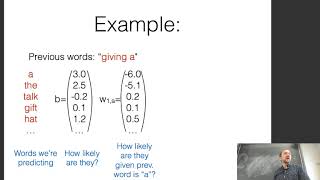
Neural Nets for NLP 2017 - A Simple Exercise - Predicting the Next Word in a Sentence
Explore word prediction techniques, including skip-grams, CBOW, and advanced word vector methods. Learn to describe, count, predict, evaluate, and visualize word relationships in natural language processing.
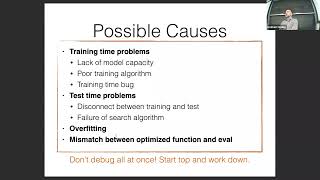
Advanced NLP: Interpreting and Debugging NLP Models
Learn advanced techniques for debugging and interpreting neural NLP models, including probing, attribution, and interpretable evaluation methods to enhance model performance and understanding.
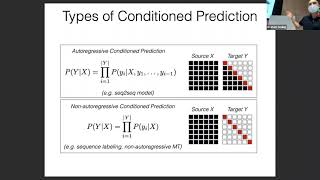
CMU Advanced NLP: Recurrent Neural Networks
Explore recurrent neural networks, LSTMs, and their applications in NLP, covering long-distance dependencies, prediction types, and optimization techniques for advanced language processing tasks.
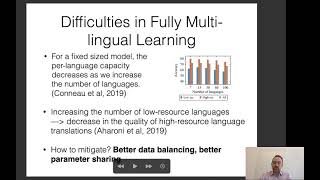
Neural Nets for NLP 2021 - Multilingual Learning
Explore multilingual learning in NLP, covering models, data balancing, parameter sharing, and cross-lingual transfer techniques for improved language processing across diverse languages.

Neural Nets for NLP - Models with Latent Random Variables
Explore neural network models with latent random variables for NLP, covering variational autoencoders, discrete latent variables, and their applications in language processing.
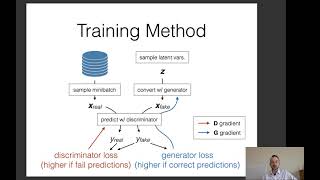
Neural Nets for NLP 2021 - Adversarial Methods
Explore generative adversarial networks, adversarial feature learning, and adversarial attacks in NLP. Learn cutting-edge techniques for robust and domain-invariant neural network models in natural language processing.
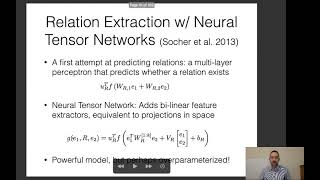
Neural Nets for NLP 2021 - Neural Nets + Knowledge Bases
Neural networks for knowledge bases: learning embeddings, incorporating KBs into models, and probing language models. Covers relation extraction, distant supervision, retrofitting embeddings, and open information extraction.
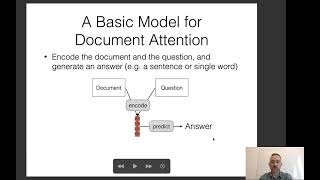
Neural Nets for NLP 2021 - Machine Reading with Neural Nets
Explore machine reading techniques for NLP, covering datasets, context encoding, multi-hop reasoning, and dataset limitations. Gain insights into advanced neural network applications in natural language processing.