Forecasting Weather with Neural Prophet and Python
Learn to forecast weather using Neural Prophet and Python. Preprocess data, train models, and generate accurate temperature predictions with this hands-on tutorial.
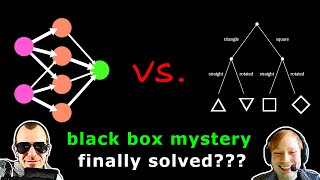
Neural Networks Are Decision Trees - With Alexander Mattick
Exploring the equivalence between neural networks and decision trees, discussing interpretability, computational advantages, and potential collaborations between the two approaches.
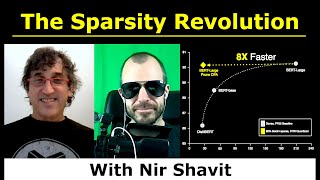
How to Make Your CPU as Fast as a GPU - Advances in Sparsity with Nir Shavit
Explore advances in sparsity and how CPUs can match GPU performance in neural networks. Learn about pruning, efficient algorithms, and the future of sparse architectures in deep learning.
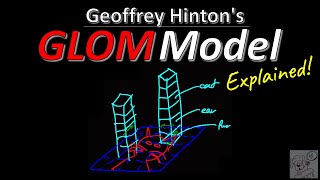
How to Represent Part-Whole Hierarchies in a Neural Network - Geoff Hinton's Paper Explained
Explore GLOM, a novel computer vision model combining transformers, neural fields, and capsule networks to dynamically construct parse trees for object recognition and scene understanding.
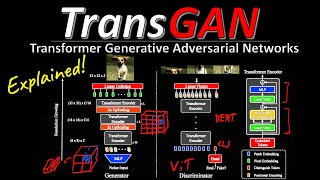
TransGAN - Two Transformers Can Make One Strong GAN - Machine Learning Research Paper Explained
Explore TransGAN, a novel approach using transformers for image generation. Learn about its architecture, key techniques, and competitive performance in various datasets.
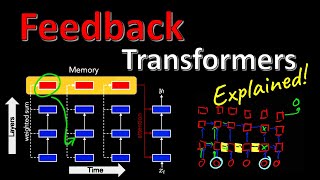
Feedback Transformers - Addressing Some Limitations of Transformers with Feedback Memory
Explores Feedback Transformers, an architecture that improves on standard Transformers by allowing higher-level representations to inform lower-level processing, enhancing performance on complex reasoning and long-range dependency tasks.
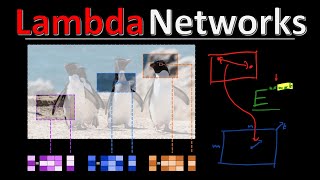
LambdaNetworks- Modeling Long-Range Interactions Without Attention
Explore LambdaNetworks, a novel approach to modeling long-range interactions in AI without traditional attention mechanisms, offering improved efficiency and performance in computer vision tasks.
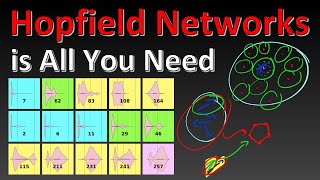
Hopfield Networks Is All You Need - Paper Explained
Explores the connection between Hopfield networks and transformer attention, analyzing BERT through this lens and applying Hopfield attention to immune repertoire classification.
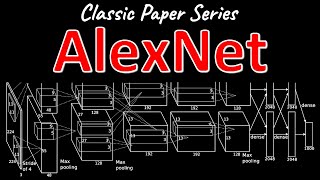
ImageNet Classification with Deep Convolutional Neural Networks - Paper Explained
Detailed explanation of AlexNet, the groundbreaking deep convolutional neural network that revolutionized computer vision and kickstarted the deep learning era in image classification.

Generative Adversarial Networks - Paper Explained
Explore the groundbreaking Generative Adversarial Networks paper, covering its innovative approach, theoretical foundations, and practical implications for AI-driven image generation and deep learning advancements.

Deep Residual Learning for Image Recognition - Paper Explained
Explore deep residual learning for image recognition, covering the problem of depth, residual connections, and their impact on neural network performance in computer vision tasks.
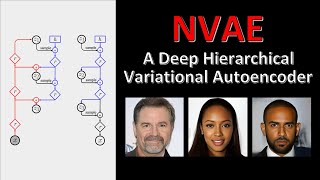
NVAE- A Deep Hierarchical Variational Autoencoder
Detailed explanation of NVAE, a deep hierarchical variational autoencoder for high-resolution image generation, covering architecture, training techniques, and state-of-the-art results.

Active Dendrites Avoid Catastrophic Forgetting - Interview With the Authors
Interview exploring how active dendrites in neural networks can mitigate catastrophic forgetting, enabling better multi-task and continual learning for AI systems in dynamic environments.
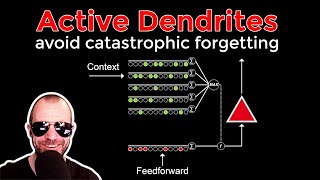
Avoiding Catastrophe - Active Dendrites Enable Multi-Task Learning in Dynamic Environments
Explore how active dendrites in neural networks mitigate catastrophic forgetting, enabling multi-task learning and adaptation in dynamic environments through context-sensitive gating and sparse representations.
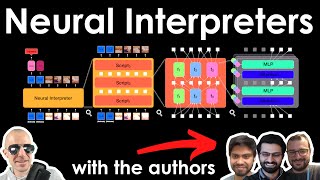
Dynamic Inference with Neural Interpreters - Interview with the Authors
Explore Neural Interpreters: a modular deep learning architecture for systematic generalization. Learn about its structure, function routing, and applications in image classification and abstract reasoning.
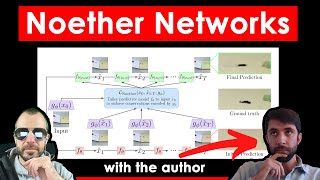
Noether Networks - Meta-Learning Useful Conserved Quantities
Explore Noether Networks: a novel approach to meta-learning conserved quantities in sequential prediction problems, inspired by Noether's theorem and aimed at discovering useful symmetries and inductive biases.
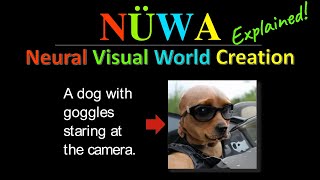
NÜWA - Visual Synthesis Pre-training for Neural Visual World Creation
Explore NÜWA, a unified multimodal model for visual synthesis tasks. Learn about its 3D transformer framework, 3D Nearby Attention mechanism, and applications in text-to-image/video generation and manipulation.
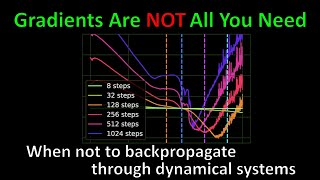
Gradients Are Not All You Need - Machine Learning Research Paper Explained
Explores limitations of differentiable programming in machine learning, focusing on chaos-based failures in various systems. Discusses alternatives to backpropagation for gradient estimation in complex, stochastic environments.
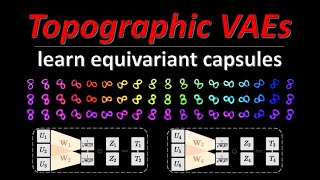
Topographic VAEs Learn Equivariant Capsules - Machine Learning Research Paper Explained
Explore Topographic VAEs: a novel approach to deep generative models with organized latent variables, bridging topographic organization and equivariance in neural networks for improved feature learning and transformation handling.
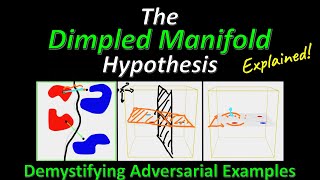
The Dimpled Manifold Model of Adversarial Examples in Machine Learning - Research Paper Explained
Explores the Dimpled Manifold Model to explain adversarial examples in machine learning, challenging existing theories and providing experimental evidence for a new perspective on neural network vulnerabilities.
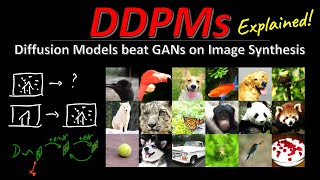
Diffusion Models Beat GANs on Image Synthesis - Machine Learning Research Paper Explained
Explore how Diffusion Models outperform GANs in image synthesis, with improved architecture, classifier guidance, and better sample quality while maintaining distribution coverage.