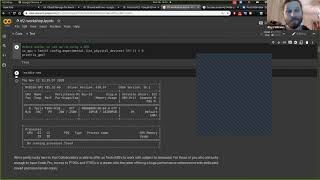
Introduction to TensorFlow - Hands-on Workshop
Explore TensorFlow through hands-on practice, completing an end-to-end tutorial to gain practical skills in building and deploying machine learning models.
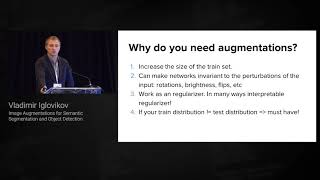
Semantic Segmentation in Satellite Imagery
Explore advanced techniques in deep learning for image segmentation and object detection, focusing on practical applications in autonomous driving.
A Cabinet of Deep Learning Curiosities - Unconventional Techniques and Overlooked Methods
Explore unconventional deep learning techniques, from obscure hacks to overlooked best practices, that have proven surprisingly effective in real-world projects.
Beating the Odds - Learning or Hallucinating? The Science of Data Today
Explore the intersection of data science, learning, and hallucination with insights from a renowned mathematician on current trends and challenges in the field.
Databricks Generative AI Fundamentals
Explore generative AI fundamentals, applications, and transformative potential in this deep dive session, focusing on practical use cases and market differentiation strategies.
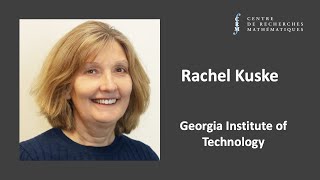
Is the World Smooth or Non-smooth? Mathematical Models in Dynamic Systems
Explore mathematical modeling approaches examining smooth vs non-smooth dynamics across climate, energy transfer, and neural systems, revealing insights into complex real-world phenomena.
In-Context Learning Over Graphs for Large Language Models - PRODIGY Method
Explore PRODIGY, Stanford's innovative approach to graph machine learning that enables in-context learning for classification tasks on unseen graphs, advancing LLM reasoning capabilities.
Deep Learning for Symbolic Mathematics
Explore neural networks for symbolic mathematics, covering expression generation, integration, ODEs, and dataset creation. Learn about sequence decoding and generalization techniques.
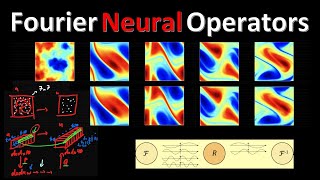
Fourier Neural Operator for Parametric Partial Differential Equations - Paper Explained
Explore a novel neural network architecture for solving partial differential equations efficiently. Learn about Fourier Neural Operators and their potential to revolutionize scientific computing and engineering simulations.

Thinking Better with Mathematics – With Marcus du Sautoy
Explore how calculus, geometry, and probability can simplify problem-solving in various fields. Learn about neural networks, efficient packing, and innovative shortcuts that have driven human progress throughout history.
Vector and Matrix Operations
Explore essential linear algebra concepts for neural networks: vectors, matrices, and operations like scalar manipulation, dot product, and matrix multiplication.
Bayesian Inference in Generative Models
Explore approximate Bayesian inference methods, including sampling-based techniques and variational inference, with hands-on exercises in implementing algorithms and using probabilistic programming languages.
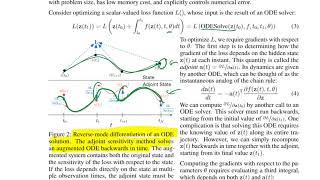
Neural Ordinary Differential Equations
Explore continuous-depth neural networks using differential equations, offering advantages in memory efficiency, adaptive evaluation, and numerical precision-speed tradeoffs for various machine learning tasks.
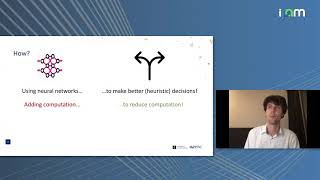
Deep Learning for Combinatorial Optimization - Count Your Flops & Make Your Flops Count
Explores deep learning for combinatorial optimization, focusing on reducing computation through learned models while balancing solution quality. Discusses practical examples, challenges, and future research directions.
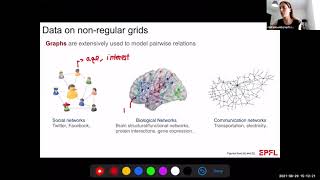
Simplicial Neural Networks
Explore simplicial neural networks, a generalization of graph neural networks for multi-dimensional data, and their applications in imputing missing data on coauthorship complexes.
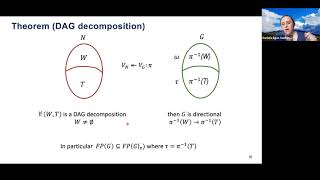
Nerve Theorems for Fixed Points of Neural Networks
Explore how network connectivity shapes neural activity using combinatorial threshold-linear networks. Learn about nerve theorems and their application in understanding fixed points of large neural networks.
Pawel Dlotko - A Few Simple Stories on Topology in Action
Explore practical applications of computational topology in material science, dynamical systems, and brain research. Learn how theory and algorithms work together to solve real-world problems.
Chad Giusti - Topology, Convexity, and Neural Networks
Explore topology in neuroscience, focusing on receptive fields, neuron convexity, and geometric features. Discover connections between neural networks and mathematical concepts.
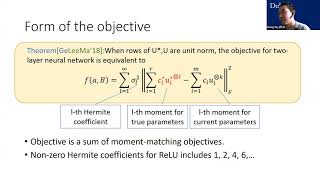
Beyond Lazy Training for Over-parameterized Tensor Decomposition
Explore over-parameterization in tensor decomposition, comparing lazy training and gradient descent approaches. Discover how gradient descent can leverage low-rank data structure beyond lazy training regimes.
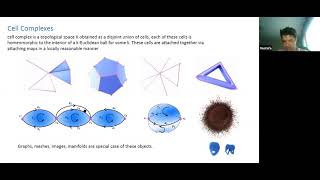
Cell Complex Neural Networks
Exploring neural network computations on cell complexes, generalizing graph neural networks and introducing inter-cellular message passing schemes that consider underlying topology.
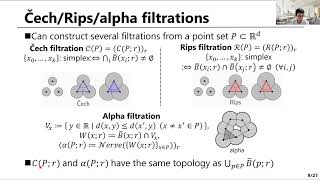
RipsNet- Fast and Robust Estimation of Persistent Homology for Point Clouds
Estimating persistence diagrams of point clouds using neural networks for faster, more robust topological analysis. Overcomes computational complexity and sensitivity to outliers in practical applications.