
The Quest for Adaptivity in Machine Learning - Comparing Popular Methods
Explore supervised learning algorithms' strengths and weaknesses, comparing k-nearest-neighbor, kernel methods, and neural networks for adaptivity and performance across various problems.

A Path Towards Autonomous Machine Intelligence
Explore Yann LeCun's vision for autonomous machine intelligence, delving into cutting-edge AI concepts and potential future developments in the field.
Rapture of the Deep: Highs and Lows of Sparsity in Neural Networks
Explore sparsity in neural networks, its role in interpretability, and innovative optimization techniques beyond gradient descent for learning fast transforms.
Perception of Visual Art and Topological Data Analysis
Explore topological data analysis applications in visual art perception, comparing eye movements for abstract paintings vs. AI-generated images using algebraic topology methods.

Learning with Missing Values: Theoretical Insights and Application to Health Databases
Explore theoretical insights and practical applications of learning with missing values in health databases, focusing on regression, classification, and neural network solutions.

Synthetic Data - Friend or Foe in the Age of Scaling?
Explore synthetic data's impact on AI scaling laws, model performance, and potential degeneration. Analyze theoretical frameworks and experimental findings for future AI development challenges.
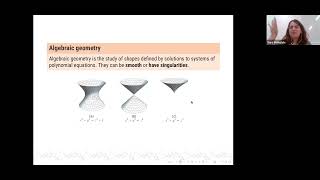
Machine Learning Detects Terminal Singularities in Q-Fano Varieties
Explore machine learning applications in algebraic geometry, focusing on Q-Fano varieties and terminal singularities detection. Gain insights into new combinatorial criteria and high-dimensional Q-Fano landscapes.
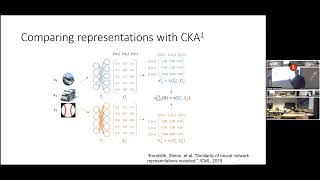
Comparing Representations Learned by Neural Networks - Deconfounded Similarity Measures
Explore improved methods for comparing neural network representations, addressing data structure confounding and enhancing functional similarity identification in transfer learning and out-of-distribution scenarios.
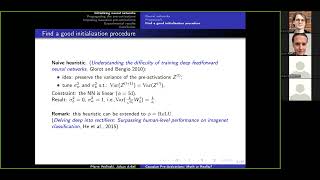
Gaussian Pre-Activations in Neural Networks: Myth or Reality?
Explore Gaussian pre-activations in neural networks, challenging common assumptions and proposing new initialization methods for improved information propagation in deep, narrow architectures.
Elucidating the Design Space of Diffusion-Based Generative Models
Explore advancements in diffusion-based generative models, including improved sampling, training, and score network preconditioning. Learn about state-of-the-art results and modular design changes for enhanced efficiency and quality.
HPC and AI/ML: A Synergistic Relationship
Explore synergies between HPC and AI/ML, focusing on scalable algorithms, efficient resource use, and data-driven models for performance optimization in large-scale computing environments.
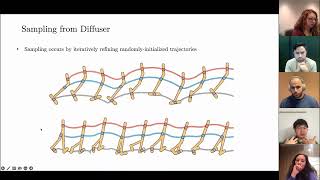
Planning with Diffusion for Flexible Behavior Synthesis
Learn flexible behavior synthesis using diffusion models for planning, exploring compositional trajectories, goal-directed planning, and offline reinforcement learning techniques.
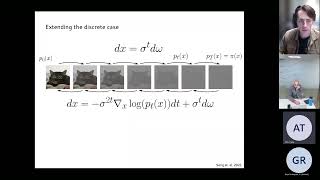
Hierarchically Branched Diffusion Models for Efficient and Interpretable Multi-Class Conditional Generation
Explore efficient and interpretable multi-class conditional generation using hierarchically branched diffusion models. Gain insights into advanced generative techniques.
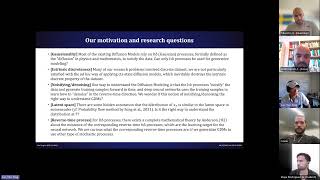
Blackout Diffusion: Generative Diffusion Models in Discrete-State Spaces
Explore generative diffusion models in discrete-state spaces through the innovative Blackout Diffusion approach, presented by researcher Yen Ting Lin.
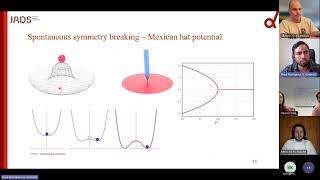
Spontaneous Symmetry Breaking in Generative Diffusion Models
Explore symmetry breaking in generative diffusion models, uncovering insights into their behavior and potential applications in AI and machine learning.
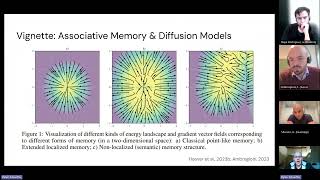
Bridging Associative Memory and Probabilistic Modeling
Explore the connection between associative memory and probabilistic modeling in this insightful presentation by Rylan Schaeffer.

Improving Pareto Front Learning via Multi-Head HyperNetwork
Explore multi-objective optimization and Pareto front learning through a novel Multi-head HyperNetwork architecture, improving solution quality for machine learning applications.

Backdoor Attacks and Defenses in AI Systems - Seminar Series
Explore backdoor attacks in AI systems, their impact on deep learning, and defense strategies against this emerging security threat.

Image Gradients for Understanding and Improving Neural Networks
Explore image gradients in neural networks to synthesize adversarial examples, visualize neurons, enhance robustness, interpret decisions, and improve image generators.

Mehler's Formula, Branching Processes, and Compositional Kernels of Deep Neural Networks
Explore deep neural networks through compositional kernels and branching processes. Gain insights into activation functions, network limits, and memorization capacity. Learn about eigenvalues and a new random features algorithm.

Explore the Sustainable Future of AI
Discover strategies for sustainable AI development, focusing on energy-efficient hardware, optimized algorithms, and renewable energy in data centers.