
LSTM Recurrent Neural Network In Depth Intuition
Gain in-depth intuition on LSTM Recurrent Neural Networks, exploring memory cells, operations, and layers for advanced understanding of this powerful deep learning architecture.

Transformers - From Zero to Hero
Comprehensive deep dive into transformer architecture, covering key concepts from self-attention to tokenization. Includes hands-on coding for both encoder and decoder implementations.

RWKV- Reinventing RNNs for the Transformer Era
Explore RWKV, a novel architecture combining Transformer and RNN strengths. Learn about its linear attention mechanism, scalability, and performance in NLP tasks.
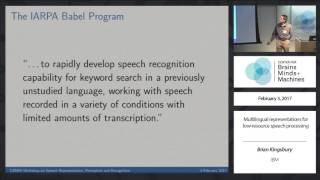
Multilingual Representations for Low-Resource Speech Processing
Explore multilingual speech representations to reduce data requirements for new language speech recognition systems, focusing on low-resource scenarios and keyword search performance.

Self-Driving from Vision Only - Tesla's Self-Driving Progress by Andrej Karpathy - Talk Analysis
Analysis of Tesla's vision-only self-driving progress, discussing data labeling, edge-case sampling, neural network training, and the advantages of camera-only systems over multi-sensor approaches.
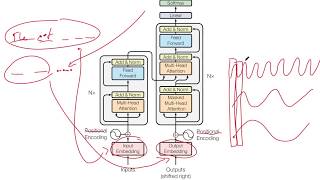
Attention Is All You Need
Explore the groundbreaking Transformer architecture, revolutionizing sequence transduction with attention mechanisms. Learn its superior performance in machine translation and generalization to other NLP tasks.
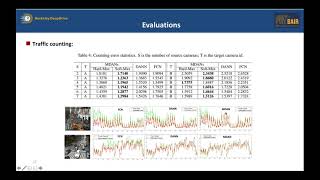
Learning with Limited Labels - ODSC West 2020
Explore advanced techniques for machine learning with limited labeled data, including domain adaptation, few-shot learning, and self-supervised learning to enhance model performance across diverse domains and novel categories.
Recurrent Neural Networks Explained Easily
Explore Recurrent Neural Networks: architecture, time series, and Back Propagation Through Time. Learn about simple RNN units and their applications in sequence processing tasks.
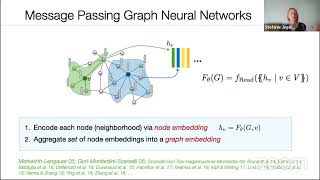
Theory of Graph Neural Networks: Representation and Learning
Explore the theory behind Graph Neural Networks, covering approximation, learning properties, and connections to graph isomorphism, equivariant functions, and dynamic programming.
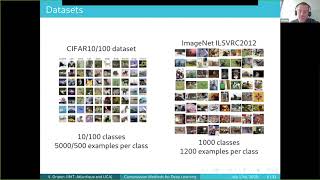
A Review of Compression Methods for Deep Convolutional Neural Networks
Explore compression techniques for Convolutional Neural Networks, including pruning, distillation, and quantization, to optimize deployment on tinyML devices without compromising accuracy.
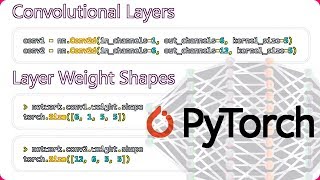
CNN Weights - Learnable Parameters in PyTorch Neural Networks
Explore PyTorch's inner workings, including OOP concepts, convolutional and linear layer weight tensors, and matrix multiplication for deep learning in neural networks.

Build PyTorch CNN - Object-Oriented Neural Networks
Learn to build a convolutional neural network using PyTorch for computer vision and AI applications. Gain hands-on experience in implementing object-oriented neural network architectures.
Basic Aspects of Convolutional Neural Networks - Tutorial
Explore fundamental concepts of convolutional neural networks in this tutorial, covering key principles and applications in deep learning for image processing and pattern recognition.

The Physics of Associative Memory - Exploring Hopfield Networks
Explore Hopfield networks, a foundational model of associative memory in neuroscience and machine learning. Learn about network architecture, inference, learning, and limitations.
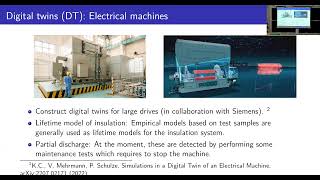
Learning Port Hamiltonian Structures Using PINNs Architecture
Explore innovative techniques for learning Port Hamiltonian structures using Physics-Informed Neural Networks, enhancing understanding of dynamical systems and machine learning applications.

Basic Aspects of Convolutional Neural Networks - Tutorial
Explore fundamental concepts of convolutional neural networks, their architecture, and applications in deep learning. Gain insights into this powerful technique for image and pattern recognition.
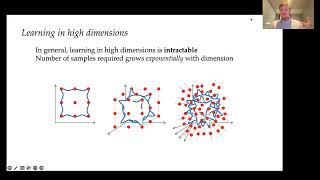
Geometric Deep Learning - Graph Neural Networks and Differential Equations
Explore Graph Neural Networks, symmetry principles, and connections to differential equations, geometry, and topology in this comprehensive introduction to Geometric Deep Learning.
Deep Learning on Disassembly
Explore deep learning techniques applied to disassembly for malware identification, covering the process from raw binaries to model training and evaluation against active malware feeds.
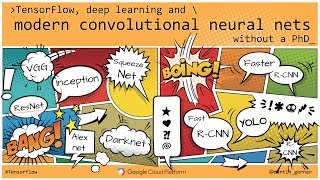
Tensorflow, Deep Learning and Modern Convolutional Neural Nets, Without a PhD
Explore modern convolutional neural networks and deep learning with TensorFlow. Learn practical tips, engineering best practices, and recent advances in image recognition without needing a PhD.
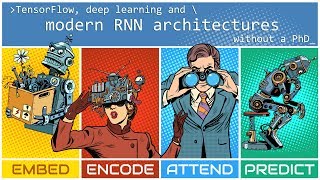
Tensorflow, Deep Learning and Modern RNN Architectures - Without a PhD
Explore modern RNN architectures and deep learning techniques for image recognition, natural language processing, and reinforcement learning. Gain practical tips and engineering best practices for applying these advanced technologies.
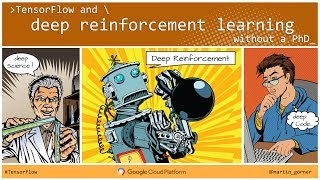
Tensorflow and Deep Reinforcement Learning, Without a PhD
Explore TensorFlow and deep reinforcement learning, covering neural network architectures, recent advances, and practical applications in image recognition, NLP, and AI game-playing.