
Strategic Deviations in Multi-Agent Imitation Learning: From Value Optimization to Regret Analysis
Delve into the complex dynamics of multi-agent AI systems, exploring strategic deviations, regret gaps, and equilibrium concepts in imitation learning through practical applications and mathematical frameworks.
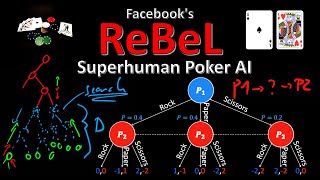
ReBeL - Combining Deep Reinforcement Learning and Search for Imperfect-Information Games
Explores ReBeL, an AI framework combining reinforcement learning and search for imperfect-information games. Explains its application to poker, convergence to Nash equilibrium, and superhuman performance with minimal domain knowledge.
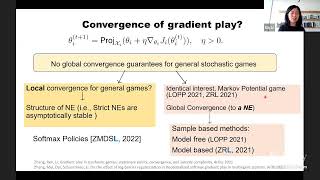
Learning Decentralized Policies in Multiagent Systems - How to Learn Efficiently
Explore decentralized policy learning in multiagent systems, focusing on scalable actor-critic methods, network structures, and performance characterization using stochastic game frameworks.

V-Learning - Simple, Efficient, Decentralized Algorithm for Multiagent RL
Explore efficient decentralized algorithms for multiagent reinforcement learning, focusing on V-learning's ability to overcome challenges in joint action spaces and achieve Nash equilibria.
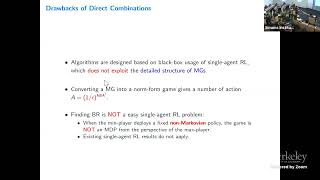
Multi-Agent Reinforcement Learning - Part I
Explore multi-agent reinforcement learning, covering game theory, interaction protocols, and Nash equilibrium. Gain insights into challenges and formulations in this emerging field.
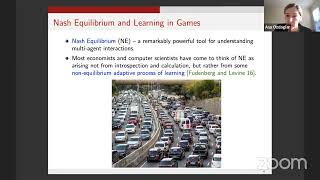
Independent Learning Dynamics for Stochastic Games - Where Game Theory Meets
Explore independent learning dynamics in stochastic games, bridging game theory and reinforcement learning. Discover convergent algorithms for multi-agent scenarios in dynamic environments.
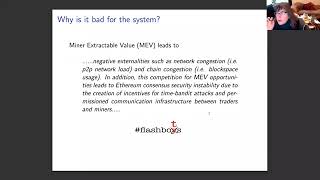
Flash Loans, Miner Extractable Value and Efficient Settlement - Joint with Alfred Lehar
Explore flash loans, miner extractable value, and efficient settlement in blockchain systems. Gain insights into decentralized finance challenges and potential solutions.

Should I Pay or Should I Go? Game Theory and Ransomware
Explore game theory concepts applied to ransomware decision-making, analyzing incentives, payoffs, and rational choices to understand the complexities of cybersecurity responses.
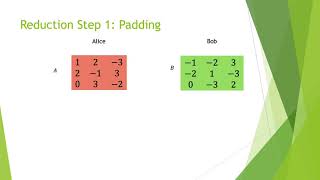
Smoothed Complexity of 2-player Nash Equilibria
Explore smoothed complexity in 2-player Nash equilibria, covering algorithmic hardness, approximation challenges, and novel approaches to finding equilibria in perturbed games.
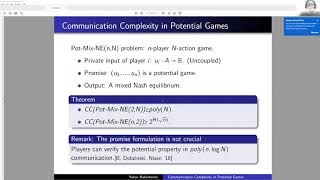
Communication Complexity of Nash Equilibrium in Potential Games
Explore communication complexity in potential games, focusing on Nash equilibrium, congestion games, and proof structures for hardness results.
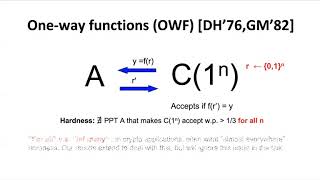
Is it Easier to Prove Statements that are Guaranteed to be True?
Explore the intricacies of proving statements in computational complexity, focusing on worst-case vs. average-case hardness and the challenges in NP-Search problems.
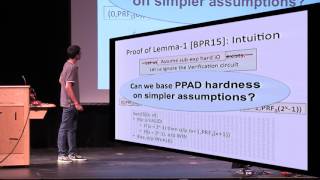
Revisiting the Cryptographic Hardness of Finding a Nash Equilibrium
Explore the cryptographic challenges in finding Nash Equilibrium, examining recent developments and implications for game theory and computational complexity.

Min LQG Games and Collective Discrete Choice Problems in Decision Making
Explore linear quadratic Gaussian games and their applications in social choice dynamics, election patterns, and micro-robotic exploration through mathematical modeling and Nash equilibria analysis.
A General Tractable Differential Game Framework - Climate Policy Applications Between Global North and South
Explore a differential game framework analyzing climate policy negotiations between global north and south, examining Nash and Stackelberg equilibria outcomes and their implications for emissions control.

Self-Play in Artificial Intelligence - Lecture by Noam Brown
Explore advanced AI techniques in imperfect-information games, focusing on self-play algorithms and their applications in poker and beyond.
Introduction to Artificial Intelligence - Game Theory - Lecture 9
Explore game theory concepts and applications in AI, focusing on advanced strategies and decision-making in multi-agent environments.

Competitive Physics Informed Networks - Overcoming Limitations in PDE Solutions
Explore competitive physics-informed neural networks for solving PDEs with unprecedented accuracy. Learn about adversarial approaches and zero-sum games to achieve single-precision accuracy in numerical simulations.
Introduction to Artificial Intelligence - Game Theory Part 1 - Lecture 8
Explore game theory fundamentals and its applications in AI, focusing on strategic decision-making and problem-solving techniques in competitive environments.
Introduction to Artificial Intelligence: Game Theory and Matrix Games - Lecture 8
Explore game theory fundamentals and matrix games in AI, covering key concepts and strategies for problem-solving in competitive environments.

From Smith's Invisible Hand to Distributed Optimization and Control
Explore how economic theory's "invisible hand" concept applies to distributed control systems, optimization algorithms, and machine learning through innovative mathematical frameworks.

Why Do We Hesitate to Take Risks? | Dan Ariely | TEDxHM
Behavioral economist Dan Ariely, the author of Predictably Irrational, argues that in many areas of our lives we are too apprehensive of downside consequences and therefore don't take enough risks. After making this point, he suggests a few ways that could help us integrate more risk so that we can