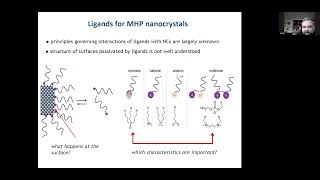
Нанокристали свинцево-галогенідного перовскіту як колоїдні наноточки: теорія, комп'ютерні симуляції та застосування
Dive into the theoretical physics and computer simulations of lead-halide perovskite nanocrystals as colloidal quantum dots, exploring their properties and practical applications.
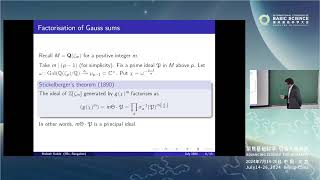
Mathematical Theories for Metamaterials: From Condensed Matter Theory to Subwavelength Physics
Explore mathematical theories for metamaterials, bridging quantum and classical physics to revolutionize nanotechnology and subwavelength wave manipulation.
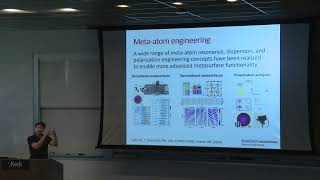
Metasurface Design for Exoplanet Exploration
Explore nano-engineering advancements in metasurfaces for exoplanet discoveries with Stanford's Jonathan Fan, discussing cutting-edge applications in space exploration.
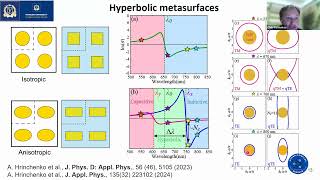
Engineering Resonant Metasurfaces for Photonic Applications
Explore engineering approaches for resonant metasurfaces in photonics. Learn about 2D nanostructures, their applications, and novel design methods for enhanced light-matter interactions and specific optical functionalities.

Graphene: A 2D Nanomaterial
Explore graphene's unique properties and applications as a 2D nanomaterial, uncovering its potential in various fields of science and technology.
Separation of Cellulose Nanocrystals from Natural Fibers Using Ionic Liquids
Explore innovative techniques for extracting cellulose nanocrystals from natural fibers using ionic liquids, presented by Prof. Silvana Mattedi.
Dissipative Self-Assembly of Colloidal Dispersions
Explore dissipative self-assembly in colloidal dispersions with Prof. Eric Furst, delving into cutting-edge research and insights from the University of Delaware.
Emergence of Mesomorphology from Molecular Ordering: Faceted Nanocrystals and Porous Clathrate Hydrates
Explore molecular ordering in faceted nanocrystals and porous clathrate hydrates, examining mesomorphology emergence and its implications.
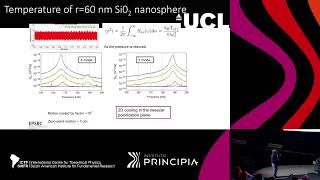
Characterizing and Calibrating Levitated Nano-Mechanical Systems for Sensing
Explore nano-mechanical systems for sensing through levitation techniques. Learn characterization and calibration methods for advanced quantum sensing applications.
Generalized Density Profiles in Single-File Systems
Explore single-file transport and bath-tracer correlations in confined systems, focusing on the Symmetric Exclusion Process and its applications to non-equilibrium situations.
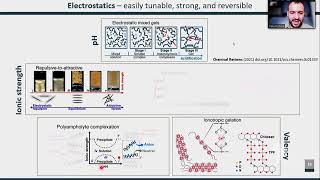
Supramolecular Assembly of Nanostructured Biomass
Explore supramolecular assembly techniques for nanostructured biomass, focusing on advanced applications and sustainable material development.
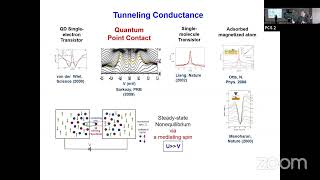
Gate-Voltage-Driven Quantum Phase Transition in Quantum Point Contacts
Explore gate-voltage-driven quantum phase transitions in quantum point contacts, focusing on localized spin formation, symmetry breaking, and Kondo coupling effects on tunneling conductance.
Semiconductor Spin Qubits for Quantum Networking
Explore semiconductor spin qubits for quantum networking, focusing on state conversion between photons and electron spins in quantum dots, and their potential for quantum repeaters and global quantum networks.
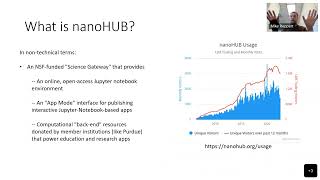
Hands-on Teaching with Jupyter Notebooks on nanoHUB
Explore hands-on teaching using Jupyter Notebooks on nanoHUB for chemistry courses. Learn to create interactive simulations, visualizations, and programming projects for enhanced student engagement and learning.
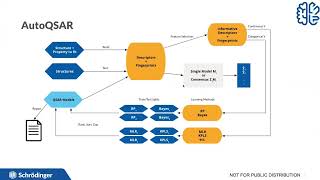
Machine Learning Models for Ionic Conductivity with Schrödinger's AutoQSAR - Hands-On Workshop
Explore machine learning for ionic conductivity prediction using Schrödinger's AutoQSAR tool. Gain hands-on experience with MS Maestro interface to create and implement models for materials science applications.

An Artist's Guide to Using Nanite Tessellation in Unreal Engine 5.4
Explore new Nanite features in UE 5.4, learn best practices for building efficient Nanite meshes, and optimize memory usage in this artist-focused guide to advanced tessellation techniques.

Budgeting in a Post-Polycount World - Unreal Engine 5.2 Workflows and Best Practices
Explore modern game development budgeting, focusing on Unreal Engine 5.2 workflows, memory management, and cutting-edge technologies for optimal performance and visual fidelity.
Optimizing UE5 - Advanced Rendering, Graphics Performance, and Memory Management
Dive deep into debugging Nanite, Lumen, and VSM performance issues in UE5. Learn memory management techniques for new graphics features and leverage virtual texturing for optimal performance.
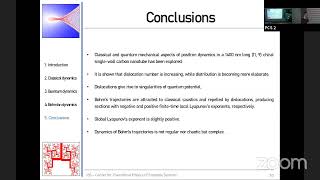
The Complexity of Bohmian Positron Dynamics Inside a Chiral Carbon Nanotube
Explore Bohmian positron dynamics in chiral carbon nanotubes, analyzing classical and quantum treatments, phase singularities, and complex trajectory behaviors.
Let's Talk Python: How to Program a Computer - From Fundamentals to Python Basics
Learn Python programming from scratch: explore computer basics, coding fundamentals, and essential Python concepts like variables, loops, and data manipulation using Jupyter notebooks on nanoHUB.
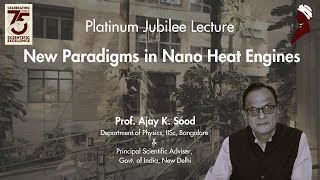
New Paradigms in Nano Heat Engines
Explore groundbreaking research in single-particle heat engines, their mesoscopic behavior, and innovative approaches to enhance efficiency through engineered system-bath interactions and bacterial reservoirs.