Latest Developments at chipshub and nanoHUB
Explore new AI, data, and EDA tools on nanoHUB and chipshub, plus Birck Nanotechnology Center's experimental data visualization and modeling resources.
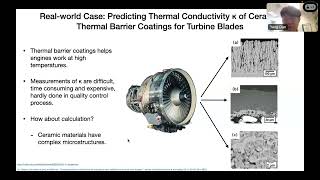
Introduction to Finite Element Analysis of Material Microstructure Properties in nanoHUB
Explore finite element analysis for material microstructures using OOF2. Learn FEA fundamentals, simulate stress distributions, and discover its applications in materials engineering and education.
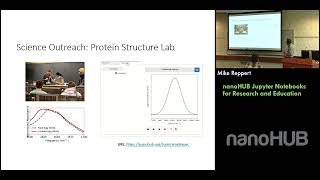
NanoHUB Jupyter Notebooks for Research and Education in Chemistry
Explore nanoHUB Jupyter Notebooks for creating chemistry teaching applications. Learn about tools for simulating proteins, analyzing lab data, and studying molecular spectroscopy. Discover how to develop and share scientific software effectively.
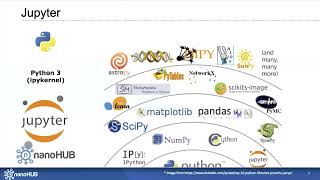
A Guided Tour of Interactive Jupyter Notebooks Powered by nanoHUB
Explore interactive Jupyter Notebooks on nanoHUB. Learn fundamentals, develop code, analyze data, create visualizations, and build GUIs using Jupyter widgets and nanohub-uidl library.
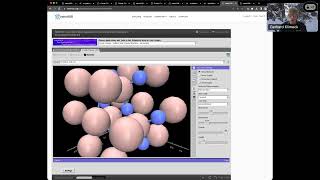
ABACUS Tool Suite Overview and Crystal Structures - Fall 2023
Explore semiconductor crystal structures using the ABACUS tool suite, focusing on visualization, symmetry, and surface properties of silicon crystals.
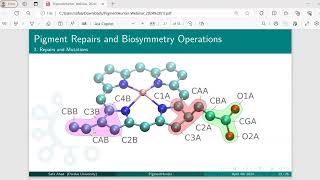
Building a Graphical Interface for Exploring Protein Dynamics and Spectroscopy - PigmentHunter
Explore protein dynamics and spectroscopy with PigmentHunter, a user-friendly nanoHUB tool for simulating excitonic spectra of chlorophyll proteins. Learn its interface, workflow, and applications in molecular dynamics and spectral analysis.
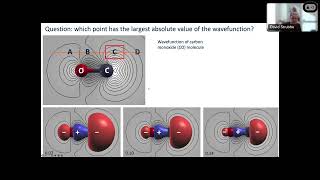
DFT with SIESTA, Data Visualization, and Sophomore-level CURE Using MIT Atomic-Scale Modeling Toolkit
Explore density functional theory, data visualization, and undergraduate research experiences using the MIT Atomic-Scale Modeling Toolkit for modern physics and condensed matter studies.
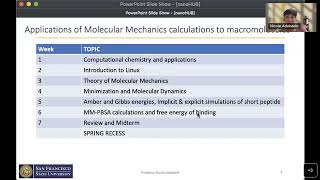
Teaching Electronic Structure Methods in Chemistry Using Simulation Tools in nanoHUB
Explore electronic structure methods in chemistry using nanoHUB simulation tools. Learn to teach computational chemistry concepts and gain hands-on practice with Hartree-Fock and basis sets using ORCA.
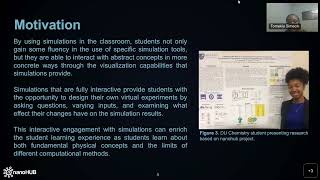
Introduction to Computational Chemistry Using the NUITNS Simulation Toolkit in nanoHUB
Explore computational chemistry using NUITNS toolkit on nanoHUB. Learn to integrate simulations in undergraduate chemistry courses and analyze nanodiamonds through hands-on demonstrations and practical applications.
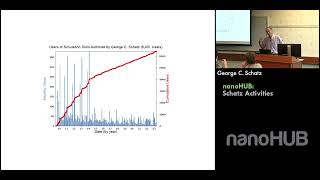
Teaching Chemistry Tools on nanoHUB - Overview by George Schatz
Explore nanoHUB tools for teaching chemistry, including DDSCAT, QC-Lab, and Nanosphere Optics Lab. Learn about applications in optics, spectroscopy, and molecular modeling from Prof. George Schatz.
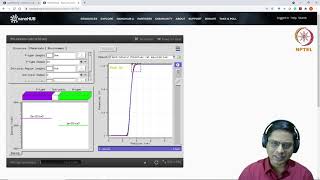
Demo of PN Junction Lab on Nanohub - Lecture 4.6
Explore PN junction behavior using Nanohub's interactive lab simulation. Gain hands-on experience with semiconductor physics concepts.
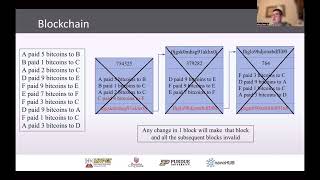
Blockchain and Proof of Work Lab: Interactive Computing and Applications
Explore blockchain concepts hands-on with interactive apps and computing, covering hash functions, proof of work, and creating your own blockchain.
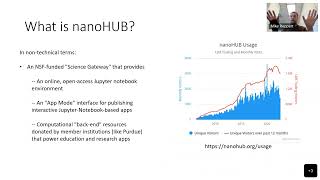
Hands-on Teaching with Jupyter Notebooks on nanoHUB
Explore hands-on teaching using Jupyter Notebooks on nanoHUB for chemistry courses. Learn to create interactive simulations, visualizations, and programming projects for enhanced student engagement and learning.
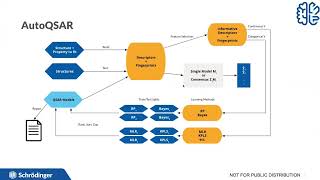
Machine Learning Models for Ionic Conductivity with Schrödinger's AutoQSAR - Hands-On Workshop
Explore machine learning for ionic conductivity prediction using Schrödinger's AutoQSAR tool. Gain hands-on experience with MS Maestro interface to create and implement models for materials science applications.
Let's Talk Python: How to Program a Computer - From Fundamentals to Python Basics
Learn Python programming from scratch: explore computer basics, coding fundamentals, and essential Python concepts like variables, loops, and data manipulation using Jupyter notebooks on nanoHUB.