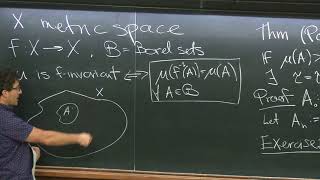
Introduction to Ergodic Theory - Lecture 3
Explore fundamental concepts and applications of ergodic theory, delving into mathematical principles that govern long-term behavior of dynamical systems.
Topological Cyclic Homology and the Fargues-Fontaine Curve
Explore the connection between localizing invariants and the Fargues--Fontaine curve, with insights on K-theory, topological cyclic homology, and the twistor projective line.
Dimension, Complexity and K Theory
Explore connections between dimension theory, complexity, and K-theory in mathematics, focusing on applications in topology and geometry. Gain insights into cutting-edge research in these interconnected fields.
Henrik Shahgholian - Free Boundaries on Lattice, and Their Scaling Limits
Explore lattice-based potential theory, examining harmonic functions and free boundary problems. Discover intriguing numerical results and their implications for facet formation in scaling limits.
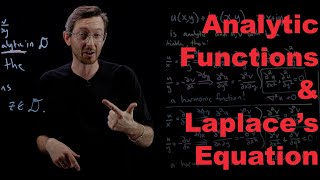
Complex Analysis - Analytic Functions Solve Laplace's Equation
Explore how analytic complex functions' real and imaginary parts solve Laplace's equation, introducing harmonic functions in this in-depth mathematical analysis.

Sparks of AGI - Analyzing GPT-4 and the Latest GPT-LLM Models
Explore GPT-4's advancements, including multi-modal input, exam performance, spatial awareness, and potential AGI implications. Analyze capabilities, challenges, and societal impacts of cutting-edge language models.
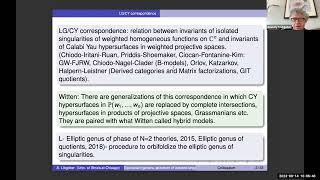
Equivariant Genera, Spectrum of Isolated Singularities & Hybrid Models
Explore equivariant genera, singularity spectra, and hybrid models in algebraic geometry. Delve into GIT quotients, McKay correspondence, and LG/CY correspondence for weighted projective spaces.

Markov Chains for Generative Music AI - Lecture 11
Explore Markov chains for generative music AI, covering intuition, formalization, music modeling, pros and cons, and practical applications in melody, rhythm, and dynamics generation.
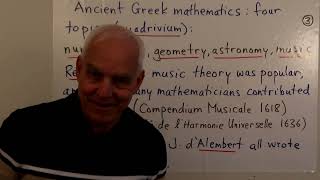
Clock Mathematics and the 12-Tone Chromatic Scale - Connecting Music Theory and Mod 12 Arithmetic
Explores the connection between mathematics and music through the 12-tone chromatic scale, clock geometry, and mod 12 arithmetic, offering a fresh perspective on music theory and mathematical notation.

The Impossibility of a Pythagorean Scale and Square Root of 2 in Music Theory
Explores the mathematical challenges in creating a perfect musical scale, linking the cycle of fifths, chromatic scale, and the irrational nature of sqrt(2) to reveal fundamental connections between music theory and arithmetic.

Standard Staff Notation Issues in Music Theory
Explores issues in music notation, focusing on pitch and duration representation. Critiques current systems, hints at alternatives, and connects mathematics with musical theory.

Scale Adjacency, Sharps and Flats - Mathematics of Music
Explore the mathematical foundations of musical scales, key signatures, and notation systems, connecting music theory to geometry and the circle of fifths for a deeper understanding of harmonics.
Chords and the Mathematical Fretboard - Exploring Guitar Music Theory
Explore the mathematical structure of guitar chords and fretboards, focusing on triads and tetrads. Learn to navigate the instrument using the 12-tone chromatic scale for a deeper understanding of music theory.
Introduction to Random Walks on Groups - Lecture 3
Explore random walks on groups, their properties, and applications in mathematics and probability theory. Learn key concepts and techniques for analyzing group-based stochastic processes.
Conquering Movement - How Math Can Help Us Become Musicians
Exploring the intersection of music and mathematics to revolutionize musician education and health through innovative analysis of physical motion and performance patterns.
Modular Regulators and Multiple Modular Values
Explore recent advancements in computing Goncharov regulator integrals for K_4 classes on modular curves, relating them to multiple modular values and single L-values of modular forms.
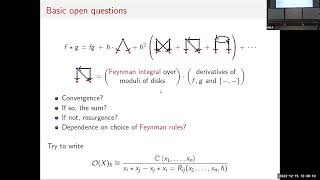
Hodge Theory for Poisson Varieties and Nonperturbative Quantization
Explore Hodge theory for Poisson varieties and nonperturbative quantization, focusing on K-theory and mixed Hodge structures to simplify complex calculations in deformation quantization.
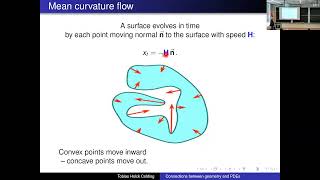
Connections Between Geometry and Partial Differential Equations
Explore the fascinating interplay between geometric structures and partial differential equations, uncovering deep mathematical insights and applications.
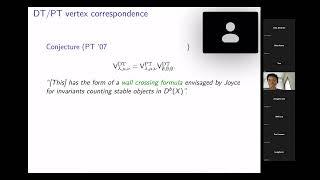
The K-theoretic DT/PT Vertex Correspondence
Explore K-theoretic DT/PT vertex correspondence on toric 3- and 4-folds, examining equivariant wall-crossing, symmetrized pullbacks, and applications to related conjectures.
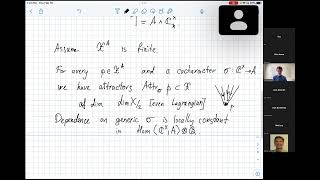
Stable Envelopes from 2D Mirror Symmetry
Explore stable envelopes through 2D mirror symmetry, connecting equivariant K-theory and Fukaya categories in Coulomb branches. Gain insights into homological mirror symmetry predictions.
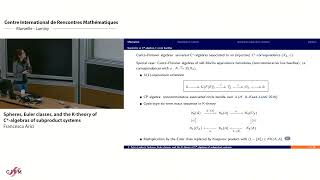
Spheres, Euler Classes and the K-Theory of C*-Algebras of Subproduct Systems
Explore spheres, Euler classes, and K-theory of C*-algebras in subproduct systems through Francesca Arici's insightful mathematical conference talk at CIRM.