End-to-End Multi AI Agents RAG with LangGraph, AstraDB, and Llama 3.1
Explore multi-agent AI systems using LangGraph, AstraDB, and Llama 3.1. Learn to build advanced RAG applications with vector databases and open-source models.
Multi-agent Games with Finite-horizon Goals
Explore complexity in multi-agent systems with finite-horizon goals, examining mathematical properties, use cases, and representation challenges in game theory and distributed systems analysis.
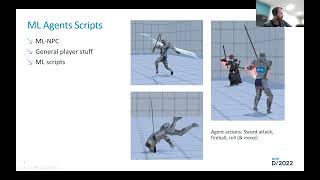
Using Unity's Machine Learning Agents on Arm for Game Character Training
Explore Unity's ML-Agents for intelligent game characters on Arm devices. Train agents using reinforcement learning for single and multi-agent scenarios in games and apps.
Practical Reinforcement Learning with Robots
Explore practical reinforcement learning for robotics, covering environment design in simulation and real-world applications, with insights on implementing RL in robotic systems.
Opponent-Shaping and Interference in General-Sum Games
Explore opponent-shaping and interference in general-sum games, delving into multi-agent reinforcement learning and its applications in AI research.
Learning to Cooperate and Compete via Self Play
Explore AI strategies for cooperation and competition through self-play, featuring insights from poker AI breakthroughs and their broader implications.

Studying the Behavior of Generative AI-Based Agents in Multi-Agent Systems
Explore generative AI-based agents in multi-agent systems using Concordia library. Learn about language-mediated simulations, flexible component systems, and the Game Master concept for diverse research applications.
Managing Small Knowledge Graphs for Multi-agent Systems - MLOps Podcast #236
Explore knowledge graph management for multi-agent systems, focusing on structural grounding, selective improvement, and end-to-end reliability. Learn strategies to enhance RAG accuracy and repeatability in AI pipelines.
The Power of Cooperation in Networks of Learning Agents - Keynote Talk
Explore the power of cooperation in agent networks for enhanced learning, focusing on performance bounds and online learning scenarios.
Multi-Agent Frameworks for LLM Applications: From Theory to Implementation
Discover how to build advanced LLM applications using LangGraph for multi-agent collaboration, enabling specialized task handling and improved workflow management through practical demonstrations and hands-on exercises.

Understanding Microsoft's Magnetic-One: A Generalist Multi-Agent AI System
Explore Microsoft's Magentic-One system, a generalist multi-agent framework that tackles complex tasks through unified code and prompts, with practical demonstrations and architectural insights.

Adversarial Intelligence in Natural and Artificial Systems
Explore the dynamics of adversarial intelligence through genetic programming and coevolutionary algorithms, focusing on designing competitive AI agents and simulating strategic rivalries.
Emergence of AI Agent Individuality and Social Behavior Through MBTI Personalities
Explore how AI agents spontaneously develop distinct personalities, social behaviors, and collective intelligence through natural language interactions in a groundbreaking research study.
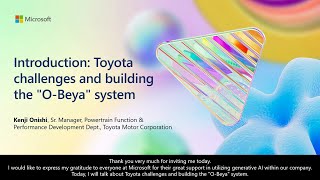
Lessons from Toyota for Building Durable Multi-Agent Copilots
Discover how Toyota leverages GenAI and Azure technologies to revolutionize powertrain development through multi-agent systems, enhancing engineering efficiency and vehicle design innovation.
A Collective Intelligence Framework for Cloud Security
Discover how multi-agent systems and collective intelligence can revolutionize cloud security through collaborative threat detection, vulnerability assessment, and incident response in distributed environments.

Introducing Azure AI Foundry Agent Service to Scale Your AI Agents - BRK102
Discover how Azure AI Foundry Agent Service enables scalable AI agent integration, featuring real-world examples from Thermo Fisher's multi-agent system and practical implementation strategies.
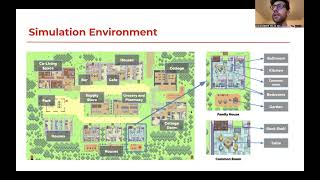
Generative Agents - Advances in Generative AI
Explore the cutting-edge world of generative agents in AI, examining their development, capabilities, and potential applications in modern technology and automation.
Cognitive Collectives - Understanding Multi-Scale Collective Intelligence
Explore groundbreaking research on collective animal behavior and intelligence through Max Planck Institute's examination of cognitive systems and group decision-making dynamics.
New Tools for Analyzing Collective Behavior
Explore analytical frameworks for understanding how local agent interactions create large-scale collective behaviors, with applications in opinion dynamics, swarming, and coordinated movement.
Collective Behavior from Surprise Minimization
Explore how cognitive principles and probabilistic decision-making drive collective behavior in animal groups, offering new perspectives on emergent patterns in biological and engineered systems.
Green Light SONATA - Training Traffic Controllers Using Collective Intelligence
Discover how AI-powered traffic control systems use musical improvisation principles to optimize vehicle movement, featuring innovative approaches to collective intelligence and neural network training.