
Functional Programming from First Principles
Explore functional programming fundamentals, side effects, and the contrast with imperative programming. Delve into concepts like monoids, category theory, and monads in this insightful talk by Erik Meijer.

Achieving Functional Programming in Java
Explore functional programming in Java using the Lambda library, covering functors, monads, lazy evaluation, and more. Learn to leverage FP concepts in Java development.
Simplicity & Complexity - The Beauty & the Beast
Explore the tension between simplicity and complexity in software development, discussing strategies to reduce complexity and create more effective solutions.
Service Objects With Dry.rb - Monads and Transactions
Explore Dry.rb's Transaction library for robust service objects. Learn about Monads, error handling, and integrating powerful, testable business logic into Ruby applications.
Down the Oregon Trail with Functional C#
Explore functional C# programming through recreating the classic Oregon Trail game, emphasizing immutability, high test coverage, and advanced techniques like higher-order functions and monads.
Monads in Modern C++
Demystifying monads in C++23: Learn functional programming techniques to simplify code, reduce boilerplate, and create pure pipelines. Explore practical examples and recent developments in std::vector and std::optional.
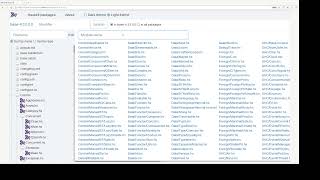
Haskell Code Exploration with Emacs
Explore Haskell code efficiently using Emacs with powerful tools like Haskell Code Explorer. Learn about monads, navigate declarations, find references, and leverage integrated help features for enhanced productivity.
Compile-Time - Run-Time Functional Programming in C++
Explore advanced C++ programming techniques at the compile-time/run-time boundary, including functional concepts like monads and continuations, with a focus on practical applications.
Boosting MPL with Haskell Elements
Explore advanced C++ template metaprogramming techniques inspired by Haskell, including let expressions, monads, list comprehension, and error handling, to enhance Boost.MPL and improve code readability and organization.
Haskell - The Pseudocode Language for C++ Template Metaprogramming
Explore functional programming concepts in Haskell to improve C++ template metaprogramming skills. Learn to read and write complex metaprograms using Haskell as pseudocode for C++.
Haskell - The Pseudocode Language for C++ Template Metaprogramming - Part 2
Explore functional programming concepts in Haskell to enhance C++ template metaprogramming skills. Learn to write and analyze complex metaprograms using Haskell as pseudocode.

Monoids, Monads, and Applicative Functors - Repeated Software Patterns
Explore abstract mathematical structures in software development, focusing on monoids, monads, and applicative functors. Learn to recognize these patterns and apply them to improve code design and problem-solving skills.
Design Patterns in the 21st Century
Explore modern C++ design patterns, functional programming concepts, and improvements to classic Gang of Four patterns. Learn how lambda expressions enable monads and enhance software design.
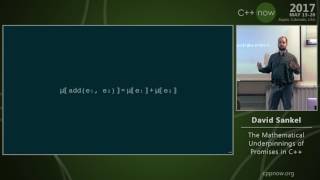
The Mathematical Underpinnings of Promises in C++
Explore the mathematical foundations of promises in C++ and their practical implementation, covering functional design principles, algebraic concepts, and real-world applications in library development.
Tacit DSL All the Things
Explore functional programming concepts in C++ through an extended ranges DSL, unifying various paradigms and libraries for more declarative and composable code.
There and Back Again - Functional Programming
Explore functional programming in Swift, its influence, and best practices for leveraging functional features while maintaining Swift's identity and Cocoa compatibility.
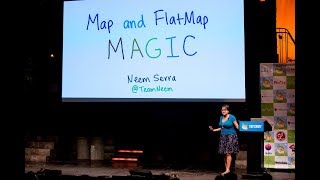
Map and FlatMap Magic
Explore elegant Swift coding with map and flatMap, transforming optionals and harnessing functional power for more efficient and "Swifty" development.
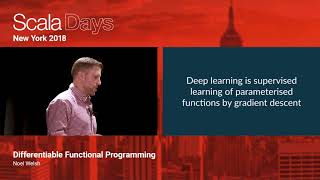
Differentiable Functional Programming
Explore differentiable functional programming, covering supervised learning, gradient descent, and deep learning concepts. Learn about tensor operations, algorithmic differentiation, and Scala's potential in next-gen deep learning systems.

Functional Programming with Effects
Explore functional programming concepts, referential transparency, and monads in Scala. Learn about functor laws and their application to Option, Either, List, Reader, and State types.
Async - Await for the Monadic Programmer
Explore async/await in asynchronous programming, comparing it with monadic approaches like Futures. Learn rationale, implementation, and benefits for improved code understanding across languages.
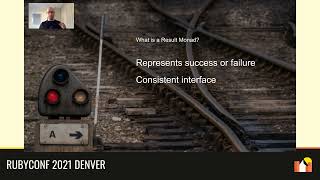
Using Monads for Elegant Error Handling
Explore functional programming and monads for cleaner, more expressive error handling in Ruby applications, improving code readability and maintainability.