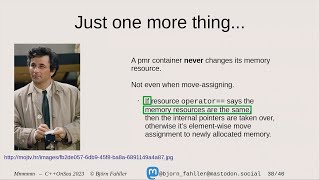
Most Malleable Memory Management Method in C++
Explore PMR in C++17 for efficient memory management. Learn analysis tools, PMR usage with standard library, custom type implementation, and best practices for optimizing program memory usage.
Catching Real-time Safety Violations in C++
Explore strategies to mitigate real-time safety violations in C++ through external tools, code transformations, and experimental compiler techniques. Learn to ensure performance and safety in critical code execution.

Taking a Byte Out of C++ - Avoiding Punning by Starting Lifetimes
Explore efficient object creation from raw bytes in C++ using start_lifetime_as. Learn zero-copy techniques and patterns for correct implementation in database engines.
Back to Basics: C++ Value Semantics - Lecture 2022
Explore value semantics in C++, its benefits, and drawbacks. Learn about std::optional, std::function, and std::variant while understanding proper usage of reference types.
Understanding Allocator Impact on Runtime Performance in C++
Explore challenges in analyzing local memory allocators' performance impact on C++ runtime. Learn to choose tools, overcome instrumentation limitations, and design effective visualizations.
C++ Concurrency TS 2 Use Cases and Future Direction - Lecture
Explore advanced C++ concurrency features, including hazard pointers and RCU. Learn about potential additions to TS 2 and how to create fast, scalable code using Concurrency TS 2 support.

The Hidden Performance Price of C++ Virtual Functions
Explore the performance impact of C++ virtual functions, understand their underlying mechanisms, and learn optimization techniques to enhance program speed.
WebAssembly: Taking C++ to the Web - CppCon 2022
Explore WebAssembly's potential for C++ developers, covering key concepts, implementation techniques, and practical exercises to enhance web application performance and cross-platform compatibility.
Back to Basics: C++ Smart Pointers - Lecture
Explore C++ smart pointers, mastering std::unique_ptr and std::shared_ptr to manage memory efficiently and prevent leaks. Learn guidelines for effective usage in modern C++ programming.

The Hidden Performance Price of C++ Virtual Functions
Dissect virtual functions in C++, understand their performance impact, and learn optimization techniques to enhance program speed while utilizing this core concept.
Back to Basics: RAII in C++ - Lecture
Explore RAII in C++: guard against resource mishandling, examine Standard Library examples, and learn design considerations for creating custom RAII classes.
C++ in the World of Embedded Systems
Explore C++ applications in embedded systems, covering concepts, architectures, and modern features. Learn to leverage C++ for efficient embedded software development with practical examples.
Fast C++ Using SIMD Types with Generic Lambdas and Filters - Lecture
Optimize C++ performance using SIMD types, generic lambdas, and filters. Learn to generate high-performance code competitive with standard libraries, exploring vectorization techniques and branching strategies.
Aliasing in C++ - Risks, Opportunities and Techniques
Explore aliasing in C++: its risks, opportunities, and techniques. Learn to identify, avoid, and harness aliasing for better code performance and functionality.
Can C++ Data-Oriented Design Be Improved?
Explore innovative techniques to enhance data-oriented design in C++, focusing on optimal transformations and improved code organization for greater flexibility and maintainability.
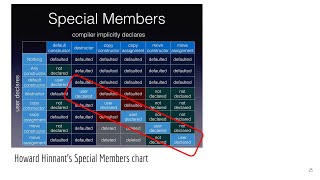
Back to Basics: The Rule of Five in C++ - Lecture
Explore the Rule of Five in C++, its origins, and potential improvements. Learn to design classes for correct copying and moving behavior, guided by Core Guidelines.
Great C++ is_trivial - Understanding Trivial Type Traits - Lecture 2023
Explore trivial type traits in C++, their impact on efficiency, and benefits for performance optimization. Gain insights into object initialization and move semantics.

Small Data Optimization Techniques in Rust
Explore small data optimization techniques in Rust, from string/vector optimizations to implementing efficient data structures using safe and unsafe code, with practical insights and performance considerations.

Understanding the Go Runtime
Explore the Go runtime's inner workings, from initialization to execution. Gain insights into garbage collection, scheduling, and core language features for optimized Go programming.
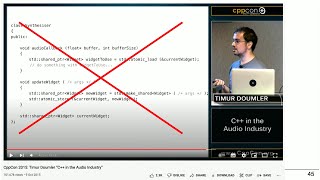
Thread Synchronization in Real-Time Audio Processing with RCU - Lecture
Explore thread synchronization in real-time audio using RCU, addressing data sharing challenges and ensuring wait-free operations on real-time threads.
How to Allocate on the Audio Thread and Why You Might Want To - Allocations Considered Beneficial
Explore memory allocation on audio threads using C++'s std::pmr namespace. Learn techniques for low-latency audio processing and improve product features through efficient memory management.