Formal Modelling and Proof in the CHERI Design and Implementation Process
Explore rigorous engineering methods for developing secure processor architecture, focusing on CHERI's hardware capabilities for fine-grained memory protection and secure compartmentalization.
Analyzing and Improving the Security Properties of Secret Memory
Explore techniques for enhancing secret memory security in Linux systems, covering trusted kernels, container security, and cloud security considerations.

Where Security and Safety Meet in Automotive Engineering
Explore the intersection of security and safety in engineering, focusing on memory protection, isolation techniques, and practical considerations for robust system design.
Limitations and Opportunities of Modern Hardware Isolation Mechanisms
Explores recent CPU hardware isolation mechanisms, analyzing their advantages and limitations for low-overhead system security across various computing domains.
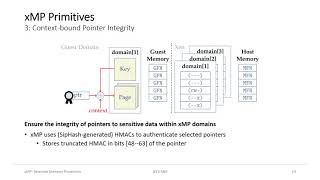
XMP: Selective Memory Protection for Kernel and User Space
Selective memory protection technique for enhanced security in kernel and user space, leveraging virtualization to isolate sensitive data and mitigate data-oriented attacks.
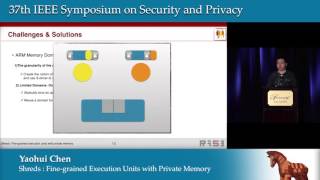
Shreds - Fine-Grained Execution Units with Private Memory
Explore fine-grained execution units with private memory for enhanced in-process security. Learn about shreds, their implementation, and practical applications in software like OpenSSH and Lighttpd.
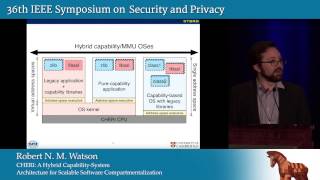
CHERI - A Hybrid Capability-System Architecture for Scalable Software Compartmentalization
Explores CHERI architecture for enhanced memory protection and software compartmentalization, demonstrating improved scalability and security benefits over traditional MMU designs.

Memory Management in OS - Contiguous Memory Allocation
Explore memory management in operating systems, covering logical and physical address spaces, memory protection, address translation, and contiguous memory allocation techniques.
HotBPF++ - A More Powerful Memory Protection for the Linux Kernel
Explore HotBPF++, an advanced Linux kernel memory protection system. Learn about its automatic deployment, on-the-fly enabling, and lightweight design for preventing and detecting various memory corruptions beyond heap exploitation.
MPK/PKS Linux Kernel Compartmentalization
Explore Intel's PKS-based kernel compartmentalization strategy to enhance security, reduce attack surfaces, and mitigate vulnerabilities in Linux systems.
HotBPF - On-demand and On-the-fly Memory Protection for the Linux Kernel
On-demand, on-the-fly Linux kernel memory protection mechanism: lightweight, hardware-independent, and deployable without rebooting. Enhances security during vulnerability disclosure to remediation window.
Introducing Hardware-Level Device Isolation to Zephyr
Exploring IOMMU/SMMU implementation in Zephyr for enhanced security against DMA-related vulnerabilities, with focus on Arm SMMUv3 support and live demo on Arm FVP platform.
Supervisor Protection Keys
Explore Supervisor Protection Keys with Ira Weiny, focusing on enhancing system security and memory protection in Linux environments.
Guest Memory Protection - Current Status and Future
Explore current status and future developments of Guest Memory Protection in virtualization technology, focusing on Intel's advancements and industry trends.
Hypervisor-Enforced Kernel Integrity for KVM
Enhancing Linux kernel security through KVM-based protection mechanisms, offering improved defense against vulnerabilities and discussing new features for mainline integration.
Thwarting Unknown Bugs - Hardening Features in the Mainline Linux Kernel
Explore Linux kernel hardening techniques to mitigate vulnerabilities, including debug features, read-only data, stack protection, memory segregation, and address sanitization.
Security in Zephyr and Fuchsia - Comparing Emerging Open Source Operating Systems
Explore security architectures and mechanisms in Zephyr and Fuchsia operating systems, comparing them to Linux. Learn about ongoing advancements and unique approaches to IoT and microkernel-based security.
Kernel Self-Protection Project: Overview and Recent Developments
Explore recent developments in Linux kernel security, including defenses against vulnerabilities, bug lifetime analysis, and ongoing challenges in the Kernel Self-Protection Project.

A New Proposal for Protecting Kernel Data Memory
Propuesta para proteger la memoria de datos del kernel mediante segmentación del espacio de direcciones vmalloc y codificación de propiedades, reduciendo la sobrecarga de verificación y allanando el camino para el endurecimiento de las tablas de páginas.

BPF-NX and CFI - Enhancing Linux Kernel Security
Explore BPF-NX+CFI: Enhancing Linux kernel security through innovative techniques and control flow integrity mechanisms.
Memory Armor for SPIRE - Fortifying with Confidential Containers
Explore enhancing SPIRE security with Confidential Containers, protecting sensitive data in memory from potential attacks and adding an extra layer of defense to your cloud-native infrastructure.