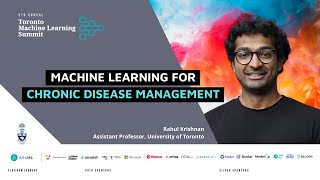
Machine Learning for Chronic Disease Management - Focus on Precision Oncology
Explore machine learning applications in chronic disease management, focusing on precision oncology, statistical modeling for multiple myeloma, and deep learning for risk stratification.
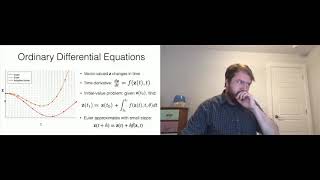
A Cookbook for Deep Continuous-Time Predictive Models
Explore deep continuous-time predictive models for irregularly-sampled time series, from feedforward approaches to latent-variable stochastic differential equations.

A.I. in the Multiverse - Measuring ROI When A/B Tests Are Not Possible
Explore deep learning techniques for assessing AI's revenue impact in e-commerce without A/B testing. Learn to measure and monitor ML pipeline performance in various business settings.

Efficient Multi-Prompt Evaluation Explained
Explore PromptEval, a novel method for estimating LLM performance across multiple prompts, enhancing evaluation accuracy within practical budgets. Gain insights from University of Michigan researcher Felipe Polo.
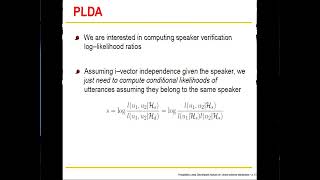
Probabilistic Linear Discriminant Analysis of i-Vector Posterior Distributions
Explore probabilistic linear discriminant analysis for i-vector posterior distributions in speaker recognition, enhancing understanding of advanced speech processing techniques.

Probabilistic Simulation Methods for Machine Learning in Science and Technology
Explore probabilistic numerics in machine learning, bridging computation and inference. Gain insights into physics-informed ML and adaptive solver integration for enhanced efficiency in scientific computing.
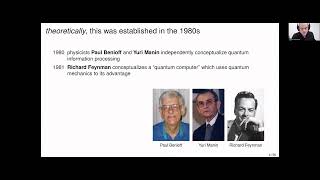
Quantum Computing for AI - Hype or Hope?
Explore quantum computing's potential impact on AI, examining promises, limitations, and realistic applications in machine learning and Bayesian network inference.
Inference and Uncertainty Quantification for Noisy Matrix Completion - Lecture 5
Explore inference and uncertainty quantification for noisy matrix completion, focusing on de-biased estimators and their distributional characterizations for optimal confidence interval construction.
Projected Power Method: An Efficient Algorithm for Joint Discrete Assignment - Lecture 3
Explore an efficient algorithm for joint discrete assignment using projected power method. Learn about low-complexity procedures, optimization techniques, and statistical models for solving discrete assignment problems.
Compatibility and the Lasso - Lecture 2
Explore compatibility and the Lasso in statistical learning with Sara van de Geer from ETH Zurich in this distinguished lecture on advanced machine learning techniques.
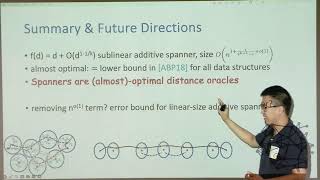
Almost-Optimal Sublinear Additive Spanners in Graph Theory
Explore sublinear additive spanners in graph theory, focusing on optimal stretch functions and size bounds for undirected unweighted graphs. Learn about recent advancements and their implications.
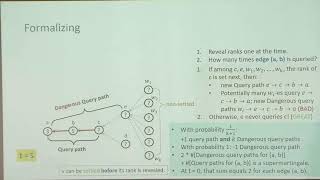
Sublinear Algorithms for Correlation Clustering
Explore sublinear algorithms for correlation clustering, focusing on a 3+eps approximation method using LCA probes, MPC rounds, and dynamic updates. Analyze technical results for maximal independent set computation.
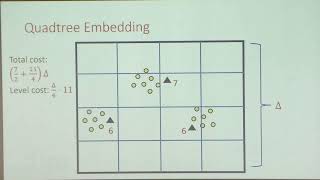
Fast Streaming Euclidean Clustering with Constant Space
Explore streaming algorithms for k-median and k-means clustering, achieving constant space complexity independent of data size and aspect ratio. Improve space and update time for approximate subspace embeddings.
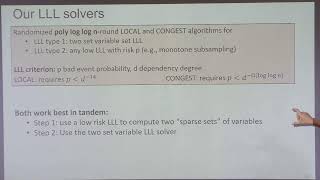
Sparsification for Communication-Efficient Distributed Symmetry-Breaking
Explore sparsification techniques for efficient distributed algorithms, focusing on local symmetry-breaking problems in graph theory and the CONGEST model.
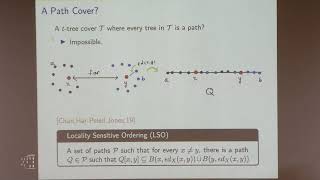
Recent Progress on Euclidean Spanners
Explore recent advancements in Euclidean spanners, including sparse, light, fault-tolerant, and dynamic variants, while discovering outstanding open problems in the field.
A Quasi-Monte Carlo Algorithm for Smooth Kernel Evaluation
Explore a novel data structure for density queries, combining discrepancy theory and LSH to build sparse coresets and enhance smooth kernel evaluation algorithms.
Parallel Algorithms for Local Problems in Sparse Graphs
Explore efficient parallel algorithms for locally checkable problems in sparse graphs, focusing on techniques beyond graph sparsification for improved performance in sublinear regimes.
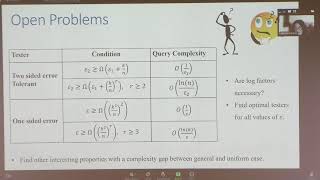
Testing Intersectingness of Uniform Families - How Dana and I Intersected
Explore efficient algorithms for testing intersecting k-uniform set families, including tolerant and one-sided error non-adaptive methods. Compare results to non-uniform families and discover optimal query complexities.
The Long Path to Square Root of d Monotonicity Testers
Explore directed isoperimetry and its application to monotonicity testing, analyzing directed random walks on product domains for optimal testers in Boolean functions on hypergrids.
Tolerant Property Testing and Distance Approximation in Sublinear Algorithms
Explore tolerant property testing and distance approximation algorithms for various object types and properties. Gain insights into bipartiteness, monotonicity, uniformity, and subsequence-freeness.

Solving Integral Equations with Inti.jl - JuliaCon 2024
Explore Inti.jl for solving volume and boundary integral equations in mathematical physics. Learn about its user-friendly features, integration capabilities, and specialized routines for handling singular kernels.