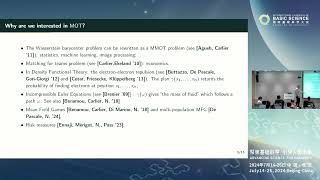
Entropic Optimal Transport: Convergence Rates and ODE Characterization
Explore recent advances in entropic optimal transport, focusing on convergence rates and a novel ODE-based numerical method for multi-marginal problems. Gain insights into theoretical bounds and practical applications.
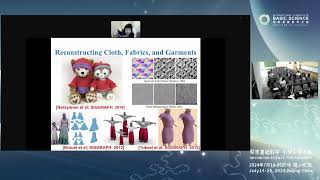
Reconstructing Reality: From Physical World to Virtual Environments
Explore data-driven modeling techniques integrating classical methods and statistical learning to reconstruct reality in virtual environments, from traffic flow to crowd behaviors and deformation estimation.
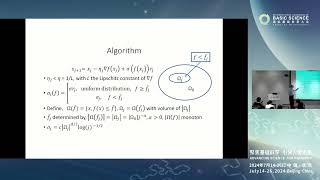
Global Convergence in Stochastic Optimization - ICBS 2024
Explore stochastic optimization algorithms with adaptive variance for non-convex functions, featuring provable convergence rates and numerical examples.
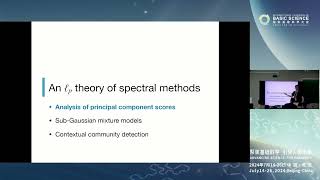
An ℓp Theory of PCA and Spectral Clustering
Explore an advanced $\ell_p$ theory of PCA, improving upon vanilla PCA for heteroscedastic noises and yielding optimal bounds for spectral clustering and community detection.
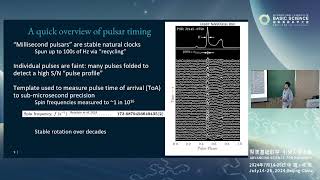
The Parkes Pulsar Timing Array Third Data Release: Overview and Search for an Isotropic Gravitational-wave Background
Explore the Parkes Pulsar Timing Array's latest data release, focusing on gravitational wave detection techniques and results from isotropic stochastic background searches.
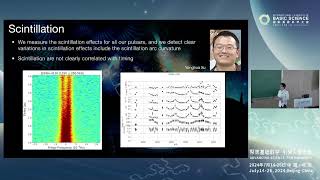
Searching for Gravitational Wave Background with Chinese Pulsar Timing Array Data Release I
Explore gravitational wave detection using Chinese Pulsar Timing Array data. Learn about millisecond pulsar observations, data analysis techniques, and key findings in the search for nanohertz gravitational wave backgrounds.
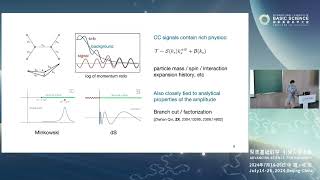
Family Tree Decomposition of Cosmological Correlators
Explore analytical methods for computing cosmological correlators, including family tree decomposition for nested time integrals in dS and FRW universes.
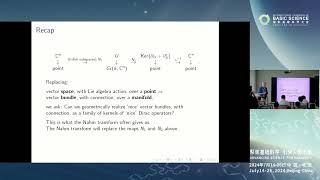
Nahm Transform: Old and New - From Yang-Mills Instantons to ALF Gravitational Instantons
Explore the Nahm transform's origins and recent extensions to ALF gravitational instantons, enhancing understanding of Yang-Mills instanton moduli spaces.
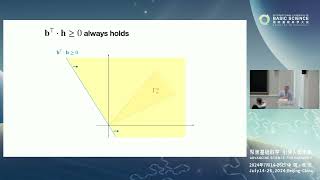
A Geometrical Interpretation of Universally Quantified Inequalities and Its Applications to Mathematics
Explore a geometrical interpretation of universally quantified inequalities and its applications across mathematics, focusing on Shannon entropy and connections to various mathematical branches.
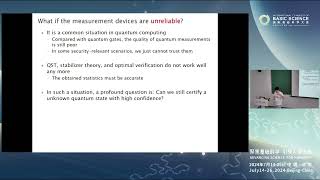
Certifying Bipartite Pure Quantum States Efficiently Using Untrusted Devices
Explore efficient certification of bipartite pure quantum states using untrusted devices, requiring fewer measurements while maintaining reliability in quantum experiments.
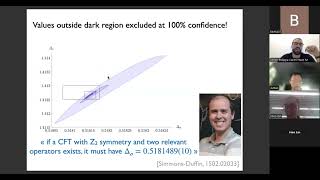
Analyticity in Spin and Causality Constraints in Conformal Bootstrap - ICBS 2024
Explore analyticity in spin and causality constraints in conformal bootstrap, including applications to operator spectrum and AdS/CFT duality.
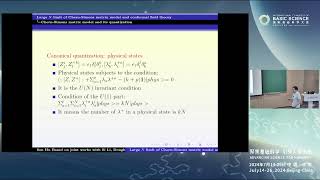
Large N of Chern-Simons Matrix Model and Conformal Field Theory
Explore the emergence of 1+1D conformal field theory from large N limit of 2+1D Chern-Simons matrix models, including Kac-Moody algebra and holographic duality.
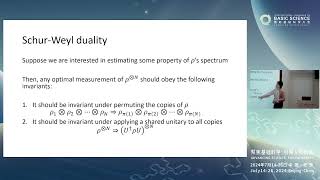
Recent Advances in Learning Quantum Phenomena
Explore recent advances in learning quantum phenomena, focusing on statistical inference and applications in quantum computation verification.
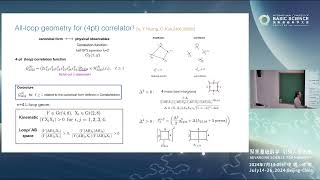
From Combinatorics to Real World Scattering - ICBS 2024
Explore combinatorial geometries in QFT and string theory, focusing on a new formulation for scattering of colored scalars, pions, and gluons.
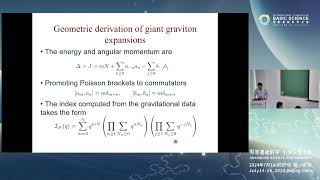
Giant Graviton Expansions, Gauge-Gravity Correspondence, and Emergent Spacetime
Explore giant graviton expansions in gauge-gravity correspondence, uncovering insights into quantum field theory, string theory, and emergent spacetime geometries.
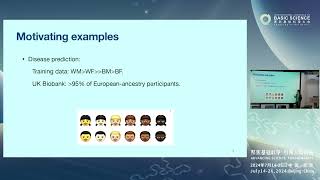
Multi-dimensional Domain Generalization with Low-Rank Structures
Explore novel tensor-based approach for robust domain generalization in linear regression, addressing challenges in underrepresented populations and achieving reliable, interpretable results with theoretical guarantees.
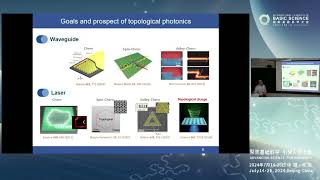
Unidirectional Light Emission from a Topological Perspective
Explore unidirectional light emission in photonic integration through topological charges, unveiling novel phenomena and applications in next-generation computing.
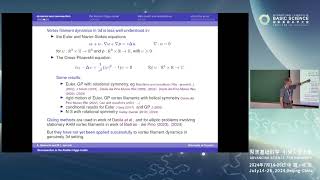
Vortex Reconnection in the 3D Critical Abelian Higgs Model
Explore vortex reconnection in 3D critical Abelian Higgs model, focusing on dynamics of nearly parallel vortex filaments and their collisions in particle physics.
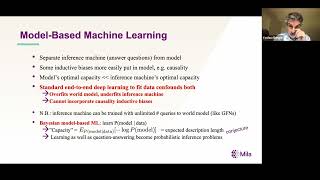
Large Neural Nets for Amortized Probabilistic Inference in Highly Multimodal Distributions
Explore amortized probabilistic inference using large neural networks for complex distributions. Learn about GFlowNets and their potential to improve AI systems with Bayesian and causal understanding.
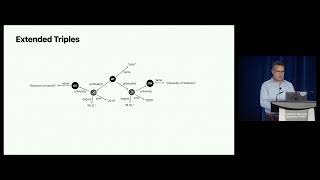
Saga: Continuous Construction and Serving of Large Scale Knowledge Graphs
Explore continuous construction and serving of large-scale knowledge graphs with Saga, an end-to-end platform. Learn about challenges in industrial settings and various graph services.

Leadership of Responsible AI - The Case for Inclusive Tech
Explore leadership in responsible AI, focusing on inclusive tech. Learn about algorithmic bias, its societal impacts, and strategies for ethical AI implementation in the digital age.