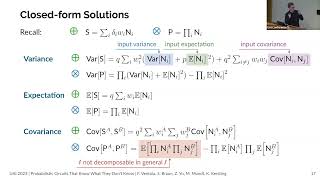
Probabilistic Circuits That Know What They Don't Know - UAI Oral Session 6
Explore probabilistic circuits' robustness to out-of-distribution data and learn about tractable dropout inference for improved uncertainty quantification in a single forward pass.
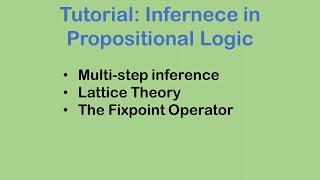
Inference in Propositional Logic: From Basics to Lattice Theory Applications
Explore propositional logic inference, including lattice theory and fixpoint operators for entailment queries. Gain insights into logic programming and knowledge reasoning fundamentals.
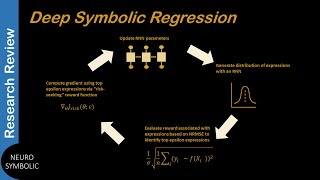
Deep Symbolic Regression - Petersen et al.'s 2021 ICLR Paper
Explore deep symbolic regression through Petersen et al.'s 2021 ICLR paper, covering innovative techniques at the intersection of symbolic methods and deep learning.
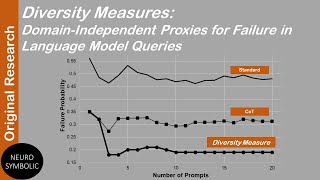
Diversity Measures: Domain-Independent Proxies for Failure in Language Model Queries
Explore domain-independent diversity measures to detect uncertainty in language model outputs, enhancing error detection and improving AI reliability.
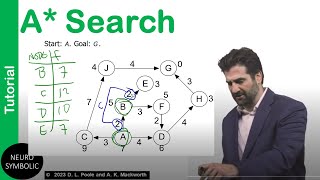
A* Search Algorithm: Introduction, Example, and Summary
Learn A* search algorithm: its principles, implementation, and applications in pathfinding and problem-solving. Explore this efficient heuristic search technique.

ME3255 - Evaluating a NYSE Monte Carlo Model
Evaluate a NYSE Monte Carlo model using advanced statistical techniques. Gain insights into financial modeling and risk assessment for stock market analysis.

Using Timers, Numerical Integration, and Other Programming Tips - HW_01
Explore timers, numerical integration, and coding tips while learning about error fixing, Linux, and numerical modeling techniques.

Integrating and Plotting Equations of Motion - CE2120 Homework 01
Integrate and plot equations of motion for engineering applications. Master techniques for solving and visualizing dynamic systems.
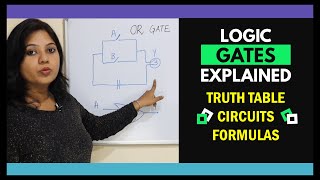
Logic Gates A to Z - Truth Tables, Circuits, Formulas, and Applications
Explore logic gates from A to Z, covering truth tables, circuits, formulas, and real-world applications. Master essential concepts through step-by-step explanations and examples.
Factoring Finally Finished - Quantum Computer Programming - Lesson 96
Complete the efficient quantum factoring algorithm by mastering Rotation Estimation in superposition, a crucial step in quantum computing.

Lindy 2.0 - AI-First Automation Platform Tutorial and Comparison
Discover Lindy 2.0, an advanced AI automation platform for custom tasks. Learn to create AI agents, build versatile tools, and integrate with various apps to enhance productivity.
Model Reparametrization with StructuralIdentifiability.jl - JuliaCon 2024
Explore StructuralIdentifiability.jl's new features for rapid identification of identifiable functions and model reparametrization, enhancing modeling and control practices.

Julia Community Reshapes Computation in Geosciences
Explore Julia's impact on geosciences: ecosystem tools, hardware acceleration, and collaborative initiatives revolutionizing Earth observation and software development in the field.
SpeedyWeather.jl - Reinventing Atmospheric Models
Innovative Julia-based atmospheric modeling tool offering interactive, user-friendly simulations for climate research, overcoming traditional Fortran constraints with flexible, extensible components.

Combined Stochastic Models for Cancer Patient Trajectories
Integrating diverse clinical data into a unified stochastic model for cancer patient trajectories, combining tumor growth, metastasis, and survival data using Julia for simulation and Bayesian inference.
NetSurvival.jl - A Glimpse into Relative Survival Analysis
Explore relative survival analysis in cancer studies using NetSurvival.jl, a Julia package offering fast, reliable tools for extracting net survival curves and integrating with StatsModels.jl API.
Cognitive Computational Modeling Made Easy with Julia
Explore cognitive computational modeling using Julia, featuring ActionModels.jl for flexible simulations and HierarchicalGaussianFiltering.jl for advanced learning and perception models.
Real Time ODEs for Sound Synthesis and Parameter Exploration - JuliaCon 2024
Explore real-time ODEs for sound synthesis and parameter analysis using Julia, combining visual and auditory representations to unveil dynamical system behaviors and control parameters.

Interpretable Hierarchical Calibration of Agent-Based Models
Explore scientific machine learning's fusion of traditional modeling and ML, focusing on neural network surrogates for agent-based models in epidemiology and automated hierarchical calibration.

Covariate Shift - Challenges and Good Practice in Machine Learning
Explore challenges and best practices in covariate shift, a crucial concept in machine learning, with insights on improving model performance and adaptability in changing data distributions.
ServiceLab: Preventing Tiny Performance Regressions at Hyperscale through Pre-Production Testing
Explore Meta's ServiceLab platform for detecting minute performance regressions in large-scale systems, addressing challenges in noisy cloud environments through statistical analysis and machine factor studies.