Recoupling Coefficients and Quantum Entropies in Condensed Matter Physics and Quantum Field Theory
Explore recoupling coefficients and quantum entropies in condensed matter physics and quantum field theory with insights from M. Christandl.
Spin Groups for Weak Spin-Orbit Coupling Materials
Explore spin groups in materials with weak spin-orbit coupling, focusing on their properties and applications in quantum materials research.
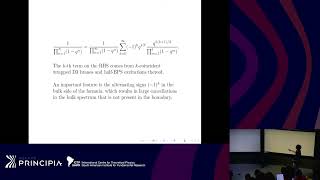
Integrability in Gauge and String Theory - On Branes and Trace Relations
Explore branes and trace relations in gauge and string theory with Ji Hoon Lee's insightful presentation on integrability concepts.
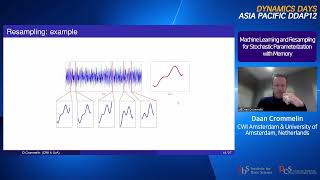
Machine Learning and Resampling for Stochastic Parameterization with Memory
Explore machine learning and resampling techniques for stochastic parameterization with memory in multiscale dynamical systems, focusing on overcoming challenges in long-memory scenarios.
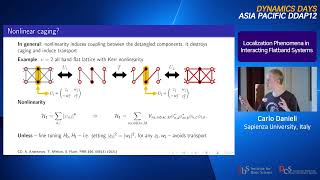
Localization Phenomena in Interacting Flatland Systems
Explore localization phenomena in flatband networks, examining compact localized eigenstates and the impact of perturbations. Discover finetuning protocols for diverse localization features in classical and quantum systems.
Fun with Functions: Designing Fast Math Approximations with Python
Explore fast math approximation techniques for audio using Python. Learn Taylor polynomials, Padé approximants, and minimax methods to optimize computations while balancing accuracy and speed.
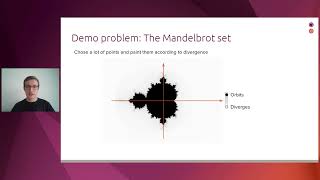
Introduction to Numerical Computation Applications Using Ubuntu WSL
Explore numerical computing on Ubuntu WSL for efficient solver development and deployment, with practical examples and insights on streamlining workflows for complex engineering problems.

Solving Optimization Problems with Near Term Quantum Hardware - QHack 2023
Explore quantum approximation optimization, cost functions, and industry applications with insights from a Strangeworks quantum scientist.
cadCAD.jl - A Modeling Library for Generalized Dynamical Systems
Explore generalized dynamical systems modeling with cadCAD.jl. Learn to simulate complex systems, evolve data structures, and gain iterative insights for enhanced system engineering and data science workflows.
PEtab.jl - Efficient Parameter Estimation for Dynamic Models
Explore efficient parameter estimation for dynamic models in biology using PEtab.jl. Learn to import problems, set up estimations, and choose optimal gradient computation methods.
Entangling Superconducting Qudits
Explore superconducting qudit-based quantum computing, focusing on efficient entanglement techniques for enhanced computational power in multi-level quantum systems.
Platonic Ququart Benchmarking - Characterizing 4-Level Quantum Systems
Explore ququart systems, implement character randomized benchmarking, and assess quantum gate errors using platonic solid symmetries and NMR techniques.

Neural Graph Databases: Combining GNNs with Labeled Property Graphs
Explore neural graph databases, combining graph databases with graph neural networks using LPG2vec encoder for improved prediction accuracy in complex graph datasets.
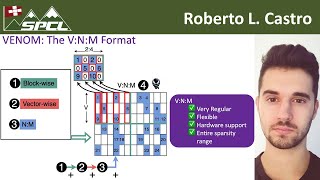
VENOM: A Vectorized N:M Format for Unleashing the Power of Sparse Tensor Cores
Explore VENOM, a vectorized N:M format for sparse tensor cores. Learn about high-performance sparse libraries and second-order pruning techniques for efficient deep learning model sparsification.
Neural Probabilistic Logic Programming in Discrete-Continuous Domains - UAI 2023 Oral Session 1
Explore neural-symbolic AI integration with DeepSeaProbLog, combining logic, probability, and neural networks for discrete and continuous domains. Learn about its semantics, inference, and unbiased learning algorithm.
Human-in-the-Loop Mixup: Aligning Synthetic Data with Human Perception - Oral Session 2
Explore human-aligned synthetic data in machine learning, focusing on mixup regularization. Discover how perceptual judgments and uncertainties can enhance model reliability and generalization.
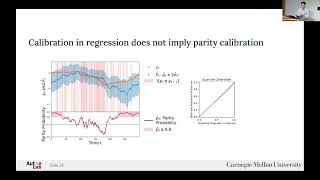
Parity Calibration in Sequential Regression - Forecasting Increase-Decrease Events
Explore parity calibration in sequential regression, focusing on predicting increase-decrease events rather than exact values. Learn its applications in epidemiology, weather forecasting, and nuclear fusion control.
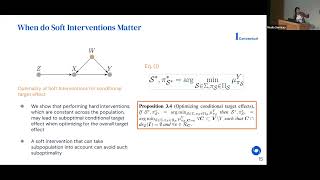
Functional Causal Bayesian Optimization - Lecture 3
Explore functional causal Bayesian optimization for optimizing interventions in causal graphs. Learn about extending CBO methods, modeling with Gaussian processes, and maximizing expected improvement.
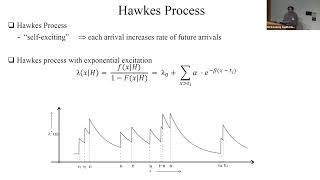
Keep-Alive Caching for the Hawkes Process - UAI 2023 Oral Session 4
Explore optimal caching policies for serverless computing, focusing on Hawkes processes. Learn to balance cache retention costs with miss costs and evaluate performance using simulations and Azure Functions data.
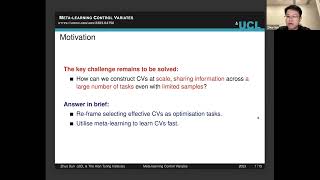
Meta Learning Control Variates for Variance Reduction with Limited Data
Explore meta-learning control variates for variance reduction in Monte Carlo estimators with limited data, leveraging similarities across multiple integration tasks for improved performance.
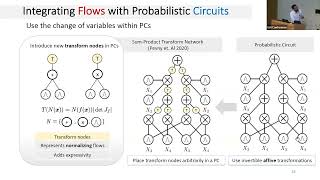
Probabilistic Flow Circuits: Towards Deep Models for Tractable Inference - Oral Session 6
Explore a novel approach combining probabilistic circuits with normalizing flows for enhanced expressivity while maintaining tractable inference in deep probabilistic models.